Why deleting accounts, clearing cookies, and clicking opt-out rarely touch the systems that actually track your identity
When I talk to clients about Digital Executive Protection, I start with a simple correction.
Privacy is not a settings toggle. It is a structural battle.
Most people assume the tools provided by websites control their privacy.
Account settings. Cookie controls. Opt-out buttons.
But those tools operate at the interface layer.
Modern identity systems operate deeper in the infrastructure.
Deleting an account removes a visible trace.
It rarely removes the identity behind it.
And that identity is often what data systems actually track.
The Infrastructure Reality
Digital identity today runs on structural rails.
Not just apps.
Not just websites.
Infrastructure.
Examples include:
- Payment networks
- Device telemetry
- Cross-domain identity graphs
- Telecom identifiers
- Credit infrastructure
- Advertising identity graphs
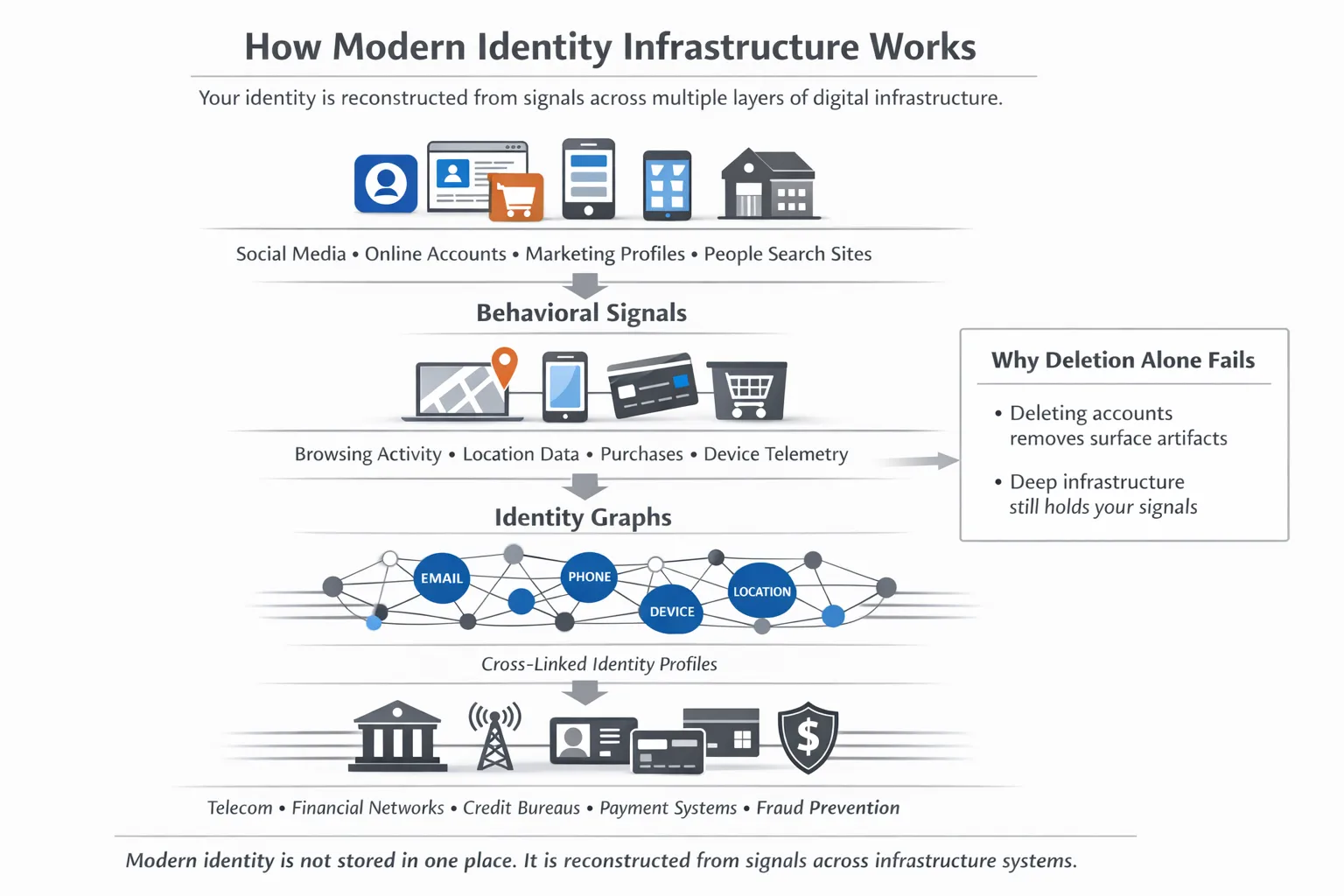
These systems do not simply store your information.
They link signals together across sectors.
A phone number connects to a device.
A device connects to browsing behavior.
Browsing behavior connects to ad networks.
Ad networks connect to identity graphs.
Eventually, these signals converge.
When they do, identity becomes structurally durable.
Deleting one data source rarely resets the system.
How Identity Is Actually Built
Many people imagine identity as a file stored somewhere.
That model is outdated.
Modern identity is reconstructed continuously from signals.
Three mechanisms dominate.
Device Telemetry
Every device emits identifying characteristics.
Examples include:
- Hardware configuration
- Browser version
- Installed fonts
- Screen resolution
- GPU characteristics
- Behavioral patterns
Combined together, these create a browser fingerprint.
Even without cookies, the fingerprint often persists across sessions.
That fingerprint becomes a silent identity.

Identity Graphs
Identity graphs aggregate signals across companies.
They combine:
- Email addresses
- Phone numbers
- Devices
- Location history
- Purchases
- Behavioral signals
From these signals, the system builds probabilistic profiles.
These profiles are used for:
- advertising targeting
- fraud detection
- account verification
- marketing attribution
- risk scoring
Once signals converge inside identity graphs, they become extremely durable.
Structural Identity Anchors
Some identifiers are stronger than others.
They function as identity anchors.
Examples include:
- phone numbers
- physical addresses
- financial identifiers
- telecom records
- government identifiers
When these anchors connect to other signals, identity hardens.
At that point, deletion becomes harder.
Not impossible.
But much harder.

Why Opt-Out Isn’t Enough
Most privacy tools operate at the interface layer.
The layer users can see.
Examples:
- account deletion
- cookie clearing
- marketing opt-outs
- privacy preference toggles
These tools matter.
But they only manage one layer of the system.
The deeper infrastructure usually remains untouched.
So clicking “opt-out” often becomes privacy theater.
It controls a visible interface.
It does not change the underlying rails.
The Structural Advantage of Identity Systems
Identity systems benefit from two structural realities.
1. Signal Redundancy
Identity rarely depends on one data source.
If one signal disappears, others remain.
Remove a marketing cookie.
The system still has:
- device fingerprints
- purchase data
- telecom identifiers
- location signals
Identity survives.
2. Cross-Domain Linking
Modern identity infrastructure connects multiple industries.
Advertising.
Finance.
Telecommunications.
Fraud prevention.
Data brokerage.
Signals move between these domains.
Once a signal enters that ecosystem, it can propagate widely.
Why Deletion and Protection Still Matter
At this point, people sometimes conclude something dangerous.
“If identity systems are this strong, privacy is impossible.”
That conclusion is wrong.
Identity infrastructure still depends on signals.
Remove the signals, and the system weakens.
That is where strategic privacy work matters.
Four Ways Privacy Strategy Disrupts Identity Systems
Professional privacy work focuses on signal disruption.
Not just deletion.
Signal disruption.
Breaking the Linkage
Identity becomes durable when signals converge.
Example:
Phone number + credit card + home address.
Remove enough signals early, and those links never fully form.
This prevents identity from hardening into structural anchors.
Signal Degradation
Identity graphs depend on signal accuracy.
Over time, signals decay.
Old phone numbers.
Old addresses.
Old device associations.
Remove new signals and the system begins guessing.
Profiles shift from deterministic to probabilistic.
Accuracy drops.
Tracking becomes weaker.
Surface Area Reduction
Most adversaries do not begin inside deep identity rails.
They start with OSINT.
Search engines.
People search sites.
Public records.
Data brokers.
Remove this surface exposure and attackers struggle to bootstrap identity discovery.
Without the initial hook, deeper systems become harder to reach.
Early Intervention
Identity infrastructure becomes strongest when signals bind to financial or telecom rails.
After that point, identity becomes systemic.
Strategic privacy work prevents these anchors from forming.
That is the most powerful moment to intervene.
Early.
The ObscureIQ Strategy
ObscureIQ approaches privacy as identity disruption.
Not cosmetic privacy settings.
Structural disruption.
Key objectives include:
- DeepDelete across high-risk data brokers
- Reduction of device telemetry exposure
- Limiting new digital exhaust
- Preventing identity signal convergence
- Eroding signal accuracy inside identity graphs
The goal is simple.
Make identity systems work harder.
Reduce certainty.
Increase friction.
Because modern privacy is not about hiding.
It is about degrading the systems that try to track you.
ObscureIQ Insight
Modern identity is not stored.
It is continuously reconstructed from signals.
That means privacy is not achieved with a single setting.
It requires disrupting the signals those systems rely on.
When the signals weaken, the identity weakens.