
How Platform Immunity and Broker Loopholes Helped Build The Surveillance Economy
“The surveillance economy needed two things: scale and resale.”
— Jeff Jockisch, ObscureIQ
We did not lose privacy in one blow.
We lost it systematically, grindingly.
The modern surveillance economy was built by two forces working together.
⚫ First
Internet platforms were allowed to scale at extraordinary speed under legal protections that reduced liability for user-generated content.
⚫ Second
Data brokers built a parallel market that collected, linked, inferred, packaged, and resold personal data at industrial scale.
One made surveillance profitable. The other made it operational.
That was the one-two punch. 💥
CDA 230 helped clear the runway for platform scale. Data brokers helped turn human lives into a tradable asset.

Platform Immunity Helped Scale Win
Section 230 did not create the ad model by itself.
That is too simple.
What it did do was help create the conditions for scale-first internet businesses to thrive. Platforms could grow fast, host huge volumes of user activity, and avoid being treated like the publisher of everything users posted. That mattered. It lowered friction. It reduced risk. It gave internet companies room to expand before society had any real framework for the downstream harms.
Once scale became the goal, advertising became the obvious business model. More users meant more engagement. More engagement meant more signals. More signals meant better targeting. Better targeting meant more revenue.
More
Users
More
Engagement
More
Signals
Better
Targeting
More
Revenue
The internet did not just become social.
It became extractive.

Data Brokers Made Surveillance Portable
Even the biggest platforms could not see everything. They needed more context. More identity resolution. More household linkage. More offline data. More behavioral clues. More ways to sort, predict, and target people.
That is where data brokers came in.
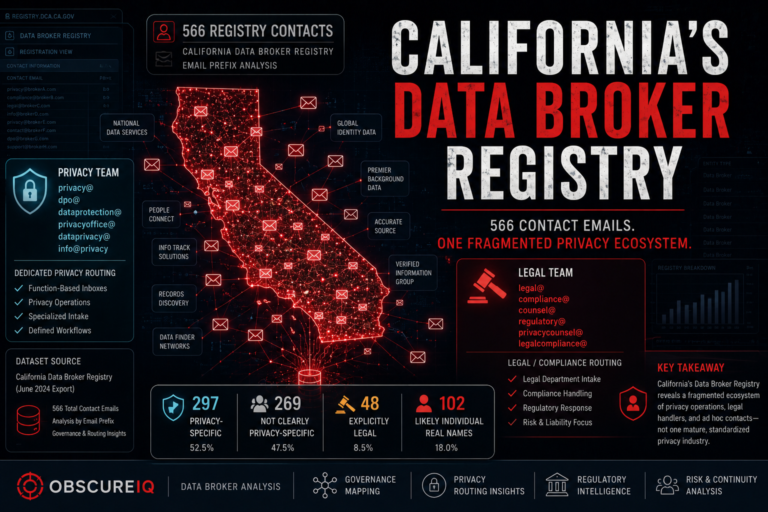
They collected information from public records, commercial sources, app ecosystems, web tracking, loyalty programs, and other brokers. Then they stitched it together, enriched it, scored it, and sold or licensed the result across a sprawling market.
- Public records
- Commercial sources
- App ecosystems
- Web tracking
- Loyalty programs
- Other brokers
Platforms
Captured behavior.
Brokers
Made it portable.
That is what made the system durable.
It was no longer just about what one company knew about you. It was about what an entire market could circulate about you.

This Was Never Just About Ads
People talk about the ad model as if the harm begins and ends with creepy targeting.
That misses the point.
This system does not just sell attention. It builds dossiers. It classifies people. It shapes how they are scored, priced, prioritized, filtered, and watched.
Data collected for ads does not stay in the ad lane. It gets repurposed. It gets resold. It gets pulled into:
- Identity systems
- Risk models
- Fraud tools
- People-search products
- Government access
Once personal data becomes a commodity, it does not stay where it started.
It moves.
Data collected in one context gets used in another. Data given for convenience becomes data used for power.
The Loophole Layer Kept It Alive
A lot of people assume data brokers operate under strong, comprehensive privacy laws.
They do not.
This market has survived and grown because it sits inside a patchwork of weak rules, sectoral laws, exemptions, and loopholes. Much of the broker ecosystem has been able to operate in the gaps.
Data gets:
- Relabeled
- Repackaged
- Shared under a different theory
- Sold under a different category
- Moved through entities that do not neatly fit the rules people assume are protecting them
The Law
Regulates slices.
The Market
Operates as a whole.
Consumers get complexity.
The market gets continuity.
The Real Story Is Incentives
The surveillance economy did not emerge because one company made one bad choice.
It emerged because the internet’s legal and commercial architecture rewarded extraction.
Platform Immunity
Helped companies get big fast.
Advertising
Rewarded attention capture.
Data Brokers
Rewarded collection beyond context.
Weak Privacy Laws
Rewarded resale.
Loopholes
Rewarded reclassification.
And the public was left inside a system they were never given a meaningful chance to understand, much less refuse.
Privacy did not just erode.
It was operationalized against us.
Want to see how deep your exposure actually runs?

Big Tech Gets the Blame. Brokers Deserve More of It.
Big Tech is the visible face of the surveillance economy. People can see the apps. They can see the feeds. They can feel the targeting.
Data brokers are the quieter force that made the system deeper and harder to escape.
They are the resale layer.
They are the identity stitching layer.
They are the reason data collected in one place can keep following you somewhere else.
Without brokers, the surveillance economy would still exist. But it would be weaker, messier, and less interoperable. Brokers helped turn fragmented observation into a functioning market.
That is why the one-two punch frame works.
Platform immunity helped the platforms scale. Broker loopholes helped surveillance spread, deepen, and persist.

How We Got Here
We got here because the internet’s foundational bargain favored growth over restraint.
First
Build first.
Then
Scale fast.
Then
Monetize behavior.
And
Let the consequences lag behind.
Consumers were told these services were free.
They were not.
We paid in exposure. We paid in profiling. We paid in asymmetry. We paid by living inside systems that know enormous amounts about us while remaining largely opaque to us.
It normalized the idea that your data is not an extension of your personhood. It is fuel.

The Bottom Line
The surveillance economy was built through a division of labor.
Platforms
Normalized extraction.
Data Brokers
Normalized redistribution.
That was the one-two punch.
And it is a big reason we ended up in a world where privacy is weak, visibility is one-sided, and people are forced to live inside markets that continuously make them legible, targetable, and exploitable.
We did not get here by accident.
We got here because scale was protected, surveillance was profitable, and data resale was allowed to flourish in the gaps.
That is how the system was built.
That is why it is so hard to escape.