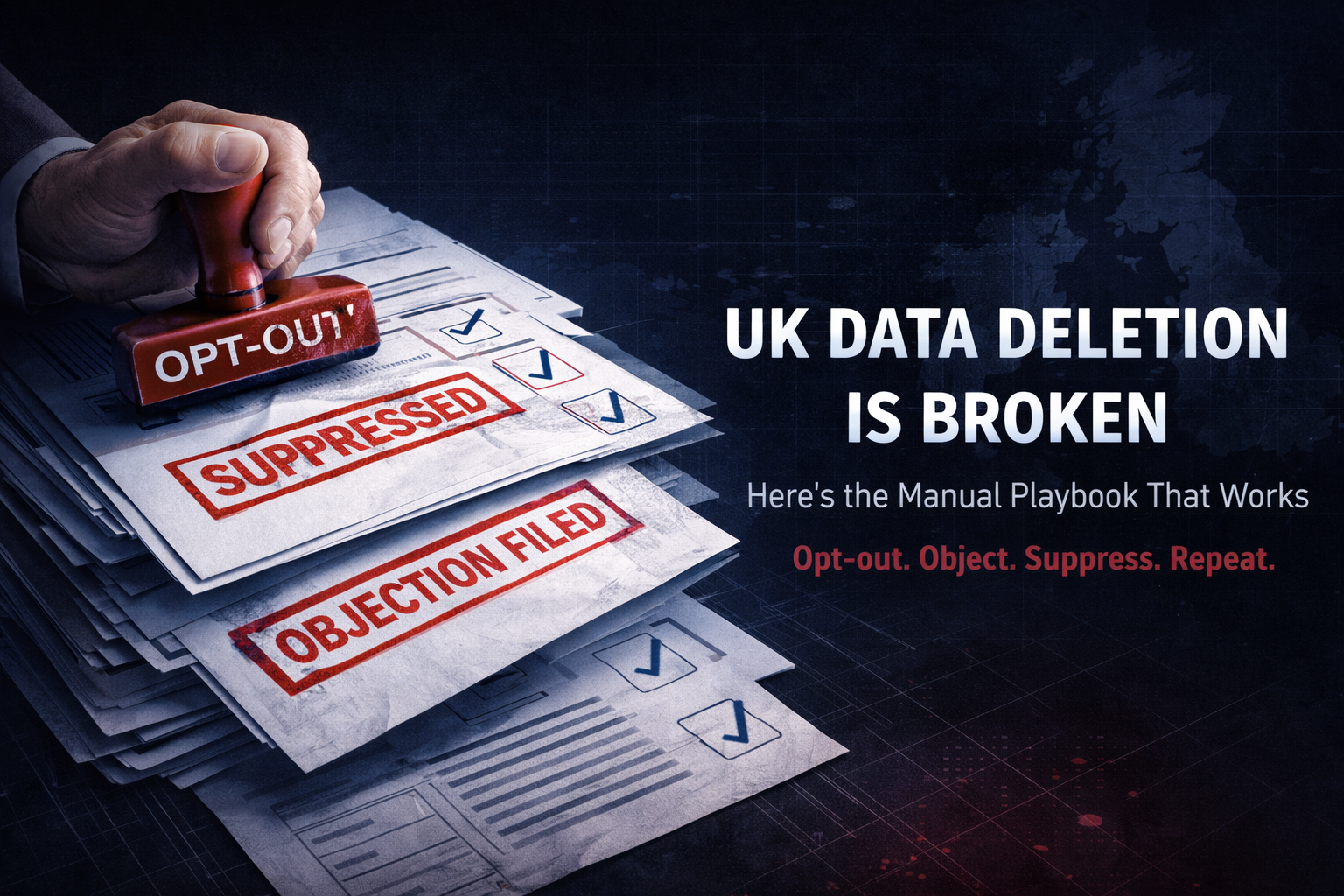
UK Data Deletion Services Are Thin. Here’s the Manual Playbook That Actually Works
If you live in the UK and want to reduce your personal data exposure, the consumer privacy-removal market is not as strong as it should be.
That is the blunt reality.
Consumer privacy services are limited across the board, and the UK market is thinner than many people expect. Many of these services were built around the U.S. people-search ecosystem. The UK is different. The exposure still exists. Your data can still be collected, sold, reused, profiled, and circulated. But the consumer-facing options are still limited, and they do not replace manual work.
That leaves most people with a hybrid reality:
- You can use a service to reduce some of the workload.
- And you can run a manual UK-specific suppression and deletion workflow to cover the gaps.
That is usually the approach that makes the most sense.
For U.S. residents looking for a consumer-level opt-out service, our recommendation is Optery. It does not provide the level of wipe or service that ObscureIQ can, but we think it offers exceptional value and some of the strongest consumer-facing coverage currently available.
For UK residents, we recommend Incogni as a convenience layer that can reduce some of the manual burden, but not as a complete UK privacy-removal solution. It can reduce some of the manual burden, but it does not replace direct objections, source cleanup, or targeted follow-up.
The second is to run a manual UK-specific suppression and deletion workflow.
That is what this post is really about.
A service can reduce some of the workload. But in the UK, it usually does not eliminate the need for manual action. If you want stronger results, you still need to know where to apply pressure: how to object, where to suppress, what to correct, and when to escalate.
That is why this guide focuses on the manual path. Not because it is elegant. It is not. Not because it is easy. It is not. But because it is often the part that makes the biggest difference.
And until better UK-facing consumer solutions emerge, that matters.
The goal is not to “delete everything”
That is not how this works.
The real goal is to reduce exposure, reduce propagation, stop direct marketing use, shut down obvious source leaks, and create enough pressure that your data stops moving so freely.
In practice, good outcomes usually look like this:
- Some records are deleted
- Some uses are stopped
- Some details are corrected
- Some records are suppressed
- Some companies retain minimal information on suppression lists
- Some data remains in places you cannot fully control
That does not mean the effort failed. It means you should focus on practical results, not fantasy outcomes.
Why the UK playbook is different
A lot of the privacy industry talks about “deletion” like it is a single action.
It is not.
In the UK, the better strategy is often a suppression stack. That means using several different levers together:
- public-record controls
- direct marketing objections
- rights requests
- source cleanup
- complaint escalation
That matters because different systems use your data in different ways. A company using your data for direct marketing can be pressured one way. A stale or inaccurate record may need rectification instead. A public source may need to be shut down at the source.
The smart play is layered. Not one-dimensional.
Start with the biggest leak points first
If you want the best return on effort, start with the systems that feed the rest of the ecosystem.
1. Opt out of the Open Register
This is one of the most important UK steps.
The Open Register is the version of the electoral register that can be bought and used more broadly, including for marketing and commercial purposes. Opting out does not affect your right to vote. It just stops your data from appearing in that more widely available version.
If someone skips this step, they are leaving one of the clearest UK source leaks open.
Template: Open Register Opt-Out
Subject: Request to opt out of the Open Register

Hello,

I would like to opt out of the Open Register for my electoral registration record.

My details are:
Full name:
Current address:
Date of birth (if needed to locate my record):

Please confirm when this has been completed.

Regards,
[Name]
This is not some niche extra. For many UK residents, it should be one of the first actions taken.
2. Register with the Mailing Preference Service
The Mailing Preference Service, or MPS, is still worth doing.
It helps reduce personally addressed unsolicited mail from participating organisations in the UK. It will not stop everything. It will not stop unaddressed leaflets. But it is still a useful first layer.
Too many people ignore physical mail because it feels old-fashioned. That is a mistake. Postal marketing still reflects active data circulation. If your name and address are being used for mail campaigns, your data is still moving through commercial systems.
3. Add the Fundraising Preference Service
This should be part of the stack too.
The Fundraising Preference Service, or FPS, is the UK’s mechanism for stopping fundraising communications from registered charities. That can include addressed mail, email, text messages, and phone calls.
This matters because MPS does not solve the charity side of the problem.
One important caveat: FPS is not a universal block-all switch. You usually have to identify the charities you want to stop hearing from.
Still, if someone gets repeated fundraising outreach, this belongs in the playbook.
4. Opt out of Royal Mail Door to Door
This is separate from MPS and deserves its own mention.
Royal Mail’s Door to Door opt-out targets unaddressed leaflets and brochures delivered through Royal Mail’s network. This is a different stream of junk mail than MPS handles.
So if the goal is to reduce physical-world data exposure and unwanted mail, both should be used.
5. Hit the full credit-agency trio
Do not stop at Experian.
If you are trying to reduce exposure through the UK marketing-data layer, you should usually pressure all three major agencies:
Many people think of these only as credit agencies. That is too narrow. They also sit close to the direct marketing and data-use ecosystem in ways that matter.
If you only object at one, that does not mean the others stop using or circulating your data in adjacent systems.
This is one of the most overlooked parts of the UK privacy workflow.
Why direct marketing objections matter more than deletion demands
A lot of privacy advice jumps straight to “delete my data.”
That sounds satisfying. It is also not always the strongest move.
In the UK, a direct marketing objection is often the cleaner tool.
If an organisation is using your personal data for direct marketing, objecting to that use can be more effective than sending a vague deletion request. It narrows the issue. It gives them less room to wriggle. It also hits the actual business value of the data.
This makes direct marketing objections especially useful against:
- list brokers
- lead-gen operators
- marketing-data providers
- enrichment vendors
- brands using your data for prospecting
- charities sending repeated fundraising communications
This is why the best UK manual playbook is not just a deletion playbook.
It is a suppression playbook.
Template: Direct Marketing Objection
Subject: Objection to direct marketing under UK GDPR Article 21

Hello,

I am exercising my right to object to the processing of my personal data for direct marketing purposes under Article 21 of the UK GDPR.

This objection includes any related profiling, list-building, audience segmentation, enrichment, or sharing for direct marketing.

Please:
1. Stop processing my personal data for direct marketing
2. Stop sharing it for direct marketing
3. Place my details on your suppression list so I am not re-added
4. Confirm completion in writing

My details are:
Full name:
Current address:
Email(s):
Phone number(s):
Any previous address or alternate identifiers you hold:

Regards,
[Name]
That is usually much stronger than “please remove me from your database.”
When to use erasure requests
Erasure still matters. It is just not the right first move for every target.
Use an erasure request when:
- the data is stale
- the data is no longer needed
- the organisation cannot justify why it still holds it
- the processing appears unlawful
- the purpose has ended
- you already objected and there is no good reason to keep using it in that way
A good erasure request should not just ask for deletion. It should also force the company to explain what it holds, where it got it, what it uses it for, and whether it shared it onward.
Template: Erasure Request
Subject: Erasure request under UK GDPR

Hello,

I am requesting erasure of my personal data under the UK GDPR.

Please delete personal data you hold about me where you no longer need it, where its processing is unlawful, or where erasure is otherwise required under the UK GDPR.

My details are:
Full name:
Current address:
Previous address(es):
Email(s):
Phone number(s):
Any profile URL, customer ID, or other identifier:

Please also tell me:
1. What categories of personal data you hold
2. The source of that data
3. The purpose for which you process it
4. Any third parties with whom it has been shared
5. Whether any data will be retained on a suppression list and why

Please confirm the outcome within one month.

Regards,
[Name]
That does two things at once. It asks for action, and it forces disclosure.
When rectification and restriction are better
Some records are not easy to erase.
But they are wrong.
They may show an old address. They may merge two different people. They may include stale or incomplete information. They may reflect bad source data that was never cleaned up.
In those cases, rectification or restriction can be more useful than an all-or-nothing erasure demand.
Template: Rectification and Restriction Request
Subject: Rectification and restriction request under UK GDPR

Hello,

Your records about me are inaccurate and/or incomplete. I request rectification of the inaccurate data and restriction of processing while you investigate.

My details are:
Full name:
Current address:
Identifiers you hold:
The inaccurate data:
The correct data:

Please confirm the restriction and the correction in writing.

Regards,
[Name]
This is especially useful for stale address history, mixed identities, and low-quality broker profiles.
Protect yourself during identity verification
This is where people make avoidable mistakes.
Some brokers and data companies ask for identity documents before acting on a request. Sometimes that is legitimate. Sometimes it is excessive. Either way, there is a real risk in sending high-quality passport or licence scans to a long list of companies you already do not trust.
So the playbook should include a rule:
Minimize verification exposure.
That means:
- Ask whether lower-friction verification is enough
- Do not send more than the minimum needed
- Redact unnecessary details where possible
- Keep records of what you shared, when, and with whom
There are also intermediary models that try to reduce this problem by verifying you once and then letting you prove identity without sending raw ID scans to every target. That idea is worth watching.
Use a separate contact channel for broker requests
This is another smart operational step.
When you contact sketchier brokers or lower-trust data sellers, do not hand them your main everyday email if you can avoid it. Use a dedicated alias email for privacy requests. Use a separate phone number if one is truly required.
Even if the broker acts in good faith, separating your main identity channels from your request workflow makes the whole process cleaner and safer.
It also makes tracking easier.
Expand your target list beyond the obvious UK names
Not every important target is a household UK brand.
Some global data infrastructure companies still matter because they touch UK residents’ data, support profiling, or participate in the broader data supply chain.
That means your target list should include:
- UK marketing-data systems
- UK-facing brokers
- list sellers
- enrichment vendors
- tracing services
- global aggregators with UK reach
- source platforms that feed the rest of the ecosystem
Too many people focus only on the most visible sites. That is not enough.
Prioritize targets in tiers
Do not hit everything randomly.
Work in tiers.
Tier 1: Core UK circulation channels
These are the highest priority.
- Open Register
- Mailing Preference Service
- Fundraising Preference Service
- Royal Mail Door to Door opt-out
- major credit and marketing-data agencies
- any company directly using your data for addressed mail or prospecting
Tier 2: Data brokers and aggregators
These include companies that:
- sell prospect or marketing data
- expose name and address combinations
- offer people-finder or identity lookup tools
- provide profiling, enrichment, or tracing services
- operate global rights portals that may still affect UK data
Tier 3: Source platforms
Sometimes the smartest move is to shut off the source.
That can include:
- old directory entries
- event attendee pages
- marketplace profiles
- forum accounts
- archived PDFs
- public contact pages
- old bios
- stale profile pages
- property-related or local listing records where editable
If the source remains public and scrapeable, the downstream copies can keep coming back.
Build a tracker or the whole thing gets sloppy
Manual privacy work becomes messy fast if you do not track it.
You do not need a fancy system. A simple spreadsheet is enough. What matters is discipline.
A useful tracker should include:
| Target | Why they matter | Request type | Date sent | Deadline | Result | Escalation |
|---|---|---|---|---|---|---|
| Local authority | Open Register | Opt-out | ||||
| MPS | Addressed mail | Registration | ||||
| FPS | Charity outreach | Registration | ||||
| Royal Mail | Unaddressed mail | Door to Door opt-out | ||||
| Experian | Marketing suppression | Article 21 objection | ||||
| TransUnion | Marketing suppression | Article 21 objection | ||||
| Equifax | Marketing suppression | Article 21 objection | ||||
| Broker A | Lead-gen / profiling | Article 21 objection | ||||
| Broker B | Public profile | Erasure |
You should also save:
- screenshots
- email confirmations
- webform receipts
- auto-replies
- dates
- names of departments contacted
- copies of what you submitted
This is not just for organisation. It is evidence.
Escalate properly
If a company ignores you, stalls, gives a vague answer, or keeps processing your data in ways it should not, escalate.
A clean follow-up email can do a lot:
Template: Follow-Up Escalation
Subject: Follow-up on UK GDPR request

Hello,

I am following up on my prior request dated [date].

This was a UK GDPR [direct marketing objection / erasure / rectification / restriction] request. Please confirm compliance or provide a lawful explanation for any refusal.

If I do not receive a satisfactory response, I will consider raising the matter with the ICO.

Regards,
[Name]
Keep it short. Keep it clear. Do not over-argue.
The bottom line
If you live in the UK and want to reduce your personal data exposure, do not wait for a perfect privacy-removal service to appear.
Use the tools that already exist.
- Get off the Open Register.
- Use MPS.
- Use FPS for charities.
- Opt out of Royal Mail Door to Door.
- Pressure the full credit-agency trio.
- Object to direct marketing.
- Use erasure where it fits.
- Use rectification where records are wrong.
- Protect yourself during verification.
- Track everything.
- Escalate when needed.
That is the real UK playbook.
It is not elegant. It is not effortless. But it is real.
And until a better UK-native solution shows up, real is what matters.
A practical shortcut for people who do not want to do this manually
Not everyone wants to manage templates, follow-ups, deadlines, verification issues, and broker-by-broker outreach.
That is fair.
If you want a more hands-off option, Incogni is one of the few services currently worth looking at for UK residents. It is not magic. No service is. But if the choice is between doing all of this yourself and using a service that can take some of the load off, it is a practical place to start.
Quick Contact List
Open Register at GOV.UK
What: Opt out of the publicly available electoral register
Website: GOV.UK Electoral Registration Office finder
Note: Contact your local Electoral Registration Office – no single national address
Mailing Preference Service (MPS)
Website: MPS Online
Address: FREEPOST LON20771, Rapier House, 40-46 Lambs Conduit Street, London, WC1N 3LJ
Phone: 0345 0700 705
Fundraising Preference Service (FPS)
Website: Fundraising Preference Service
Address: Fundraising Regulator, 50 Featherstone Street, London, EC1Y 8RT
Helpline: 0300 3033 517
Royal Mail Door to Door
Website: Royal Mail advertising mail opt-out page
Method: Download, print, sign, and mail the opt-out form
Phone: 0345 266 0858
Telephone Preference Service (TPS)
Website: TPS Online
Experian UK
Website: Experian UK Consumer Information Portal
Email: customerservices@uk.experian.com, uk.dpo@experian.com
Address: PO Box 8000, Nottingham, NG80 7WF
TransUnion UK
Website: TransUnion consumer enquiries
Email: ukconsumer@transunion.com, ukdpo@transunion.com
Equifax UK
Website: Equifax UK Privacy Hub
Email: UKDPO@equifax.com
Address: PO Box 10036, Leicester, LE3 4FS
Phone: 0333 321 4043, 0800 014 2955
Acxiom
Website: Acxiom Consumer International Rights Portal
Note: Use the international rights portal for requests
Information Commissioner’s Office (ICO)
Website: ICO
Address: Wycliffe House, Water Lane, Wilmslow, Cheshire, SK9 5AF
Helpline: 0303 123 1113
Note: Use for escalation after company fails to respond properly