
Why modern identity infrastructure keeps reconnecting you
Most people think privacy works like this:
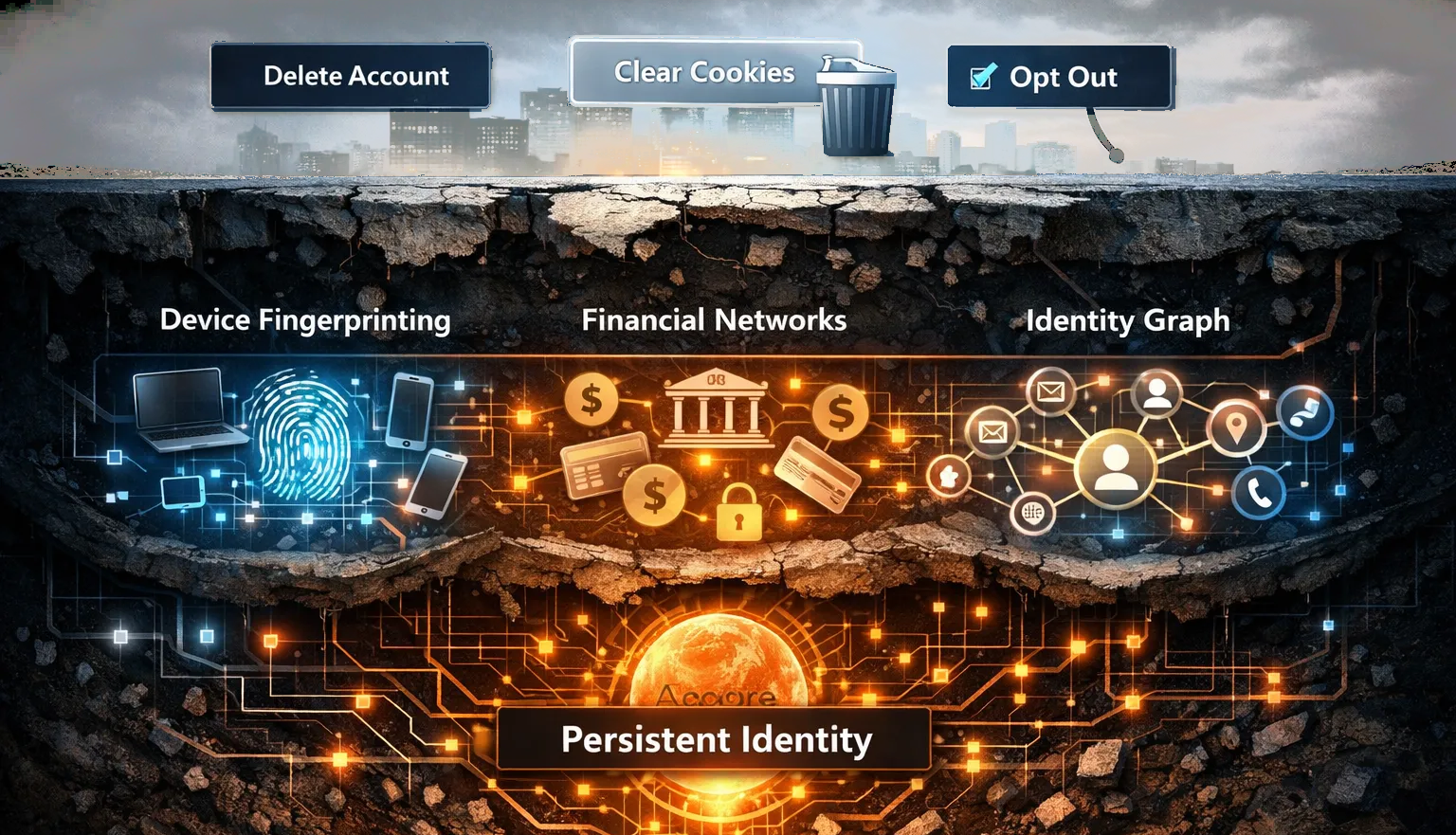
- Delete the account
- Clear the cookies
- Opt out
Problem solved.
That model used to be closer to reality.
It is not how the modern identity system works.
Most privacy controls operate at the interface layer. The part of the system users can see.
Your identity often lives deeper.
It lives in infrastructure.
A new analysis of the identity ecosystem by ObscureIQ shows why many opt-outs fail to produce the results people expect.
Because they never reach the structural identity layer.
The Structural Identity Problem
Digital identity is no longer stored in a single place.
It is assembled.
Every interaction generates signals. Those signals feed systems that link identities across companies, sectors, and infrastructure layers.
Delete an account and the surface changes.
But the deeper structure often remains.
Think of it like tearing down a house while leaving the foundation intact. The structure can always be rebuilt.
Several identity rails make this persistence possible.
⚫ The Silent Identity Rail
Your most persistent identity is often one you never created.
It is inferred automatically.
Modern platforms use telemetry and fingerprinting to generate device-level identities from signals such as:
- Hardware characteristics
- Browser configuration
- Network metadata
- Behavioral patterns
This creates what privacy researchers call device fingerprints.
These fingerprints can reconnect the same user across sessions and services.
Even if you:
- Clear cookies
- Use private browsing
- Delete accounts
The system can often rebuild the identity.
Because the identity was never tied to an account in the first place.
There is also rarely a meaningful opt-out mechanism.
You cannot opt out of the hardware configuration of your laptop.

⚫ Embedded Financial Anchors
Financial infrastructure creates another powerful identity rail.
Once your identity attaches to regulated financial systems, it propagates widely across the economy.
Examples include:
- Banks
- Payment processors
- Credit bureaus
- Fraud detection networks
- KYC identity verification systems
These systems share identity signals across industries.
They are also designed for persistence.
Regulatory frameworks such as anti-money laundering rules require financial institutions to maintain identity records for years.
That persistence is not a bug.
It is a legal requirement.
You can rotate an email address.
You cannot rotate your financial identity.
⚫ The Persistence of the Identity Graph
Modern identity systems increasingly rely on cross-domain identity graphs.
These systems combine signals from multiple sectors and link them together.
Common signals include:
- Phone numbers
- Email addresses
- Device identifiers
- Behavioral telemetry
- Payment signals
- Location patterns
The result is an evolving identity graph.
Deleting data from one company rarely dismantles the graph itself.
Signals continue to flow between sectors.
Telecom.
Finance.
Security.
Advertising.
Fraud detection.
Each node contributes signals.
The structure persists even when individual nodes disappear.

Why Opt-Outs Often Feel Ineffective
Many privacy tools focus on data removal from a specific service.
This can still be valuable.
But it often does not affect the deeper identity rails that drive modern identity reconstruction.
The result is a common user experience:
- Data gets deleted
- Tracking appears again later
- The identity seems to rebuild itself
Because in many cases, it actually did.
Identity systems are designed to reconnect signals.
🔵 ObscureIQ Insight
Most industry “privacy controls” manage the interface layer. The visible part of the system.
Identity power lives deeper in infrastructure.
An account can be closed.
A structural identity graph usually cannot.
This does not mean privacy controls are useless.
They can still reduce exposure.
But they rarely change the underlying architecture of digital identity.
If the foundation of the digital world is designed for persistence, a few opt-outs will not erase it.
They only modify the surface.
What This Series Will Explain
This article is the first in the ObscureIQ Identity Infrastructure Series.
In the coming posts, we will examine the deeper architecture of digital identity, including:
- Identity inference systems
- Device fingerprinting infrastructure
- Financial identity rails
- Identity graphs and cross-sector linking
- Behavioral telemetry and digital exhaust
- Delegated identity exposure
Understanding these systems changes how you think about privacy.