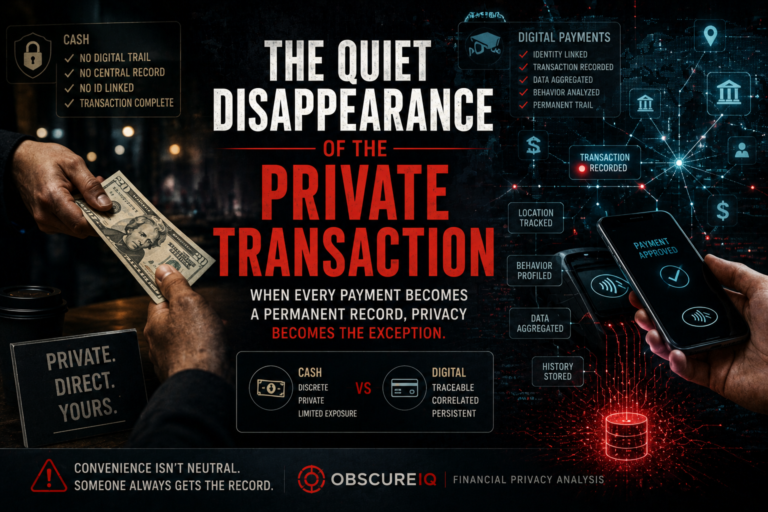
Every time you make a payment, your identity is evaluated.
Not simply by your bank.
Behind most transactions is a chain of systems that continuously analyze risk, identity signals, and regulatory compliance. These include:
- 🔹 payment processors
- 🔹 card networks
- 🔹 fraud detection platforms
- 🔹 regulatory monitoring systems
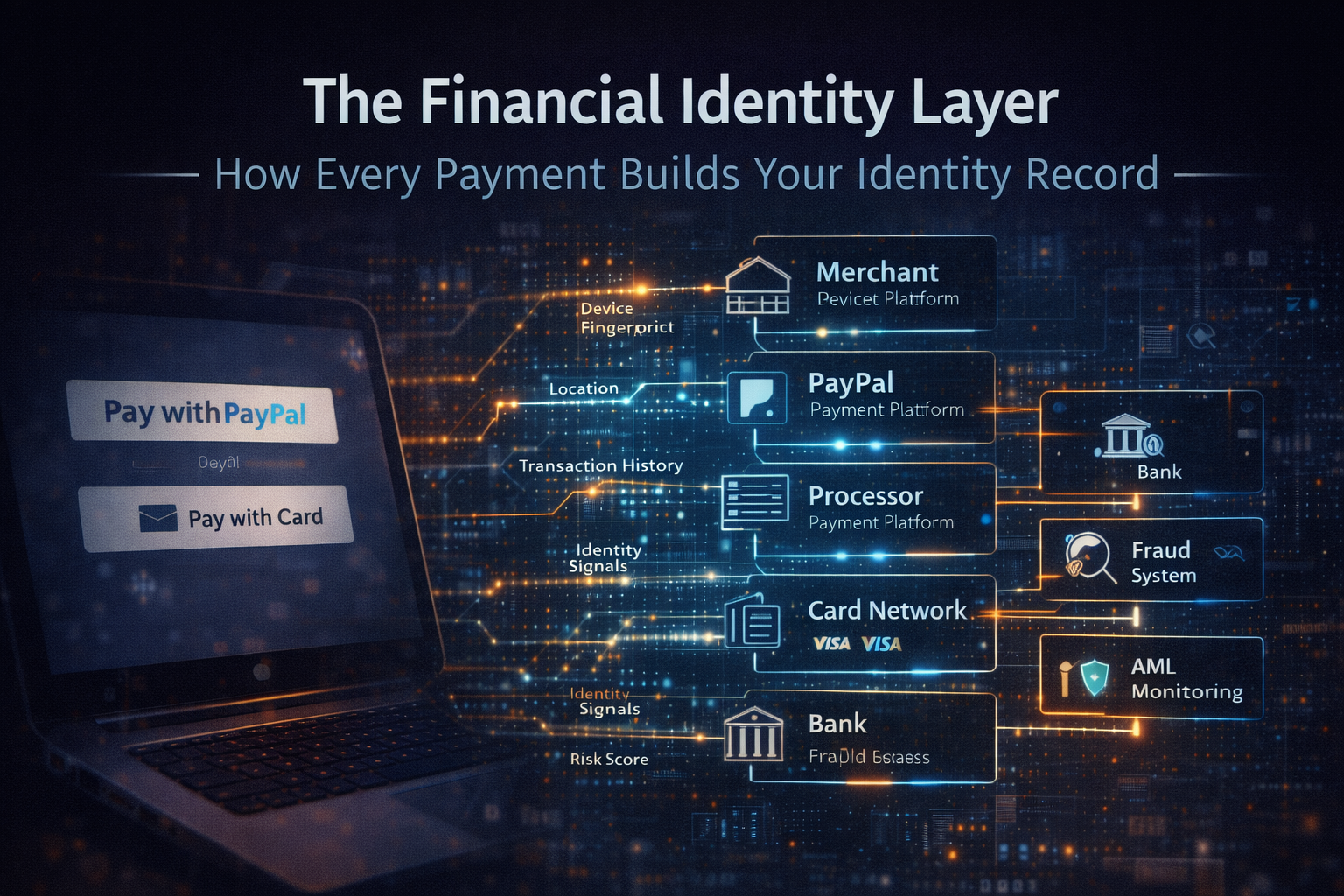
Together, these systems form what we call the financial identity layer.
It is one of the most persistent identity infrastructures in the digital world.
The Systems Behind Every Payment
Digital payments rarely move directly from you to a merchant.
Instead, transactions pass through several layers of financial infrastructure designed to confirm identity and detect fraud.
Along the way, systems analyze signals such as:
- 🔹 device identity
- 🔹 location patterns
- 🔹 transaction history
- 🔹 behavioral anomalies
- 🔹 account relationships
Even when a payment method appears anonymous, the surrounding signals often are not.
These signals are used to determine whether a transaction should be approved, flagged, or blocked.
What Actually Happens When You Make a Payment
Consider a simple purchase.
You hear about a new online retailer from a friend that sells CBD gummies. You visit the site and place an order. At checkout, you choose to pay through PayPal.
From your perspective, the transaction takes only a few seconds.
Behind the scenes, your payment travels through a complex chain of financial infrastructure. At multiple points along that path, systems evaluate your identity and risk profile.
🔵 Merchant Platform
The moment you load the checkout page, the merchant platform begins collecting signals.
These often include:
- your IP address
- device type and browser configuration
- session behavior and navigation patterns
- approximate geographic location
Many e-commerce platforms also run basic fraud tools that evaluate whether the session appears legitimate.
This is the first layer where your device identity and behavioral signals enter the transaction record.
🔵 PayPal (Payment Platform)
When you choose PayPal, the transaction moves into PayPal’s payment environment.
PayPal evaluates the request using internal risk models.
These models may analyze signals such as:
- your PayPal account history
- login patterns and device recognition
- transaction velocity
- location consistency
If something appears unusual, PayPal may trigger additional verification, such as a login challenge or one-time code.
Even when the payment succeeds, PayPal logs risk signals associated with the transaction.
🔵 Payment Processor
Behind PayPal, payment processors and banking partners help move the funds.
These systems transmit transaction details to the card network and financial institutions involved.
At this stage, systems may analyze:
- transaction amount
- merchant category code (CBD products fall into specific regulatory categories)
- location and merchant risk profiles
- historical transaction patterns
Processors maintain their own transaction records for fraud monitoring and dispute handling.
🔵 Card Network
If your PayPal account is linked to a credit card, the transaction is routed through a card network such as Visa, Mastercard, or American Express.
The network routes the authorization request to your issuing bank.
During this process, network-level fraud systems may also evaluate signals like:
- merchant risk history
- cross-network fraud indicators
- abnormal purchase patterns
Card networks maintain extensive transaction metadata for fraud prevention and compliance.
🔵 Issuing Bank
Your bank ultimately decides whether the transaction is approved.
The bank’s risk systems compare the purchase against your historical behavior.
They may evaluate:
- typical spending patterns
- geographic consistency
- merchant category risk
- transaction timing
If the purchase looks unusual, the bank may decline the payment or trigger a fraud alert.
Even when approved, the transaction becomes part of your long-term financial activity record.
🔵 Fraud Detection Systems
Throughout the process, specialized fraud platforms may analyze the transaction.
These systems often use machine learning models trained on massive datasets.
They analyze signals such as:
- device fingerprinting
- behavioral patterns during checkout
- IP address reputation
- account relationship graphs
Many financial institutions share fraud intelligence through consortium systems that identify emerging attack patterns.
🔵 Regulatory Monitoring Systems
Finally, financial institutions must comply with regulatory monitoring requirements.
These systems analyze transactions to detect suspicious activity under Anti-Money Laundering (AML) rules.
Monitoring platforms may look for patterns such as:
- unusual transaction volumes
- rapid movement of funds across accounts
- activity involving regulated product categories
Financial institutions are often required to retain transaction records and identity data for five to ten years or longer.
😲 The Hidden Identity Trail
From your perspective, you simply bought a box of CBD gummies.
But behind the scenes, that single purchase likely generated records across multiple independent systems:
- the merchant platform
- PayPal
- payment processors
- the card network
- your bank
- fraud monitoring platforms
- regulatory compliance systems
Each system evaluates identity signals.
Each system stores transaction metadata.
And together they contribute to your financial identity layer, one of the most persistent identity infrastructures in the digital ecosystem.
Gift Cards Are Not Invisible
Gift cards are often viewed as anonymous payment tools.
They reduce direct linkage to a bank account.
They do not eliminate identity signals.
Retail systems still capture:
- purchase location
- purchase time
- activation records
- device and IP data during redemption
Fraud monitoring systems also analyze how gift cards are used.
Gift cards reduce financial linkage.
They do not make transactions invisible.
Crypto Has Identity Infrastructure Too
Cryptocurrency is often described as anonymous.
In practice, it is usually pseudonymous.
Most users interact through:
- exchanges
- payment platforms
- custodial wallets
These platforms typically operate under KYC and AML regulations.
They often require:
- government identification
- phone verification
- bank account linkage
- device fingerprinting
Blockchain analytics companies also cluster wallets and trace transaction patterns.
Over time, crypto activity frequently reconnects to traditional financial identity systems.
The Public Ledger Problem with Crypto
One of crypto’s defining features is also one of its biggest privacy limitations.
Most major blockchains operate as public ledgers.
Every transaction is recorded permanently and can be viewed by anyone.
The ledger does not contain names, but it does contain:
- wallet addresses
- transaction amounts
- timestamps
- transaction paths between wallets
Because these records are permanent, analysts can map how funds move through the ecosystem.
Specialized companies such as Chainalysis, Elliptic, and TRM Labs build tools that:
- cluster related wallets
- trace transaction flows
- identify exchange interactions
- flag suspicious activity
Once a wallet touches a regulated exchange or payment platform, the identity behind that wallet can often be linked to real-world records.
From that point forward, the historical transaction trail may become traceable.
This is why cryptocurrency is better described as pseudonymous rather than anonymous.
Your name may not appear on the blockchain.
But the transaction history remains visible forever.
Why Financial Identity and Crypto Identity Are Converging
Early cryptocurrency systems were designed to operate outside traditional financial infrastructure.
That separation is disappearing.
Today, most crypto activity passes through regulated gateways such as:
- exchanges
- stablecoin issuers
- payment platforms
- custodial wallets
These platforms are increasingly integrated with traditional banking systems.
They often connect to:
- bank accounts
- credit and debit cards
- identity verification providers
- fraud monitoring platforms
In other words, the same identity signals used in traditional finance are now being applied to crypto transactions.
As a result, crypto identity trails increasingly intersect with the broader financial identity layer.
A wallet that interacts with an exchange may become linked to:
- KYC identity records
- banking relationships
- device fingerprints
- behavioral transaction patterns
Once those connections exist, crypto activity can become part of the same identity graph that already maps traditional financial behavior.
The boundary between crypto identity and financial identity is rapidly disappearing.
Cybercrime and the Blockchain Traceability Debate
Cryptocurrency is often portrayed as a tool for anonymous cybercrime.
The reality is more complicated.
Most major blockchains are fully transparent public ledgers.
Every transaction is permanently recorded and visible.
This means investigators can often trace the flow of funds across wallets and services.
Law enforcement agencies increasingly rely on blockchain analytics platforms to follow these trails.
In many cases, cryptocurrency has actually made certain forms of financial crime more traceable than traditional systems.
Cash transactions leave little forensic evidence.
Blockchain transactions leave permanent records.
When funds eventually pass through an exchange or regulated service, investigators may be able to connect those transactions back to real-world identities.
This has led some investigators to describe blockchain as one of the most powerful forensic accounting tools ever created.
The real privacy challenge is not that cryptocurrency is invisible.
It is that the financial system now contains multiple identity layers operating at once.
Traditional financial rails.
Crypto infrastructure.
Fraud monitoring networks.
Regulatory compliance systems.
Together, they form a complex ecosystem that continuously analyzes and records identity signals.
And once those signals begin to connect, the resulting identity graph becomes extremely difficult to unwind.
The Regulatory Layer
Financial identity persists partly because regulation requires it.
Payment infrastructure must comply with:
- Know Your Customer (KYC)
- Anti-Money Laundering (AML) rules
- fraud monitoring requirements
Financial institutions are often required to retain identity records for five to ten years or longer.
This makes financial identity one of the most durable identity layers in the digital ecosystem.
What Identity Infrastructure Mapping Shows
Mapping identity infrastructure across industries reveals a consistent pattern.
Financial systems act as core identity anchors.
Banks, payment networks, and fraud platforms exchange risk signals across the ecosystem.
These signals often propagate into:
- payment processors
- credit bureaus
- identity verification platforms
- fraud scoring systems
Once an identity becomes anchored in this layer, rotating it becomes extremely difficult.
The Strategic Reality
Some identifiers can be changed.
- email addresses
- phone numbers
- online accounts
Financial identity is different.
Payment rails are designed for persistence.
They form one of the most durable identity infrastructures in the digital world.
Which means privacy strategy is not about removing financial identity.
It is about limiting how many other signals connect to it.
Because when financial identity becomes the center of an identity graph, the rest of your digital life becomes far easier to map.