ALPR vs. GPS: Why License Plate Tracking Is Surging
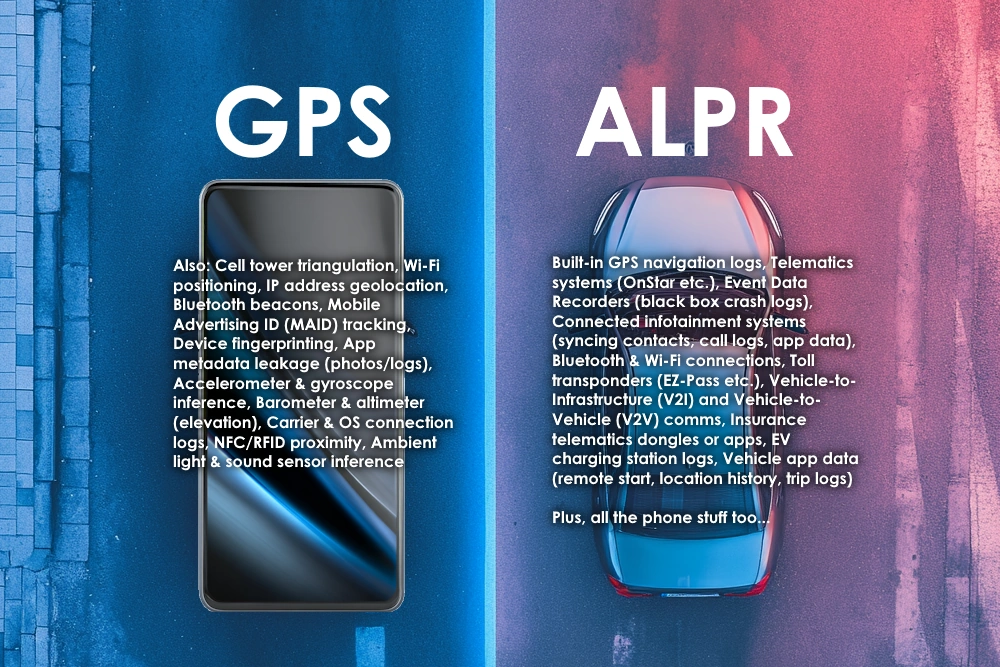
Law enforcement has always had ways to follow you. Phones broadcast your location through GPS, cell towers, and Wi-Fi beacons. That data is rich, precise. And often locked behind warrants, subpoenas, or private data broker paywalls.
Automatic License Plate Recognition (ALPR) is different. Cameras mounted on intersections, patrol cars, and even private property quietly scan every plate that passes. Billions of scans are collected each month across the U.S., flowing into massive commercial and government databases.
Unlike GPS data, ALPR is…
- Already tied to identity. Your license plate is a government-issued marker linked directly to you or your household. No need to triangulate.
- Easier to access. Agencies can query commercial databases or run their own cameras for a few thousand dollars. Some private investigators, insurers, and repo firms already do.
- Real-time in practice. While coverage is spottier than GPS, ALPR can ping the instant a car passes a hot zone camera. Turning every garage, toll booth, or intersection into a checkpoint.
This explains why ICE and other agencies lean heavily on plate data: it’s cheap, pervasive, and less encumbered by the legal barriers that govern phone tracking.
The tradeoff? Less precision, but higher immediacy. Instead of a breadcrumb trail from your phone, ALPR offers alerts: “The car is here. Right now.”
That shift (away from signals on your device, and toward what you drive) makes ALPR one of the most underestimated surveillance threats today.
ALPR Stats
- 15+ billion plate scans: Commercial networks like Flock Safety and DRN each store over 15 billion license plate scans, growing by hundreds of millions every month.
- <$2,000 to build a system: A determined actor (or even a PI) can build their own ALPR rig for under $2,000, using dash cams, IP cameras, or Raspberry Pi kits.
- Widespread private use: ALPR is now used not just by law enforcement but also real estate developers, HOAs, repo networks, and private investigators.
- State-level restrictions: Only a handful of states (like Vermont, New Hampshire, Maine, Alabama) outright prohibit private ALPR use; most allow it with minimal limits.
The value equation explains it all. For less than the cost of a mid-range laptop, anyone can set up ALPR surveillance. For law enforcement, that means a low-friction alternative to phone tracking. But the same accessibility makes it attractive to private investigators, insurance companies, corporate spies, and even stalkers. The technology is too cheap, too pervasive, and too closely tied to identity for its use to stay confined to police.
ALPR isn’t just a law enforcement tool anymore… it’s quickly becoming everyone’s.