The CSI Enhance Button Is a Lie: What Image Al Really Does
Pop culture has trained us to believe in a magic “enhance” button. The detective yells, the tech zooms in, and suddenly a blurry security cam shot reveals a perfect face. In reality, that’s impossible.
Image enhancement tools don’t recover lost detail. They can only sharpen or hallucinate.
The difference lies in the method used and the era of technology.
Two Generations of Image Enhancement
- Traditional methods (1980s–2010s):
Techniques like interpolation (bicubic, Lanczos) and deconvolution sharpen or smooth existing pixels. They don’t hallucinate, only rework what’s already there. The results often look flat or filled with artifacts, because no real detail is added. - Modern AI methods (2014–present):
Deep learning models (CNNs, GANs, diffusion) are trained on massive datasets. They generate detail by predicting what blurry pixels are likely to represent. This is true hallucination. The AI isn’t recovering the original scene. It’s inventing textures and features that look plausible but may not be accurate.
In practice, the AI model is saying: “When I’ve seen blurry pixels like this before, they usually resolved into sharp pixels like that.”
Video vs. Single Images
With video, you’re not limited to a single frame. Multiple images provide more data points. The right tool can combine this data to improve results. Interpolation and hallucination become more powerful when applied across frames. But again, this doesn’t guarantee perfect recovery. It is only a more informed guess.
Sidebar: GAN vs. Diffusion. Which Models Do What?
Image enhancement AI splits broadly into GAN-based and diffusion-based systems. Each has tradeoffs worth knowing.
- GAN-based (2014–2021)
- How they work: A generator creates detail, and a discriminator critiques it until results look realistic. Fast, sharp, but sometimes too generic.
- Where you’ll see them:
- Best for: Quick upscaling when you want consistent sharpness. Works well on structured patterns like text, logos, or synthetic images
- Diffusion-based (2021–present)
- How they work: Start with noise and iteratively refine the image, guided by the blurry input. Produces more natural and varied textures, but slower and sometimes drifts.
- Where you’ll see them:
- Stable Diffusion upscalers (e.g., SD Upscaler, Real-ESRGAN x4+)
- Topaz Photo AI (newer versions)
- Adobe Firefly / Photoshop Super Zoom
- Best for: Photographic images where subtle, organic detail matters. Stronger at skin, fabric, and natural textures.
Quick guide:
- Need speed and consistency? → Use GAN models.
- Need nuance and realism? → Use diffusion models.
- Both hallucinate. Neither reveals hidden truth. The choice is about style of hallucination, not accuracy.
Why This Matters
Ben H., a journalist and OSINT investigator, recently put it bluntly: even the best AI (or “secret government software”) cannot turn a pixelated PNG into an accurate high-res photo. Enhancement isn’t truth recovery. It’s probabilistic reconstruction. His social post is enlightening.
One striking example Ben notes: researchers fed a pixelated photo of Barack Obama into a neural network. The “enhanced” output looked like a completely different man. The AI didn’t find hidden pixels. it invented new ones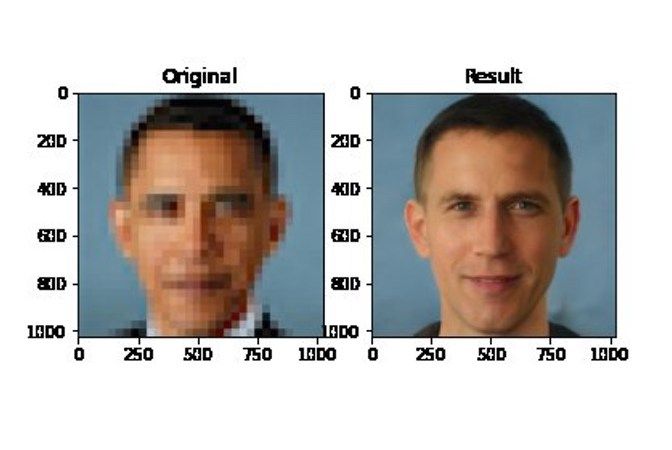
Understanding how image enhancement works is critical.
Enhancing a blurry face can easily fuel a conspiracy theory rather than reveal some hidden truth. The model is just creating a new, imaginary face, with randomized features.
The responsible path for journalists and those resharing images on social media is to demand higher-quality sources. Don’t not rely on AI images or AI enhancements .
The Bottom Line
- Traditional methods sharpen but don’t add detail.
- AI methods hallucinate detail that looks real but may be wrong.
- Multiple frames can help, but there’s no CSI magic.
Image enhancement is powerful, but it’s not a window into hidden reality. Treat it as a tool for plausibility, not certainty.