
Why modern identity risk lives in payment rails, identity graphs, and device telemetry.
KYC (Know Your Customer verification) does not create identity.
It activates identity infrastructure that already exists.
Most conversations about identity risk begin with KYC and AML vendors.
That is understandable.
- These systems onboard customers.
- They collect identity documents.
- They screen sanctions lists.
- They satisfy regulatory obligations.
They are visible.
They are procedural.
They are auditable.
But they are not where structural identity power lives.
KYC is procedural.
Identity infrastructure is structural.
That distinction matters.
A Necessary Clarification About KYC
Regulators are right to scrutinize KYC providers.
Modern onboarding processes collect large volumes of sensitive data:
- Government IDs
- Biometric scans
- Proof of address
- Financial documentation
- Device and behavioral metadata
That creates legitimate privacy concerns:
- overcollection
- retention practices
- vendor sprawl
- secondary use of identity documents
Data minimization matters.
But even if every KYC provider adopted perfect minimization tomorrow, the broader identity risk landscape would remain.
Because KYC is not where identity becomes persistent.
It is simply where institutions attach individuals to existing identity infrastructure.
Procedural Systems vs Structural Systems
Procedural systems execute policy.
They:
- verify documents
- screen sanctions lists
- trigger enhanced due diligence
- freeze or escalate accounts
They operate inside institutions.
Structural systems operate differently.
They:
- anchor identity
- bind identity across contexts
- amplify identity visibility
- persist identity signals across sectors
Procedural systems act on identity.
Structural systems shape how identity exists.
Structure shapes procedure.
Procedure legitimizes structure.
The Identity Infrastructure Stack
When the ecosystem is mapped structurally, identity systems fall into five layers.
Tier 1 :: Foundational Identity Rails
These systems anchor identity at infrastructure scale.
Examples include:
- payment networks
- national biometric systems
- cross-domain identity graph platforms
They define identity persistence across sectors.
When these rails expand or integrate new signals, the effects cascade across industries.
Opt-out is limited or nonexistent.
Tier 2 :: Identity Amplifiers
These systems convert fragmented signals into portable identity.
Examples include:
- credit bureaus
- identity brokers
- large intelligence data aggregators
They combine identity data across domains and produce persistent identity profiles.
This is where identity becomes portable across institutions.
Tier 3 :: Identity Utilities
A rapidly expanding layer of infrastructure allows organizations to plug identity signals directly into software systems.
Examples include:
- enterprise identity systems
- device fingerprinting platforms
- identity resolution APIs
- authentication infrastructure
These utilities make identity programmable.
Once identity becomes programmable, it becomes persistent.
Tier 4 :: Institutional Gatekeepers
These systems execute decisions within organizations.
They:
- approve or deny onboarding
- trigger compliance reviews
- escalate account monitoring
- enforce internal policy
Examples include:
- AML engines
- fraud detection systems
- onboarding workflows
They consume identity signals but do not create the infrastructure itself.
Tier 5 :: Investigative Intelligence Tools
These tools accelerate identity research.
They include:
- OSINT platforms
- monitoring dashboards
- investigative search systems
They make identity easier to discover.
But they do not operate structural rails.
The Hidden Structure of Identity Data
When we analyze identity infrastructure vendors across the ecosystem, an important pattern emerges.
Despite the complexity of the market, most identity systems cluster around a small number of core signal categories:
- Device telemetry
- Financial transactions
- Government identifiers
- Behavioral analytics
- Biometrics
These five signal types form the backbone of modern identity infrastructure.
Different vendors collect different pieces.
But identity persistence emerges when these signals are combined across systems.
The Most Dangerous Identity Rails
Three infrastructure rails play an outsized role in identity persistence.
💣 Financial Identity Rails
Global payment networks anchor identity in the financial system.
Payment rails connect:
- banks
- merchants
- fintech platforms
- subscription services
- marketplaces
Financial identity is difficult to rotate.
Regulatory retention requirements make it persistent.
Once an identity is tied to payment rails, that anchor propagates across the economy.
💣 Cross-Domain Identity Graphs
Large data aggregators stitch identity signals together.
They merge data such as:
- addresses
- phone numbers
- emails
- financial records
- telecom metadata
- behavioral signals
The result is a probabilistic identity graph.
Once a person enters one of these graphs, their identity tends to propagate across many sectors.
Deleting one dataset rarely removes the underlying identity structure.
💣 Device Identity Infrastructure
Device telemetry has quietly become a powerful identity rail.
Device intelligence systems analyze:
- browser fingerprints
- hardware characteristics
- network signals
- behavioral patterns
The user never explicitly creates this identity.
It is inferred automatically.
Even when accounts are deleted or cookies cleared, device identity often reconnects the same user.
The device becomes a persistent identity anchor.
The Identity Power Pyramid
Identity power is layered. The higher layers are visible. The lower layers are structural.
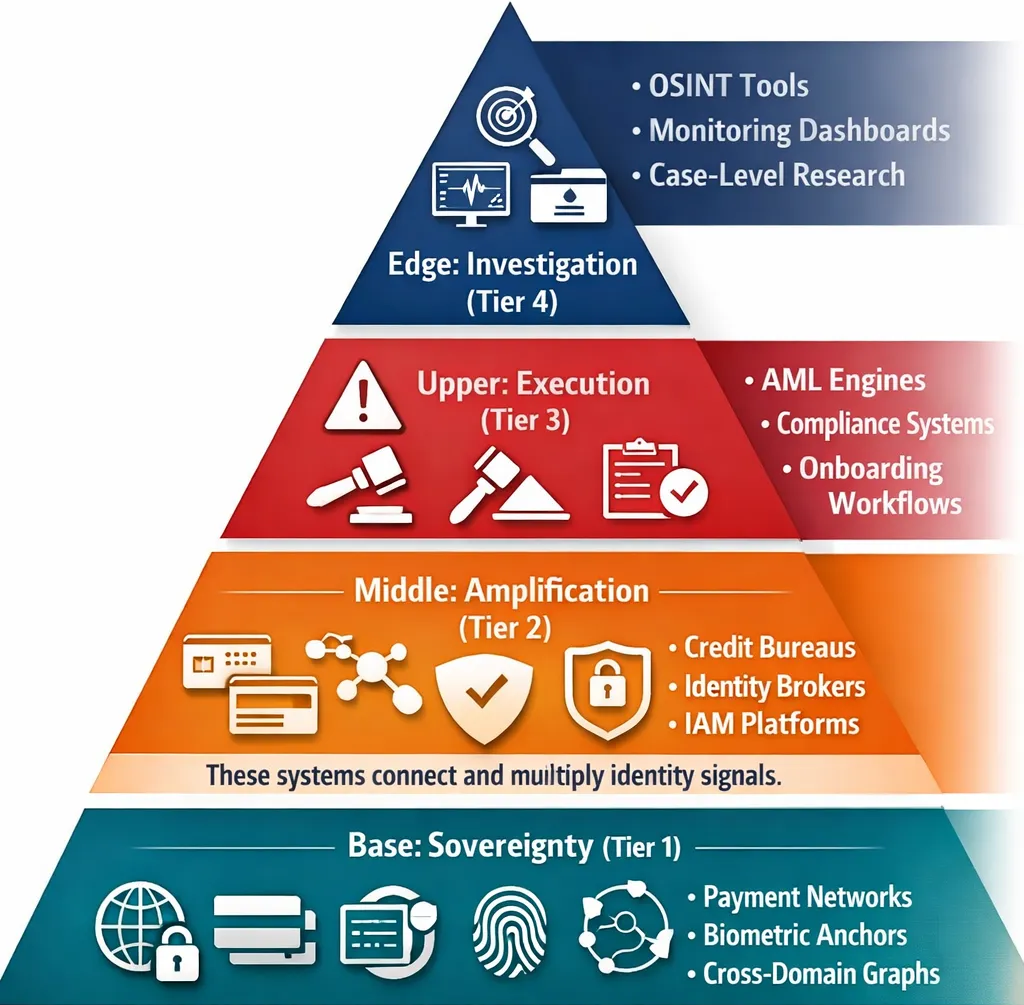
The higher you move in the pyramid, the more visible the systems become.
The lower you move, the more structural their power.
Base Layer :: Identity Rails
- Payment networks.
- Biometric infrastructure.
- Cross-domain identity graphs.
Middle Layer :: Amplification
- Credit bureaus.
- Identity brokers.
- Data aggregation networks.
Upper Layer :: Execution
- Compliance engines.
- Fraud systems.
- Onboarding workflows.
Edge Layer :: Investigation
- OSINT tools.
- Monitoring platforms.
- Research systems.
If oversight focuses only on the upper layers, the foundation remains unexamined.
A Subset of the Stack
To illustrate the difference between structural and procedural identity systems, consider a small cross-section of the ecosystem.
| Tier | Example | Structural Role |
|---|---|---|
| 1A | Visa | Global transaction identity rail |
| 1A | Mastercard | Global payment identity infrastructure |
| 1B | IDEMIA | National biometric enrollment backbone |
| 1B | NEC | Government biometric identity infrastructure |
| 1C | Palantir | Cross-domain identity graph infrastructure |
| 2A | Experian | Cross-sector identity amplification |
| 2A | Okta | Enterprise identity access infrastructure |
| 2B | Chainalysis | Domain-specific identity graph (blockchain analytics) |
| 3 | NICE Actimize | Institutional enforcement engine |
Notice where KYC vendors appear in this structure.
- They sit above the infrastructure layers.
- Their job is not to create identity rails.
- Their job is to connect individuals to them.
When the identity ecosystem is mapped structurally, patterns appear that are not visible at the vendor level.
The dataset highlights several dynamics that explain how identity signals propagate, combine, and persist once they enter the infrastructure layer.
Insights From the Dataset
Mapping identity infrastructure across vendors reveals several structural patterns. These patterns help explain why identity exposure is so persistent once it enters the infrastructure layer.
⚡ Infrastructure Concentration
One of the clearest patterns in the dataset is infrastructure concentration. Many identity services that appear independent actually rely on the same underlying rails. Payment networks, credit bureau datasets, biometric enrollment vendors, and identity graph providers serve as shared foundations for thousands of downstream systems.
This concentration means identity risk is rarely confined to a single vendor. When a major infrastructure layer expands its signals or integrations, the effects cascade outward across institutions that rely on that infrastructure. What appears to be a distributed ecosystem is often anchored by a small number of structural identity providers.
⚡ Cross-Sector Identity Propagation
Identity signals do not stay confined to the sector where they originate. Financial activity informs fraud detection systems. Telecom metadata appears in identity verification platforms. Behavioral data collected in consumer applications flows into advertising identity graphs and security tools.
As a result, identity data collected in one context can quickly become usable in another. Most individuals interact with only a handful of institutions, yet their identity signals propagate through many more. The infrastructure layer enables identity to move between sectors in ways that are largely invisible to the individual.
⚡ Signal Fusion Creates Persistence
No single vendor holds every identity signal. Instead, identity persistence emerges when multiple signals are fused together across systems. The dataset shows most identity infrastructure clustering around five core signal types: device telemetry, financial transactions, government identifiers, behavioral analytics, and biometrics.
Individually, each signal has limitations. Together, they form highly stable identity profiles. When signals from multiple categories intersect inside identity graphs or infrastructure platforms, the resulting identity becomes difficult to unwind.
⚡ Device Identity as a Silent Rail
Device telemetry has quietly become one of the most powerful identity anchors in the modern ecosystem. Many security, advertising, and fraud systems rely on device signals such as browser fingerprints, hardware attributes, network characteristics, and behavioral patterns.
Unlike financial or government identity systems, device identity is rarely visible to the user. It is inferred automatically. Yet it allows platforms to reconnect identity across accounts, sessions, and services even when users attempt to reset or obscure their digital footprint.
⚡ Procedural Systems Depend on Structural Systems
Compliance engines, fraud detection platforms, and onboarding workflows often appear to be the center of identity decision-making. In reality, they depend heavily on upstream infrastructure. These systems rely on signals from identity graphs, device intelligence vendors, credit bureau data, and payment networks.
This dependency highlights the difference between procedural and structural identity power. Procedural systems decide how institutions respond to identity signals. Structural systems determine how those signals exist in the first place.
⚡ Identity Infrastructure Is Becoming Programmable
Another pattern visible in the dataset is the rapid growth of identity utilities. Identity access platforms, identity resolution APIs, and device intelligence services allow organizations to integrate identity signals directly into software systems.
This makes identity programmable. Developers can query identity signals, automate risk scoring, and link identity across applications through APIs. As identity becomes easier to integrate into software, it becomes easier for identity signals to propagate across the ecosystem.
⚡ Oversight Often Targets the Wrong Layer
Most privacy and regulatory attention still focuses on procedural systems such as KYC vendors, onboarding workflows, and compliance platforms. These systems are visible and institution-specific, which makes them easier to regulate.
However, the dataset shows that identity persistence often originates deeper in the infrastructure layer. Payment rails, identity graphs, biometric systems, and identity utilities operate across institutions and sectors. When oversight focuses only on procedural systems, the structural layers that actually shape identity persistence remain largely unexamined.
Why This Matters for Privacy and Regulation
When identity becomes:
When identity is:
- linked across domains
- bound to economic rails
- anchored in biometrics
- enriched by cross-sector graphs
Risk becomes systemic:
Risk becomes systemic rather than procedural.
Even where deletion is technically possible, identity signals propagate across interconnected systems.
Persistence becomes distributed.
Access to the Full Dataset
This post includes only a small subset of the identity infrastructure map.
The full dataset spans multiple layers, structural roles, and tier classifications across the identity ecosystem.
If you are a regulator, researcher, or privacy professional and would like access to the complete dataset, contact us at:
We continue to expand and refine the model as identity infrastructure evolves.
Final Observation
KYC is where institutions verify identity.
But identity persistence is determined elsewhere.
KYC does not create identity.
It activates identity infrastructure that already exists.
Understanding modern privacy risk requires mapping that structure.