A VPN Ban Won’t Protect Kids (But It Will Break Everything Else)
Age verification laws tied to VPN bans are gaining momentum.
Two states are advancing legislation that would make VPN use functionally illegal across large parts of the internet.
- Wisconsin AB105/SB130 requires websites with a “substantial portion” of adult content to block all traffic from VPN IP ranges.
- Michigan HB4938 goes further and pushes ISPs to detect and block VPNs used as “circumvention tools.”
Both bills are framed as child protection laws. Both create more risk than they remove.
Everyone agrees that protecting kids online matters. This approach doesn't achieve that goal. It creates new risks for families and removes protections that people rely on every day.
Here we outline those costs.

🔘 The Technical Requirements Are Impossible

AB105 requires sites to block “IP ranges linked to VPN systems.”
A platform cannot tell which VPN users sit inside Wisconsin.
The IP looks the same whether the user sits in Milwaukee or Madrid.
The only workable compliance path is blocking all VPN traffic worldwide.
Security analysts called this “technically unworkable” in AB105 testimony.

🔘 Good Intentions, Wrong Directions
Age-verification laws are sold as simple protections for minors. The premise is easy to support. Kids should not be exposed to explicit content. Most people agree with that goal.
But the way these laws work in practice takes us in the wrong direction. The systems designed to shield minors end up blocking far more than what they target. And when lawmakers attach VPN restrictions to these bills, the collateral damage becomes enormous.
The pattern is the same everywhere these bills appear.
- The laws define “harmful” content broadly.
- The definitions ignore context, nuance, or purpose.
- The enforcement mechanisms are blunt.
- The technology required to comply does not understand intent.
Once enforced, the system does not distinguish between:
- Pornographic material
- Sexual education
- LGBTQ+ resources
- Abuse recovery forums
- Health information
- Art, literature, and science that deals with sexuality
Filters block categories, not meaning. And age-verification systems often push platforms into overblocking to avoid liability. That means minors lose access to information that is healthy, helpful, and necessary.
Bluesky blocked all Mississippi users after the state’s SB 2346 age-verification law took effect. The platform chose a full state-level ban rather than collect IDs or deploy intrusive verification.
Imgur pulled out of the United Kingdom following the Online Safety Act’s age-verification requirements, opting to geoblock the entire country instead of building a mandatory ID-collection system.
The unintended but predictable outcome
A teenager trying to learn about consent, safe relationships, contraception, gender identity, or recognizing abuse can hit the same wall as someone seeking explicit content. This is not speculation. It has been documented in every region that has tried broad category filtering.
When the UK tried broad filters, OFCOM found that nearly one in five educational sites were blocked by mistake.
It creates a world where the only acceptable source of information is a parent, a school, or a state-approved channel. That would be fine if every parent was informed, supportive, or even present. Many are not. Some are abusive. Some are unsafe. Some are simply not equipped.
The internet has been the one place where kids could fill those gaps with accurate, accessible information. Age-verification laws lock that door.

What happens when VPN blocking enters the picture
VPN restrictions make it worse. VPNs protect access to lawful content. They protect privacy when looking up sensitive questions. They protect anonymity for vulnerable youth. If a state says “you cannot reach this category of content while using a VPN,” it strips that privacy away.
So the very kids these laws aim to protect lose:
- Privacy
- Safe access to information
- Anonymity when researching personal topics
- Protection from ISP tracking
- Protection from unsafe or unsupportive home environments
Blocking explicit content becomes blocking sexual content becomes blocking sensitive content becomes restricting access to information.
And the consequences are real.
1- A law meant to shield kids can end up isolating them.
2- A system built to protect minors can end up stripping them of resources that prevent harm.
3- A policy framed as safety can remove the safest channels they have.
And when lawmakers attach VPN bans to these systems, the fallout reaches everyone. Kids. Adults. Abuse survivors. Students. Workers. Anyone who depends on privacy.
We can protect minors without breaking access to critical information. These bills do not take that approach.
These systems break access. The technical side breaks it even faster.

🔘 The Fallout Hits People Who Need Protection
Protecting children is a valid goal. They are a vulnerable population. But they are not the only vulnerable population. Banning or degrading VPN use strips safety from millions of people who rely on private tunnels every day.
VPNs are not niche tools. They are the backbone of modern digital security. They protect groups who already face real risk.
People who lose protection when VPNs break
- Abuse survivors. They rely on masked IP addresses and hidden location patterns to avoid stalkers and violent former partners.
- Journalists. Reporters depend on encrypted tunnels to communicate with sources, file sensitive work, and protect their physical location. Reporters in a country with heavy censorship use VPNs to reach blocked websites.
- Human rights workers. Many operate in hostile regions. They need secure outbound channels to avoid state surveillance.
- Students and remote workers. They use VPNs to access school systems, internal servers, cloud dashboards, and corporate data environments.
- Travelers. They need secure access to banking, email, and identity accounts across untrusted networks.
These populations are not hypothetical. This is millions of people.
This is not limited to private citizens.
Lawmakers, executives, agency staff, and senior officials use VPNs every day. They rely on them when they travel. They use them to review sensitive documents. They use them to keep internal communication out of public view. A broad restriction would not spare them. It would break the same tools they depend on to do their jobs safely.
And the impact does not stop with individuals.

🔘 VPN Ban Breaks the Systems Businesses Depend On
Age-verification bills that restrict VPNs do not only impact “commercial VPN providers.” They also break the core technology businesses rely on to function. If VPN traffic is treated as unlawful or suspicious, companies cannot deliver secure internal access to their own employees.
That means:
- No safe remote access into corporate environments. No safe remote access into corporate environments.
- No encrypted tunnels between field workers and internal systems. No encrypted tunnels between field workers and internal systems.
- No secure connections into financial services dashboards. No secure connections into financial services dashboards.
- No protected pathways for medical professionals accessing patient data. No protected pathways for medical professionals accessing patient data.
- No shielded access for lawyers, accountants, or compliance teams moving sensitive files. No shielded access for lawyers, accountants, or compliance teams moving sensitive files.
This is not a small disruption. Something like 90% of Fortune 100 companies rely on corporate VPNs for secure internal access. So, this is a threat to the basic functioning of private enterprise.
Without VPNs, companies face new and immediate risks
- Breach risk jumps. Traffic that used to be inside a tunnel becomes exposed to ISP-level inspection and interception.
- Ransomware exposure grows. Attackers exploit remote-access weaknesses as their first foothold.
- Shadow IT explodes. Employees will use unapproved tools and unsafe workarounds.
- Compliance failures multiply. Many industries are required to use private networks under HIPAA, GLBA, SOX, or NIST frameworks.
- Operational continuity breaks. If a site blocks VPN ranges, an entire workforce may lose access overnight.
Here’s a tight, direct version you can drop into the post. Short sentences. Clear structure. No em-dashes.
VPNs Are Not Optional for Business
Most companies require VPNs for remote work. They use them to secure internal systems, protect client data, and control access to sensitive tools. A VPN ban, even one aimed at “just certain websites,” breaks that model. It creates a conflict between state law and standard cybersecurity practice.
Critical sectors depend on these tunnels every day. Finance uses VPNs to protect transactions and comply with PCI and FFIEC rules. Healthcare relies on encrypted channels to meet HIPAA requirements. Defense contractors use private tunnels to move classified and sensitive files. Government agencies use VPNs for secure communication between staff and field teams.
The policy fallout becomes a business-continuity risk. It becomes a national cybersecurity risk. It becomes a supply chain risk.
Ending VPN use does not protect children.
- It dismantles protections for survivors, journalists, workers, students, and entire commercial infrastructure layers.
- It creates risk for the very people lawmakers say they want to protect, and for many who cannot function without private networks at all.

🔘 Age Verification Vendors Become Surveillance Hubs
The bills require age verification, but they do not include meaningful oversight of how verification vendors store, process, retain, or share sensitive data. The statutes in Wisconsin and Michigan specify that vendors should not “knowingly retain” identifying information, but they provide…
- no technical standards
- no audits
- no reporting requirements
- no retention limits
- no penalties for mishandling user data
That is not real oversight. It creates a vacuum.
These systems are built to collect sensitive data. They are not built to safeguard it.
Several verification companies already store IP addresses, device fingerprints, and behavioral logs even when they claim to delete ID scans. This creates a concentrated attack surface that has failed before.
The 2023 Identity Verification Provider Leak
A major ID-verification company left an unsecured cloud bucket exposed in 2023. Attackers accessed millions of passport images, driver’s license scans, and face photos collected for KYC and onboarding checks. This included biometric data and government documents from global users. TechCrunch
The Discord Age Verification Breach (2024)
Discord began collecting government IDs to comply with new UK and Australian age-verification laws. Users had to submit a selfie or a scanned passport or driver’s license for age checks, especially during appeals of underage bans.
- Scattered LAPSUS$ Hunters claimed to have stolen 1.5 terabytes of data from a third-party vendor involved in Discord’s verification process, including over 2.1 million images of government-issued IDs from more than 5.5 million users.
Discord insisted that only the appeals pipeline was affected, but the scale of the stolen data shows how quickly an age-verification system becomes a high-value target.
The fact that a gaming chat platform was forced into collecting passports for compliance demonstrates how far age-verification “mission creep” has spread. Laws aimed at “protecting children from pornography” now pressure unrelated platforms to build ID-collection systems that expose millions.
Legislators are creating more choke points inside an ecosystem that already leaks. They are mandating identity collection without mandating protection.

🔘 The Structure Mirrors Authoritarian Censorship
China, Russia, and Iran all restrict VPNs under the same justification.
- Block VPN ranges.
- Force identity checks.
- Require platforms to enforce state-defined morality rules.
U.S. states are now adopting this model under the banner of child protection. EFF described Wisconsin’s bill as censorship infrastructure in disguise.

🔘 Kids Bypass These Systems Anyway
- Louisiana (2023): Users bypassed ID-checks on day one by switching to offshore sites, mirrors, and proxy tools. Documented by Futurism and Louisiana news outlets.
- United Kingdom and Australia: Long-running ISP filters failed in practice. BBC, The Guardian, ZDNet, and ABC reported minors evading blocks with proxies, DNS tweaks, mobile networks, and basic circumvention tools.
- South Korea and China: Even strict national identity-verification regimes fail. Korean and Chinese press reported teens routing around controls with foreign VPN nodes, private tunnels, and offshore apps.

🔘 Cybercrime Gets Easier When VPNs Go Away
VPNs block the easiest attack paths. They reduce exposure to ISP-level tracking, local network attacks, packet sniffing, and public WiFi interception. Remove VPNs and those protections disappear.
That creates immediate openings for attackers across every layer of the stack.
What happens when VPNs are removed
- Credential theft rises. Verizon’s Data Breach Investigations Report shows that 74 percent of breaches involve stolen credentials or credential misuse. VPNs help reduce exposure to the places those credentials get harvested. (Verizon DBIR)
- OSINT targeting becomes easier. Without a VPN, home IPs, travel patterns, device metadata, and browsing behavior become visible to advertisers, data brokers, and criminal OSINT crews. Research from Mozilla and The Markup shows that commercial trackers pull granular identifying data from IP addresses.
- Corporate attack surfaces expand. CrowdStrike’s Global Threat Report notes that remote access vulnerabilities are top initial intrusion vectors, and secure VPNs are one of the strongest mitigations companies have. (CrowdStrike report)
Why cyber insurers care
Cyber insurers already track higher loss patterns tied to weak consumer network hygiene. Coalition Cyber Claims Report shows that small businesses with weak network protections experienced 47 percent higher claim severity, mostly due to credential theft and insecure remote access.
A VPN ban removes a core layer of protection from both individuals and businesses.
- It increases exposure.
- It increases breach risk.
- It widens the attack surface across entire industries.
- And it hands attackers more information about every target they want to study.
🔘 One State Rule Can Break Access for Everyone
Sites cannot detect which VPN users live in Wisconsin.
To avoid liability, platforms will over-block. The safest choice is to restrict all VPN traffic. Users in California, Canada, Germany, Japan, and everywhere else lose access to services because one state passed an unworkable rule.
Techlore and multiple rights groups warn that AB105 creates global collateral damage.
🔘 Surveillance Expands When VPN Use Drops
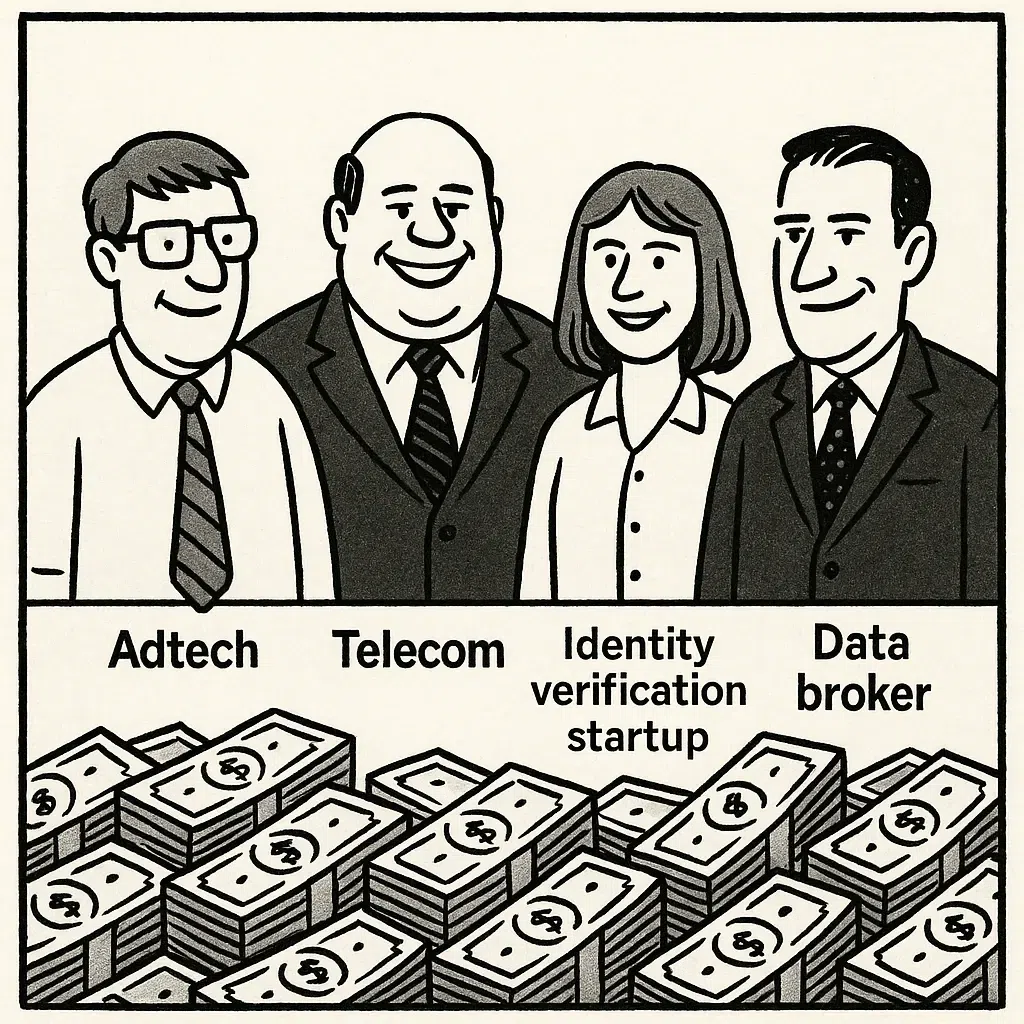
The wrong actors benefit when privacy collapses.
- Without VPNs, ISPs regain full visibility into browsing.
- Advertisers and data brokers gain more behavioral data.
- Age-verification vendors gain access to sensitive IDs.
- The surveillance economy collects more info than ever.
🔘 Who Gets Hurt When VPNs Break
Not a small group. Not edge cases. Millions.
A VPN ban weakens digital safety for:
- Every student who relies on private access for schoolwork.
- Every worker who logs in from home.
- Every parent managing finances or medical records online.
- Every teenager searching for sensitive health information.
- Every business that needs secure internal systems.
- Every traveler connecting on public WiFi.
- Every consumer protecting themselves from scams.
- Every vulnerable person trying to stay safe online.
These laws do not create protection for children. They create exposure for everyone.
ObscureIQ Insight
What a VPN ban actually does
- Weakens cybersecurity for homes, schools, and businesses.
- Exposes survivors, journalists, and vulnerable communities.
- Expands surveillance by ISPs, data brokers, and verification vendors.
- Fragments the open internet into geoblocked fragments.
What it does not do
A VPN ban will not protect children.
Kids still route around blocks with mirrors, alternate networks, proxies, and new tools. The main result is less privacy, not less exposure to explicit content.
An ObscureIQ Prescription
Protecting kids online requires precision, not blunt instruments. A VPN ban is blunt. It hits everyone and solves nothing. Real safety comes from targeted tools and smarter design choices.
-
⚙️ Strengthen platform-level safeguards.
Most large platforms already run moderation, risk scoring, and automated detection. They need sharper filters for grooming behavior, rapid takedown channels, and faster response pipelines for flagged accounts. These improvements protect minors without collecting IDs from millions of adults.
Platform -
⚙️ Expand private-by-default youth spaces.
Kids thrive in digital spaces that do not harvest data, track activity, or expose them to open networks. Companies can create child accounts that limit discoverability, block unsolicited messaging, hide location metadata, and suppress profiling. These protections work regardless of whether the child uses a VPN.
Platform -
⚙️ Give parents tools that do not require surveillance.
Most parental tools today are intrusive and easy to bypass. We can do better. Simple dashboards. Clear app-level controls. Time limits per category. Safe search toggles that can’t be overwritten by ad networks. These help families without forcing biometric scans or government-grade ID checks.
Platform Parents -
⚙️ Require platforms to reduce unnecessary data collection.
Predators exploit leaks, exposures, and dark patterns. If fewer companies hoard sensitive data, there is less material for bad actors to weaponize. Lawmakers can push platforms to minimize tracking of minors, shorten retention windows, and stop sharing youth behavioral data with third parties.
Government Platform -
⚙️ Improve reporting and escalation channels.
Most harm persists because kids do not know where to report abuse or expect slow action when they do. Mandating fast, well-staffed response centers is far more effective than banning privacy tools. Quick escalation saves lives. VPN bans do not.
Platform Government -
⚙️ Support evidence-backed digital literacy.
Kids who understand manipulation, risky behavior, and online deception navigate the internet safer than kids who are simply blocked. Education works at scale. It reduces harm across all platforms. It outperforms age gates and ID uploads by orders of magnitude.
Government Parents Schools -
⚙️ Target bad actors, not privacy tools.
Law enforcement already has channels for pursuing abuse networks. Strengthen those pipelines. Fund cybercrime units. Build systems that flag coordinated grooming patterns. These efforts strike the people causing harm instead of criminalizing kids who want privacy to search sensitive questions.
Law enforcement Government -
⚙️ Promote safer platform design.
Defaults shape behavior. When apps hide adult content by default, disable unsolicited DMs, and prevent algorithmic drift into explicit material, kids are safer. These design choices deliver protection without collecting IDs or blocking VPNs.
Platform -
⚙️ Mandate transparency, not identity.
Instead of forcing every user to verify their identity, require companies to publish clear risk reports and safety audits. Transparency pressures platforms to improve protections across the board without compromising privacy for everyone else.
Government Platform
Protecting children online is essential. We can do that without dismantling the security foundations that keep families, businesses, and governments safe. A VPN ban is not a safety measure. It is a security risk. We can choose a better path.