California’s Data Broker Registry Emails Reveal a Fragmented Privacy Ecosystem
When California data brokers register, they list a point of contact. That sounds mundane. It is not. Those contact emails can tell you a lot about how these companies actually handle privacy — not whether they are competent, not whether they are honest, but how they appear to operationalize the function. That alone is revealing.
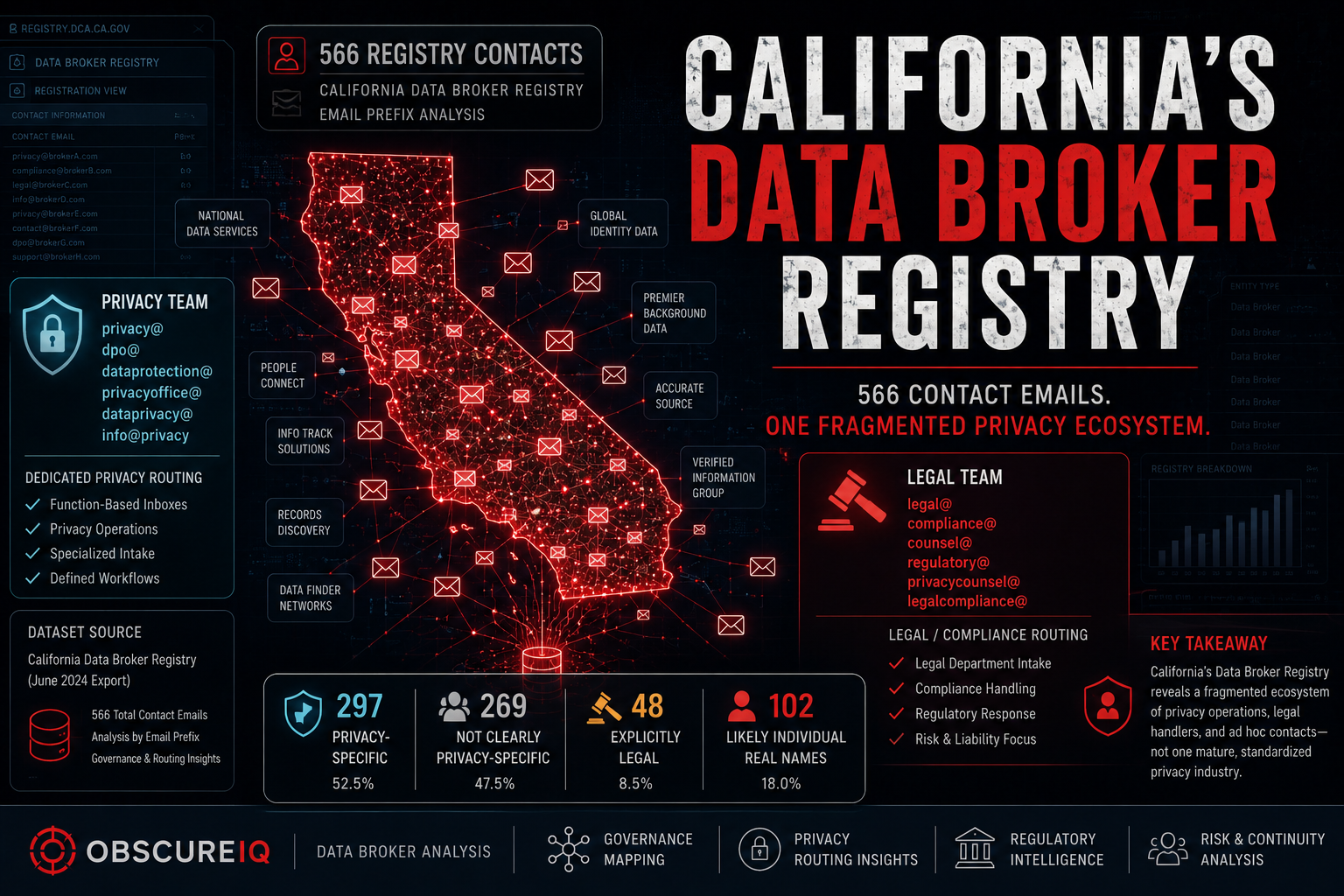
566 addresses — what the data shows
- 297 used privacy-specific prefixes
- 269 were not clearly privacy-specific
- 48 routed explicitly to legal
- 102 appeared to be individual real names
- 1 was explicitly sales or marketing
At first glance, that may look like a niche email formatting exercise. It is not. It is a small window into how a messy industry organizes itself behind the scenes.
What the Prefixes Suggest
Email prefixes are not proof of maturity. They do not tell us whether a company takes privacy seriously. A privacy@ inbox can be ignored. A named employee can be excellent. A legal inbox can be responsive and competent. But prefixes do tell us something about routing. They show where requests are likely to land. They show whether privacy appears to be treated as a defined function, a legal obligation, or a side duty handed to whoever is available. That matters. Because when a consumer, regulator, journalist, or counterparty reaches out, the first stop often shapes the whole process.Supposition 1
This is not a clean ecosystem of dedicated privacy inboxes
If this registry were tightly standardized, you would expect most entries to point to durable privacy addresses. That is not what this looks like. Yes, more than half of the emails used clearly privacy-oriented prefixes. But a very large minority did not. That means the contact layer is mixed. Some firms seem to have dedicated privacy routing. Many do not. That suggests the registry is not connected, across the board, to clean, specialized privacy operations. Instead, it appears uneven. Some firms look structured. Others look improvised.Supposition 2
Many brokers treat this as legal or compliance, not a standalone privacy function
The legal slice stands out. A meaningful subset of addresses appears to route directly into legal or compliance. That is not shocking. In many companies, privacy lives under legal. In others, privacy is treated mainly as a regulatory response function. That distinction matters. A company that treats privacy as a customer-facing operational discipline tends to build systems around intake, workflow, continuity, and response. A company that treats privacy mainly as a legal obligation may still respond well, but the mindset is different. The work may be narrower. The incentives may be more defensive. This dataset suggests many brokers fall into the second category. Not all. But many.Supposition 3
Dedicated commercial intake barely shows up
Only one contact email appeared explicitly sales or marketing related. That is interesting. When I did similar analysis years ago, the commercial angle felt more visible. This time, at least at the contact-prefix level, it seems far less overt. There are a few ways to read that. Maybe firms have matured. Maybe they now understand that obvious commercial-facing inboxes look bad in a privacy registry. Maybe the same underlying functions still exist, but the front-facing contact layer has been cleaned up. Or maybe they are simply better at masking intent. The number alone does not settle that question. But it does suggest a shift in how these firms want to be seen.Supposition 4
Named individuals create continuity risk
This was one of the more telling patterns. 102 of the contact emails looked like they belonged to specific people. That creates fragility. Role inboxes survive turnover. Personal inboxes do not. When the contact point is a named individual, the process becomes more dependent on that person staying in place, checking that mailbox, and handing it correctly. That introduces continuity risk. It also suggests that some portion of the market may consist of smaller, less formalized operations. People often imagine data brokers as only giant firms with massive infrastructure. Some are. But the ecosystem also appears to include a long tail of smaller organizations, niche operators, and less mature businesses. The named-address pattern fits that reality.What This Does Not Prove
We should be careful. This analysis does not tell us:- which firms are actually good at privacy
- which firms respond properly to requests
- which firms have mature internal controls
- which inboxes are monitored versus decorative