Opinion: Flock Safety is Surveillance Sold as Safety
Garrett Langley, CEO of Flock Safety, wants the world to believe his billion-dollar network of cameras and drones is about “ending crime.” What he is really building is a surveillance machine and a billion dollar business model.
Let’s be clear. Surveillance intelligence has value. I know because I have used it. Sometimes a camera hit can be the key to finding a stalker, a fraudster, or a violent threat. Police departments use it. Private investigators use it. On rare occasions, even we at ObscureIQ use it to protect a client. The information can be powerful.
But that is not the story Langley is selling. He is not telling the public that he is building a commercial surveillance grid. He is telling them he is solving crime. He is selling fear and calling it safety.
 Surveillance as a Business Model
Flock Safety does not exist to eliminate crime. It exists to sell recurring surveillance. Homeowners associations, schools, businesses, and police departments all pay into a subscription that keeps Flock’s system running. Once a city plugs in, it becomes dependent. The revenue flows because fear flows.
That is the business model. Surveillance as a Service.
Drones in the Sky: License Plate Readers on Wings
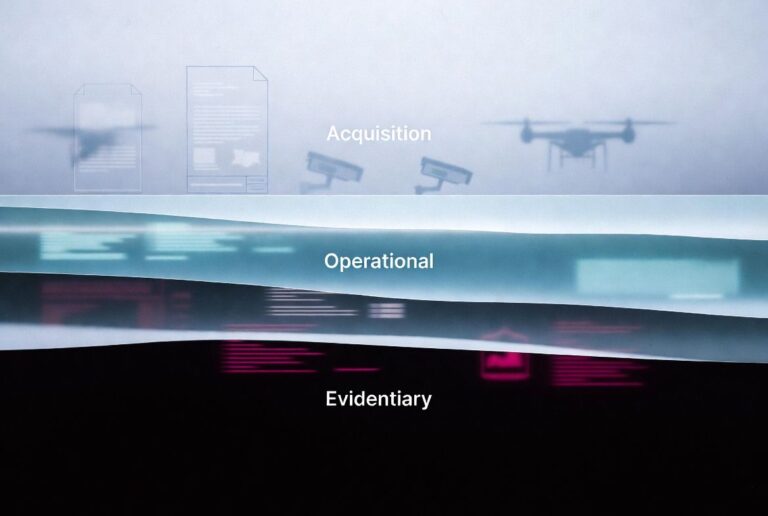
What’s changing fast? What accelerates the business model? The move from fixed cameras and cruiser-mounted ALPRs to airborne surveillance. Companies in the police-tech ecosystem have begun merging Automated License Plate Readers (ALPRs) with drones. The result is not just more cameras; it is a mobile, pervasive dragnet that can scan every car under its flight path.
Flock Safety’s Aerodome drones and the company’s ALPR technology are being presented to police as complementary tools. That combination matters for three reasons:
- Scale and reach. Fixed ALPRs record cars at choke points. Drones can grid entire neighborhoods in minutes and see into places a patrol car can’t — backyards, driveways, alleys, even over fences. Where a fixed camera records a slice of street life, a drone can gather an entire city block’s movements quickly and repeatedly.
- Mobility = ubiquity. A drone on call can be overhead for routine responses: a traffic crash, a burglary report, a noise complaint. Every such flight risks turning ordinary citizen movement into persistent data points in a searchable database.
- Function creep and payload risk. ALPRs already collect more than plate numbers: make, model, color, and sometimes identifying marks. Firms talk openly about linking plate reads to dossiers. Connecting a plate to name, address, and other data the system can pull together. Drones also enable additional payloads that raise even larger threats: microphones, cell-site simulators, thermal cameras, and other sensors that extend surveillance beyond sightlines.
This isn’t hypothetical. Drone-as-First-Responder (DFR) programs have been expanding, and regulatory changes and new waivers make beyond-line-of-sight operations easier for police. What was once a niche capability is fast becoming routine procurement language in police budgets and vendor pitches: “buy our drone platform, buy our sensors, pay a recurring fee, and we’ll deliver you continuous surveillance.”
Add mobile ALPRs into that mix and the public’s movements (not just suspicious activity) are captured, stored, shared, and monetized. The business model of recurring surveillance becomes dramatically more lucrative when the unit of sale is a city-wide, persistent dataset rather than a handful of cameras at intersections.
The Problem With the Pitch
“I think we can have a crime-free city and civil liberties… We can have it all.” – Garrett Langley, CEO of Flock
Mass surveillance doesn’t just capture “the bad guys.” It captures everyone. Every license plate. Every face passing under a camera. Every innocent person who never consented to being part of a corporate database.
Langley claims you can have both perfect safety and civil liberties. That is marketing. Civil liberties require limits. They require boundaries. You cannot have blanket surveillance and then pretend nothing is lost.
Why Transparency and Oversight Matter Now
If a local government approves a drone purchase, it must be clear what capabilities are included and what data those capabilities will generate. Too often, procurement language, vendor demonstrations, and glossy presentations do not say “this also collects ALPR data” in plain terms. Communities deserve the disclosure, the cost-benefit conversation, and a chance to say no.
Left unchecked, the path is predictable: routine drone deployments, expanding ALPR activation, data retention policies that outlive oversight, and cross-agency sharing that spreads the surveillance web beyond the original jurisdiction. The outcome is not just more cameras; it is normalized surveillance infrastructure with persistent, searchable movement records tied back to people.
What Communities Should Demand
- Full disclosure at procurement. No approval unless the municipality explicitly understands and documents whether ALPR or other data-rich payloads are installed or can be installed.
- Strict limits on activation and retention. Drones should not be used for generalized surveillance; ALPR captures in particular should be limited to narrowly defined exigencies and deleted after short, enforceable retention windows.
- No wholesale sharing without warrants. Data sharing agreements should be narrowly scoped, transparent, and require judicial authorization for cross-jurisdictional searches.
- Independent audits and public reporting. Vendor logs, access logs, and data usage should be subject to independent audit and regular public transparency reports.
- Community vote where feasible. Surveillance of public spaces (especially when expanded via airborne systems) is a civic decision and should be treated as such.
Call It What It Is
If you are going to build a surveillance machine, call it what it is. Do not hide behind utopian promises. Build in privacy protections. Admit the tradeoffs. Treat it like the powerful but dangerous tool that it is.
What Flock Safety is doing matters. But not for the reasons Langley claims. It matters because it normalizes fear-driven surveillance in our neighborhoods and our public spaces. It matters because it shows how quickly safety rhetoric becomes a cover for mass data collection.

Turn Surveillance Awareness Into Safety
Surveillance can be useful. Surveillance can even save lives. But surveillance should never be confused with safety. And it should never be sold as a fantasy of a crime-free America.
Want to understand more about Automated License Plate Reader risk? Read A Day in the Life of Your License Plate.
If you want to know whether you are already being tracked in systems like Flock’s, call ObscureIQ. We will tell you if your data is in play, and what you can do about it.