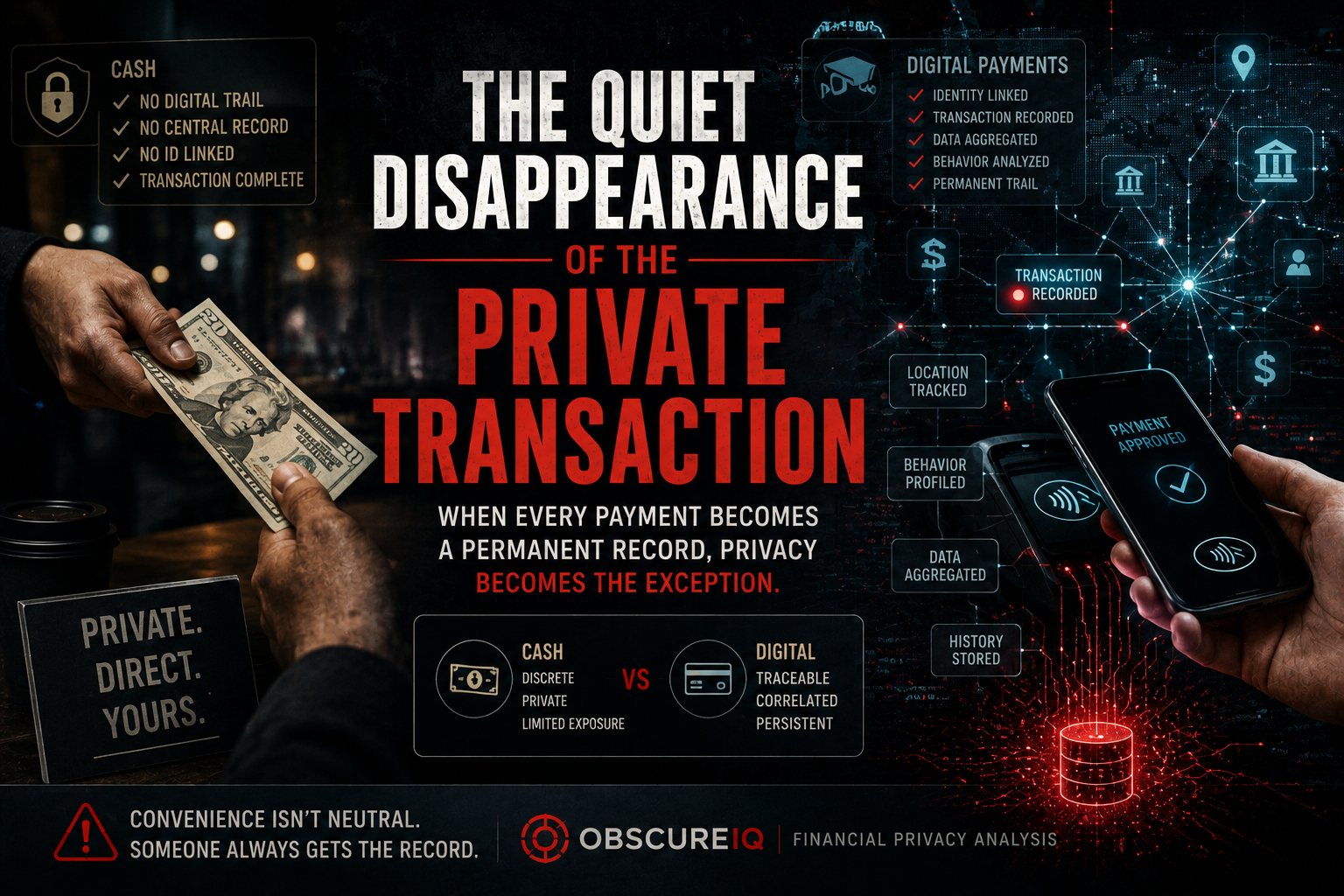
The Quiet Disappearance of the Private Transaction
There is a version of this story that focuses on criminals. It usually goes like this: cash enables crime, digital payments create accountability, and moving toward a cashless society is therefore progress.
That framing is not wrong. It is just incomplete. And the part it leaves out is the part that matters most.
Because the same infrastructure that makes financial crime harder to commit also makes ordinary life easier to monitor. Those two things do not come apart. You cannot build a system that creates a permanent, correlated record of every transaction and then decide whose records get examined and whose do not. The architecture does not work that way. Oversight does not work that way. And history suggests institutions do not work that way either.
The real question has never been whether opaque money can be abused. It can. The real question is whether that risk justifies building a world in which every ordinary transaction becomes a permanent record by default.
Cash Was Never Just About Money
Cash has always done something that most people never had to think about: it created practical distance between a person and a payment trail.
When you buy something with cash, the transaction is essentially complete at the point of exchange. No intermediary authenticates it. No database retains it. No system correlates it with your identity, your location, your purchase history, or your behavioral profile. The merchant gets paid. You get the good or service. The record that exists is minimal and local.
Not a bug. A feature.
That practical distance has historically mattered to journalists protecting sources, lawyers conducting privileged work, executives negotiating deals they cannot yet disclose, individuals navigating sensitive personal situations, and ordinary people who simply believe that what they buy is their own business.
Digital payments do not preserve that feature. They eliminate it. Every digital transaction passes through layers of authentication, logging, routing, and retention. The payment itself becomes legible — not just to the merchant, but to the issuer, the network, the acquirer, fraud and risk vendors, compliance systems, and any regulatory authority with jurisdiction over any of those entities. In some cases, that trail is accessible to parties the consumer never interacted with and cannot identify.
That is not a criticism of digital payments as such. Convenience is real. Speed is real. The benefits to commerce are real. The point is simply that something else was real too, and it is quietly disappearing.
The Shift Is Not Arriving as Policy. It Is Arriving as Friction.
Cash is not being abolished. In many places it remains legal tender, and laws exist requiring businesses to accept it. None of that is under serious threat in most jurisdictions.
What is changing is the environment around cash — the practical conditions that determine whether it functions as a normal payment method or a tolerated edge case.
Platforms are built without it. Apps do not contemplate it. Venues that technically accommodate it increasingly do so only through a conversion step: insert bills, receive a prepaid card, proceed. The cash is accepted. But the privacy properties of cash — the directness, the minimal record creation, the low traceability — are not preserved. They are absorbed by the digital system the cash is being routed into.
This is the mechanism worth understanding.
Cash does not have to be outlawed to lose its place in ordinary life. It only has to become inconvenient enough, awkward enough, exceptional enough that using it starts to feel like a statement rather than a choice.
At that point, routine transactional privacy has already been lost — not through any single decision, but through the accumulated weight of a thousand small frictions.
What “Managed” Means in Practice
When value moves as cash, it does not carry a unique identifier. It cannot generate a timestamp, a merchant record, a location signal, or an authorization event. It cannot be correlated across purchases, across time, or across institutions.
When that same value moves through any managed instrument — a prepaid card, a stored-value account, a digital wallet — all of that changes immediately. The instrument has an identifier. Each use produces metadata. That metadata passes through infrastructure that was built, explicitly, to authenticate, route, monitor, and retain.
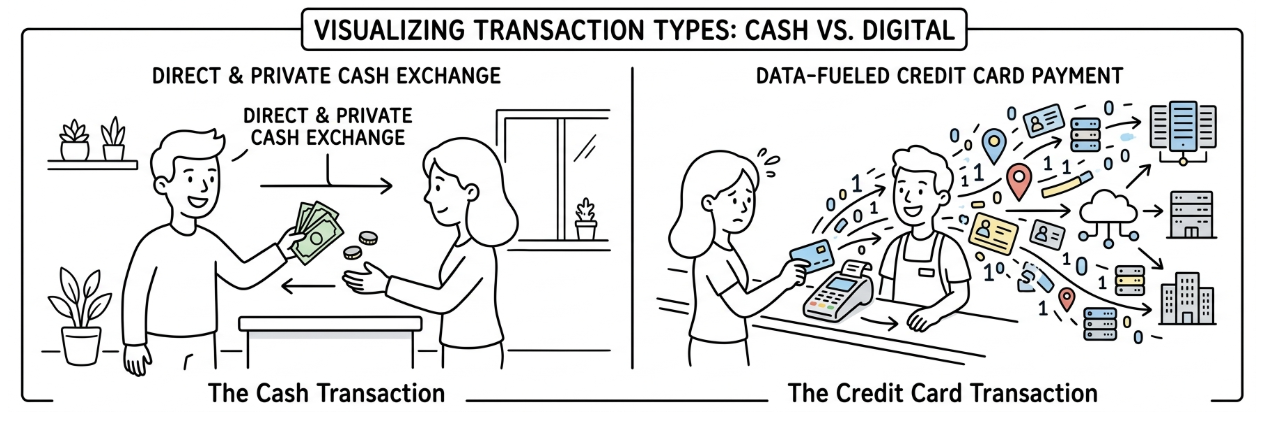
For most people most of the time, this is invisible and inconsequential. But for individuals whose transactions carry real-world stakes — whose counterparties, purchases, or locations could be used to construct a picture they have a legitimate interest in keeping private — the difference between cash and managed instruments is not technical. It is material.
A single transaction may seem trivial. A correlated record of many transactions, assembled across issuers, networks, and compliance systems, is something else entirely.
The Asymmetry Nobody Talks About
There is an asymmetry built into this transition that rarely gets named directly.
For institutions — commercial, governmental, regulatory — the move away from cash is almost entirely beneficial. Operations simplify. Records are automatic. Auditability improves. Oversight becomes easier to apply and easier to scale.
For individuals, the calculation is more complicated. Convenience improves, certainly. But something else is being traded: the practical ability to conduct ordinary transactions without those transactions automatically entering a system that is not under the individual’s control and does not serve the individual’s interests first.
That trade is not being made explicitly. It is not being negotiated. It is happening incrementally, through design choices and operational decisions that each seem neutral in isolation.
- Tap here.
- Use the app.
- Load the card.
- Create the account.
- Accept the terms.
Each step is small. The cumulative effect is a different social contract — one in which transactional privacy is no longer a default condition of ordinary life, but an exception that requires justification.
What a Serious Response Looks Like
This is not an argument for financial opacity. Anti-money laundering concerns are legitimate. Fraud is real. Illicit finance causes genuine harm, and oversight of financial systems serves important public interests.
The argument is narrower and more specific: a society serious about both security and liberty should be able to hold two things at once. Private transactions can be abused. And ordinary people still have a legitimate interest in conducting normal financial life without generating a permanent, correlated, institutionally accessible record of everything they buy.
Once the second principle is treated as expendable — once total payment visibility becomes the assumed cost of participation in modern commerce — the system stops distinguishing between targeted oversight and universal surveillance. That is not a hypothetical outcome. It is a structural consequence of the direction the infrastructure is heading.
The question for anyone advising individuals who have real stakes in transactional privacy is not whether cash will survive as a legal instrument. It probably will. The question is whether the conditions that made cash valuable as a privacy tool will survive alongside it — or whether cash will quietly become a legacy input for a digital system that was never designed to preserve what made it distinct.
About ObscureIQ
ObscureIQ works with clients to understand how payment systems, identity infrastructure, and digital records create real-world privacy risk — and what that means for individuals, organizations, and the policies that govern them.