The Three Layers of Surveillance Secrecy
A county policy telling deputies to describe license plate readers as county resources is not primarily a secrecy policy. It is an evidentiary policy, and it maps exactly where surveillance accountability breaks.
Wapello County, Iowa, operates four automated license plate reader cameras under a contract signed in late 2024. Its standard operating procedure, written in November 2025 and released through a public records request, instructs deputies not to mention ALPR use to vehicle occupants and not to mention it in a report or complaint unless absolutely necessary. If a report has to describe how the vehicle was identified, the policy supplies preferred wording:
“Using county resources, I discovered the suspect vehicle was bearing an Iowa plate.”
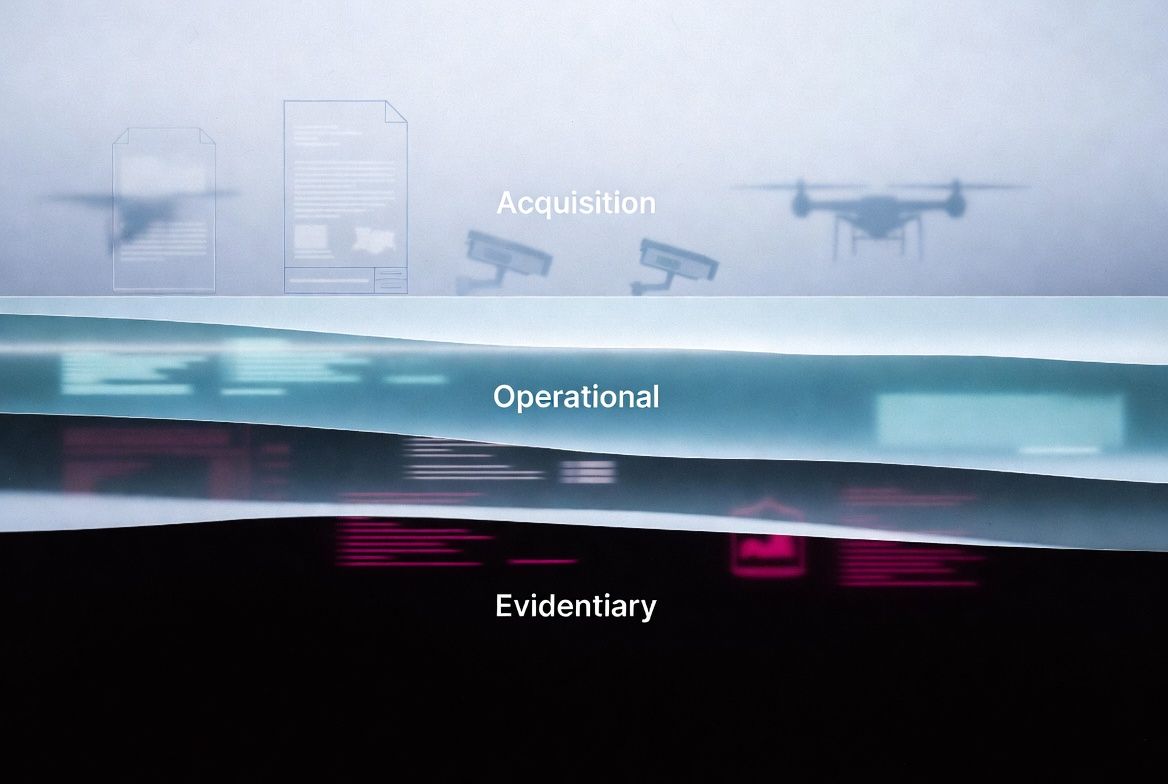
Wapello County ALPR standard operating proceduresRead that as an evidentiary instruction rather than a secrecy instruction. It governs whether the tool survives into the record through which its use could be challenged. Surveillance secrecy operates at three layers: how a capability enters an institution, how it is operated, and how its role is represented in a case. Nearly all oversight attention sits on the first two. Wapello County is a rare written specimen of the third.
Whether the practice is common is an open question. What makes this document unusual is not necessarily the behavior but that the concealment logic was written down. That is an empirical question, and it is answerable. The last section proposes how.
Three kinds of silence
Concealment, nondisclosure, and provenance laundering overlap, and treating them as one thing hands an agency an easy rebuttal. They separate cleanly.
- Tactical nondisclosure
- Do not alert a subject during an active investigation. Ordinary, widely accepted, and largely defensible. This is the ground the sheriff’s public defense stands on: methods and sources are withheld so subjects cannot work around them.
- Administrative opacity
- Do not document the capability’s use in records that are internally reviewable or publicly obtainable. Contestable, and usually fought through records law rather than in court.
- Evidentiary concealment
- Do not disclose the source to prosecutors, defense counsel, or the court. This is the serious category, and it is the one this policy reaches when it governs reports and complaints rather than roadside conversation.
The roadside instruction is unremarkable. The reporting instruction is the entire argument.
The Stingray inversion
With cell site simulators, secrecy was substantially imposed from outside. Federal nondisclosure agreements executed as a condition of purchase gave agencies a formal basis for concealment, required notice of discovery requests, and in some instances led prosecutors to abandon cases rather than let a court compel disclosure. Those agreements did not excuse everything. Agencies and prosecutors still made consequential local choices about legal process and about how far the secrecy extended, including in warrant applications. But there was an external document to point at.
Wapello County has no such document. Four cameras, a sheriff’s office, and a locally authored policy that chose concealment on its own. That is a preference rather than a constraint, and it is harder to attack because there is no single agreement at the center of it.
Provenance laundering
The policy adopts the logic of parallel construction: preserve the downstream action and remove the upstream surveillance source from the narrative. The document says as much, directing deputies to treat the reader’s output like intelligence, a lead that was verified and acted on.
The verification claim is weaker than it sounds. Running the plate manually retrieves registration data attached to a plate the reader already supplied. It does not independently establish that the vehicle was in that place, and it does not test whether the system correctly transcribed that plate on that vehicle at that moment, which is the error the technology is actually capable of producing. The check confirms the record. It does not confirm the read.
Underneath the general idea there are four distinct methods, ordered here by increasing sophistication and decreasing detectability. Each is separately identifiable in a written policy, which makes the practice measurable rather than merely arguable.
- Omission. The surveillance source is simply absent from the report.
- Euphemism. The source is replaced by a generic descriptor: county resources, investigative means, department databases.
- Substitution. A later conventional action is presented as the origin of the fact.
- Attenuation. The tool is acknowledged but characterized as an insignificant lead, which forecloses inquiry without concealing anything.
The framework
Collapsing the three layers is why the public debate keeps stalling. A win at one layer gets described as a win overall, and the layer that decides case outcomes goes untouched.
Stratigraphy of concealment
How the capability arrives
Contracts signed without council debate, grant funding, vendor-drafted memoranda, no-cost pilots on leased equipment that never appears as a purchase.
Procurement law, surveillance technology ordinances, mandatory council approval, disclosure of leases and donations.
Budget documents, contracts, lease terms, grant awards. Reasonably well mapped already.
How the capability is used
Who queries, on what predicate, retained how long, shared with which outside agencies, logged by whom. Practice varies widely between jurisdictions.
Audit logs with defined custody, query justification requirements, retention and sharing limits, statutory impact and use policies.
Agency operating procedures and mandated policy filings. Least mapped of the three.
How the capability disappears
The tool’s role omitted from, or renamed in, the record that reaches a prosecutor and a courtroom. This is where county resources lives.
Brady where the information is favorable and material, discovery motions, suppression where a violation attaches, sanction where a duty is breached. Pressure points, not guarantees.
Defense counsel who already knows the tool was involved. Which is the problem.
Cross-cutting: reviewabilityAn accurate report still does not guarantee meaningful review. Logs may sit in vendor custody, records may fall under categorical exemptions, retention windows may close before litigation opens, and affected people may never receive notice. Reviewability is not a fourth layer. It is the test applied at each of the three, and it is where a complete record can still be an unreachable one.
The load-bearing fiction
Investigative lead, not evidence is self-sealing. Because the plate read is never the thing adjudicated, its error rate is never tested in court, only asserted. Because it is never tested, there is no reliability standard to violate. Because there is no standard, describing the system vaguely in a report reads as ordinary discretion rather than suppression of anything a defendant was entitled to.
Attack the phrase and all three layers become contestable at once. Leave it intact and each layer gets defended by pointing at the others: the contract was public, the queries are logged, the lead was verified. Three partial answers that never meet.
The same vendor, one layer up
None of this stays on the ground. Flock acquired the drone-as-first-responder company Aerodome in October 2024 for more than $300 million and now markets an aerial platform that reads license plates from as far as 2,000 feet and feeds the same databases and hot list alerts as its fixed cameras. The drone is a mobile plate reader. Every argument above extends to aerial capture, sold by the same company, under the same euphemism.
Drone programs also supply the clearest evidence for each layer.
Acquisition. Fort Worth launched its program in June 2026 as a one-year, no-cost pilot in which the city owns neither the cameras nor the drones, because the vendor leases the equipment. A free pilot with no asset purchase clears most procurement thresholds by design. That is Layer 1 opacity requiring no concealment at all.
Operation. New York is the strongest case precisely because disclosure there is statutory. Auditing compliance with the city’s surveillance transparency law, the Department of Investigation found the police department’s drone impact and use policy contained inaccuracies about deployment supervision and reporting structure, omitted several drone capabilities, and misstated how flight logs were maintained. Custody of the logs was itself a finding. The same oversight office has separately criticized the department for boilerplate policy language, for grouping technologies under a single policy to avoid technology-specific review, and for adding new tools to existing policies to evade public comment. A mandated regime, audited annually, still produced an inaccurate drone policy.
Evidence. Chula Vista, which ran one of the first such programs in the country, produced the figures that matter most.
Roughly a third of flights generate no narrative record anywhere. That is not omission by instruction. It is a capability operating structurally outside the document layer where challenges get made, and it is the evidentiary layer expressed as a percentage.
Reviewability. When a local journalist requested one month of that footage in 2021, the city denied the entire request by claiming all drone video was categorically exempt as investigative records. In Castañares, the California Fourth District held in December 2023 that drone footage is not automatically exempt, sorting it instead by whether particular footage actually belongs to an investigation, and the California Supreme Court declined review in April 2024. On remand the trial court ordered roughly two dozen videos released with portions blurred, the city asked the Supreme Court to weigh in a second time, and the footage was eventually disclosed. In October 2025 the city was ordered to pay the requester’s counsel just under $500,000 in fees.
Note the shape of the defense. The city argued that reviewing and redacting the footage would have consumed one employee for roughly 229 workdays, and said its refusal reflected not a desire for secrecy but a concern that the program could not survive those costs. Take that at face value and it is still the reviewability problem stated plainly: the volume of collection is itself the barrier to inspecting it. Four years of litigation and about half a million dollars, for one month of video.
A proposed lifecycle
The sequence recurs often enough to be worth stating as a model, not a law.
- A capability arrives that is cheap, high volume, and legally untested.
- A concealment posture forms before any reliability standard exists, because concealment is what defers adjudication.
- Deferred adjudication removes one of the principal constraints on scale. Falling cost, grant funding, vendor financing, and political demand supply the rest.
- Scale eventually produces a case too visible to suppress, at which point the posture either collapses or gets codified.
Baltimore ran the cycle twice, and the two rounds are worth keeping separate because they illustrate different layers.
In January 2016 a contractor began flying camera-equipped aircraft over the city. The flights were paid for by private philanthropy routed through a community foundation, which kept the program off the municipal books entirely: no procurement, no council authorization, no public notice. The mayor said she learned of it only shortly before Bloomberg Businessweek disclosed it that August. That is Layer 1 at its purest, and Layer 2 failed alongside it. Record keeping was poor enough that subsequent reporting could not establish whether the footage contributed to closing even one of roughly a hundred homicide cases during the flights.
The 2020 reboot was the opposite: openly approved by the Board of Estimates, again privately funded, and litigated in public. In June 2021 the Fourth Circuit, sitting en banc, held that warrantless access to data allowing police to reconstruct the whole of a person’s movements was a search violating the Fourth Amendment. The program had already been discontinued, but the case was not moot because the department still held the data it had found useful. Note which round produced the ruling. Visibility is what makes adjudication possible, which is precisely what a concealment posture defers.
Cell site simulators took roughly a decade to reach that point. Ground-based and airborne plate readers are mid-cycle, and deployment density is arriving considerably faster than the litigation.
Coordinated secrecy, reproduced secrecy
The useful contrast is not federal against local. It is coordinated against reproduced.
Stingray secrecy was substantially coordinated: federal agreements, vendor restrictions, prosecutorial practice, sealed filings, and judicial unfamiliarity working in the same direction. Plate reader and drone concealment is increasingly reproduced: local policy, shared training material, model language, and institutional imitation. Reproduced secrecy has no chokepoint at the policy layer.
Two qualifications. Vendors are themselves a centralizing force, supplying model policies, training material, and messaging guidance that propagate language the way a template does. And a sufficiently broad ruling can reach an entire jurisdiction at once, as Castañares did across California. What no single records disclosure or vendor concession is likely to reach is the thousands of local documents reproducing the practice.
What should be built
Every one of those operating procedures is a public record. Nobody has assembled them, which means the concealment posture of American plate reader and drone deployment is currently unmapped and entirely mappable. Records requests at volume, coded consistently, would answer the question this piece cannot.
Coding variables per agency policy
- Subject notification: required, discretionary, prohibited, silent
- Report disclosure: required, conditional, discouraged, prohibited, silent
- Euphemism supplied: yes, no
- Concealment method: omission, euphemism, substitution, attenuation
- Prosecutor notification: required, conditional, silent
- Court disclosure: required, conditional, silent
- Query justification: pre-query, post-query, none
- Hit confirmation: mandatory, recommended, absent
- Exculpatory hit handling: defined, absent
- Audit retention: defined, discretionary, absent
- External sharing: restricted, logged, unrestricted, silent
- Log custody: agency, vendor, shared, unclear
Coded that way, the corpus measures more than secrecy. It shows how concealment interacts with reliability testing, log custody, and data governance, and it establishes whether Wapello County is an outlier or a specimen.
The protective read
For principals under digital executive protection, the exposure is not that a vehicle gets queried or a property gets overflown. It is that the trace may exist inside agency or vendor systems while remaining absent from every record the subject would ordinarily receive.
Make it concrete. A drone launched on a neighbor’s call overflies a principal’s property, vehicles, and occupants. On the Chula Vista figures there is roughly a one in three chance that no report describes the flight at all. The footage sits in agency or vendor custody, and the agency’s first instinct is a categorical exemption.
Two consequences for posture. Absence of record cannot be read as absence of collection. And requesting the obvious artifact will not surface the others, because the obvious artifact was written not to point at them. Where a trace is likely to exist but not to be indexed, the only durable protection is reducing what the trace can show.
The ordinary record is being written so that nobody knows which extraordinary records to request.
Wapello County reporting: Jason Koebler, 404 Media, 4 August 2026. The standard operating procedure was obtained by a 404 Media reader through a public records request. Earlier 404 Media reporting covered vendor guidance to agencies on promoting the technology.
Chula Vista flight figures and the Castañares procedural history: CBS 8 San Diego, Times of San Diego, NBC 7 San Diego, and La Prensa San Diego; Castañares v. Superior Court (2023) 98 Cal.App.5th 295, review denied April 2024; fee award reported October 2025. Baltimore: Bloomberg Businessweek, August 2016; Baltimore Magazine and The Appeal on the 2020 reboot; Leaders of a Beautiful Struggle v. Baltimore Police Department, 2 F.4th 330 (4th Cir. 2021) (en banc). New York findings: NYC Department of Investigation, Office of the Inspector General for the NYPD, and Brennan Center analysis of the city’s surveillance transparency law. Vendor drone acquisition and capability figures: company announcements and contemporaneous trade and local reporting, including Fort Worth Report, June 2026.
ObscureIQ provides privacy intelligence and digital executive protection for principals, family offices, and government clients.