Domain History: The Durable Record
Domain history is the durable record of those transactions and the identities behind them. It persists beyond intent, cleanup, and simple redaction. That persistence creates leverage.
A Sexy Domain
A Sexy Domain: A public official purchased a sexually suggestive domain through a registrar's privacy service, assuming the ownership would remain hidden. It did not.
The domain had been registered earlier without privacy protections. That first record included a personal email address and administrative contact tied directly to them. Later redaction changed what was visible. It did not erase what had already been captured.
When the domain later appeared during an unrelated inquiry, those early ownership records were already preserved.
Every domain accumulates historical residue, whether the owner intends it or not. Ownership details. Contacts. Infrastructure decisions. Mistakes. Attempts to hide. Those records persist long after a website changes hands or a brand cleans itself up.
For investigators, domain history is a reconstruction tool.
For high-risk individuals, it is often an unrecognized liability.
This report examines who preserves that memory, where it fragments, and how reliably it can be reconstructed.
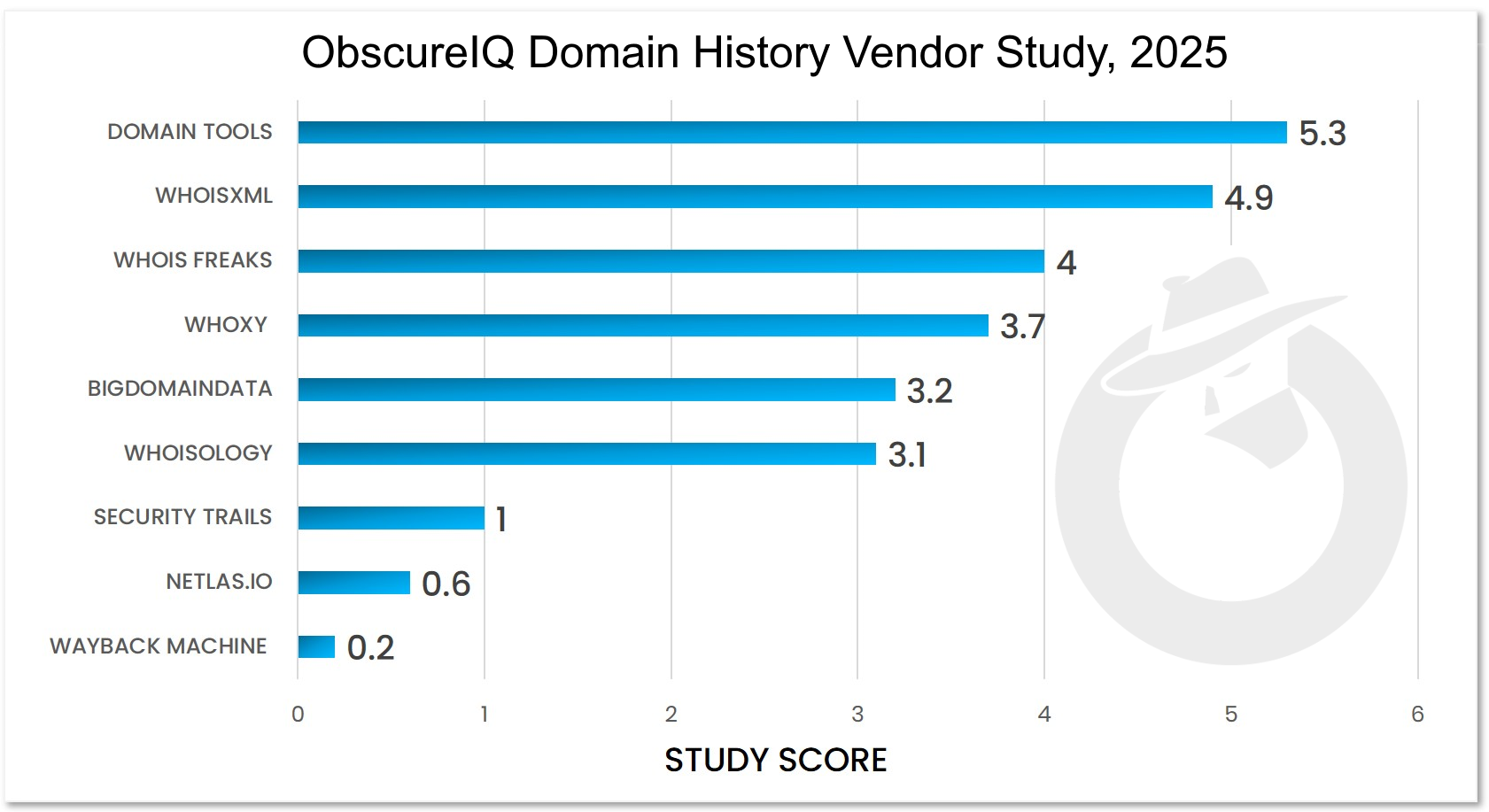
Why Domain History Matters More Than You Think
Domain ownership records function like property deeds that never fully disappear, even when obscured.
At minimum, historical WHOIS data can expose:
Legal names and organizations
Personal email addresses and phone numbers
Physical mailing addresses
Registrar behavior over time
Moments when privacy protections were added too late
For individuals and companies that operate quietly or defensively, this matters because domain history frequently reveals the pre-privacy state.
Most people obscure their data only after the domain is live. That first snapshot is often the most revealing.
The Problem With "Just Look It Up"
Anyone who has tried to research a domain quickly learns that there is no single record to consult:
- Different tools show different timelines.
- Dates do not align.
- Records appear and disappear without explanation.
- Some platforms quietly mirror others.
Until now, there has been no systematic comparison of these vendors.
We conducted a structured, side-by-side evaluation using the same domains across platforms to understand how they differ in practice.
How This Study Was Conducted
Timeframe
Between November and December 2025, ObscureIQ analyzed domain history across nine platforms using six carefully selected domains.
Test Domains
The domains were chosen to stress the system, not flatter it, and to expose common failure modes:
- A large US apparel company as a baseline
- A domain linked to criminal activity
- A privacy-focused organization
- A former porn site whose owners attempted erasure
- A currently active adult site
- A personal domain lost and repurposed by monetizers
Platforms Evaluated
Scoring Criteria
Each vendor was scored on:
- Volume of records returned
- Oldest and newest dates
- Timestamp presence
- DNS history
- Usability and value
Data Access and Tier Considerations
Several platforms evaluated in this study offer multiple data tiers, including higher-cost packages that provide more frequent or more current data collection.
Our testing did not include every available premium or real-time feed.
In particular, DomainTools and WhoisXML API both offer expanded datasets that would likely increase coverage of very recent events. Access to those feeds would have required substantially higher spend and, in many cases, separate contracts.
This was intentional.
The study reflects the level of access most investigators actually work with, including trial access and lower-tier plans. In practice, historical depth is often prioritized over real-time visibility. When budgets are constrained, access to current feeds is usually purchased last.
As a result, this evaluation should be read as an assessment of practical, commonly available access, not a claim about the maximum capabilities of any platform under ideal conditions.
The Headline Result
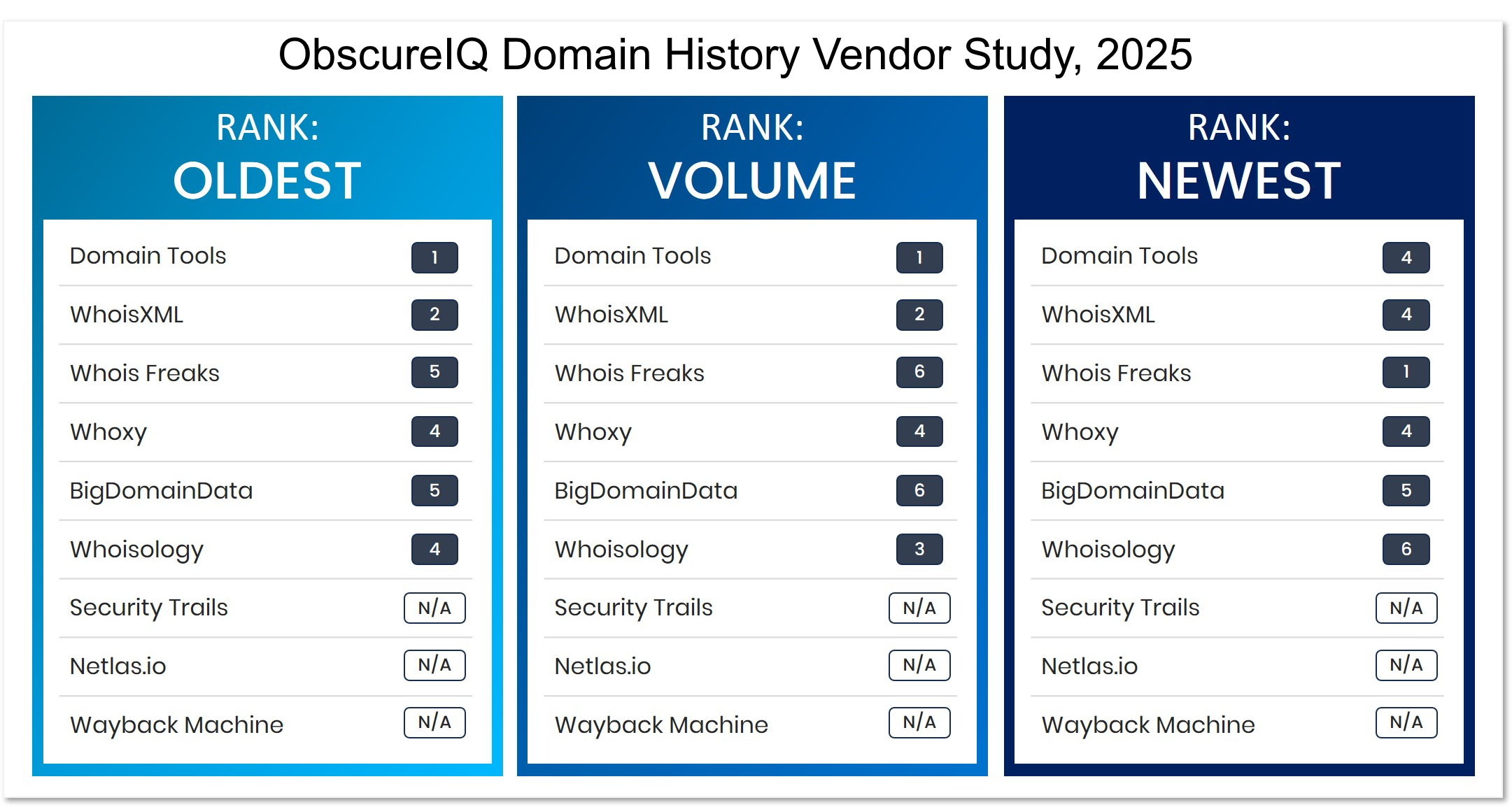
The Rest of the Field, Clearly Ranked
Strong Second Tier
Specialists and Edge Cases
Aggregators and Subsets
Patterns emerged:
- Whoisology appears to pull heavily from WhoisXML
- BigDomainData appears closely tied to Whoxy
Useful, but rarely additive.
Not Domain History Tools
What No Vendor Does Well
This section matters because the gaps are structural, not vendor-specific, and cannot be solved by switching tools.
Ownership Changes Are Poorly Captured
No platform reliably captures full domain ownership change events.
In our estimation, there are two main reasons:
As a result, ownership transitions tend to be inferred indirectly, if at all.
No Confidence Scores or Provenance
No platform provides confidence scoring or clear provenance for historical records.
In practice, this means:
- Users cannot tell whether a record is primary, derived, mirrored, or inferred.
- Conflicting records are presented without explanation.
- Older data is treated as equally reliable as newer data.
The exception is the Wayback Machine, which clearly identifies the archive source. Unfortunately, its records rarely include ownership detail.
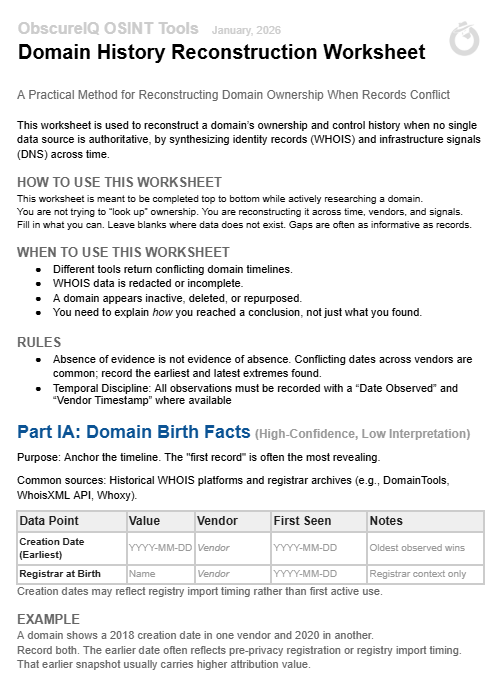
Analysts using the Domain History Reconstruction Worksheet should attach the completed worksheet when presenting a final attribution assessment.
TLS History Is Largely Absent
Historical TLS and certificate data is generally absent from traditional domain history and WHOIS-focused platforms.
This does not mean TLS history is unavailable.
It increasingly exists within infrastructure intelligence, attack surface management, and threat hunting platforms that track certificate reuse, host bindings, and service exposure over time. These tools operate outside the domain history category and are designed to model technical behavior rather than registrant identity.
This distinction matters. TLS history is often more effective for identifying shared control or reuse patterns, while WHOIS history remains more useful for attribution tied to registration events and declared ownership.
The decline of WHOIS visibility has accelerated a shift toward infrastructure-based attribution. Passive DNS and TLS certificate history increasingly function as proxies for ownership when registrant data is redacted.
This shift does not eliminate the value of domain history. It changes how it must be interpreted and what it must be paired with.
Some services expose current certificate information. A few provide cursory metadata. None reconstruct certificate history or rotation events in a way that supports attribution or timeline analysis.
This is a blind spot across the market.
Coverage Is a Fraction of Reality
Even the strongest platforms captured only a small fraction of true domain history.
This limitation appears tied to the same root causes:
- Partial visibility into registrar systems
- Inconsistent historical retention
- Dependence on external data sources with unknown completeness
Domain history is not a single ledger.
It is a set of overlapping, incomplete memories, each preserved by different actors, using different collection methods, at different moments in time.
Some records exist because they were captured during brief windows of exposure. Others persist because they reflect technical behavior rather than declared ownership. Still others exist only because data was shared, resold, or retained elsewhere.
This is why single-source answers fail. Domain history must be reconstructed, not retrieved.
Operationalizing Domain Memory
The findings in this report point to a consistent pattern: domain history persists across vendors, even when identity data is redacted.
To operationalize this insight, ObscureIQ developed a standardized analyst worksheet that forces temporal discipline, cross-vendor triangulation, and explicit confidence scoring.
The ObscureIQ Domain History Reconstruction Worksheet
The ObscureIQ Domain History Reconstruction Worksheet is the internal framework used to reconstruct domain history when no single source is authoritative.
It is designed for investigators, analysts, and expert testimony contexts where partial records and conflicting timelines are the norm.
Why This Matters
For investigators, these gaps mean no single source is authoritative.
Cross-referencing multiple sources is essential for complete attribution.
For high-risk individuals, absence of evidence is not evidence of absence.
What you do not see may still exist elsewhere.
What This Means
What This Means for High-Risk Individuals
If you own or have owned domains personally, you should assume:
- Your earliest registration data is preserved somewhere.
- Privacy added later does not remove earlier exposure.
- Attempts to erase history can backfire by creating visible gaps.
- Your domain footprint may outlive your brand strategy.
Domain history is often how investigators connect identities across time.
Ignoring it does not make it go away.
What This Means for Investigators
If you are doing serious OSINT or attribution work:
- Single-vendor research is insufficient.
- Data overlap is common. True independence is rare.
- DomainTools remains the highest-yield entry point.
- WhoisFreaks can surface newer activity others miss.
- DNS history should be treated as corroboration, not attribution.
Memory lives in fragments. Your job is synthesis, not certainty.
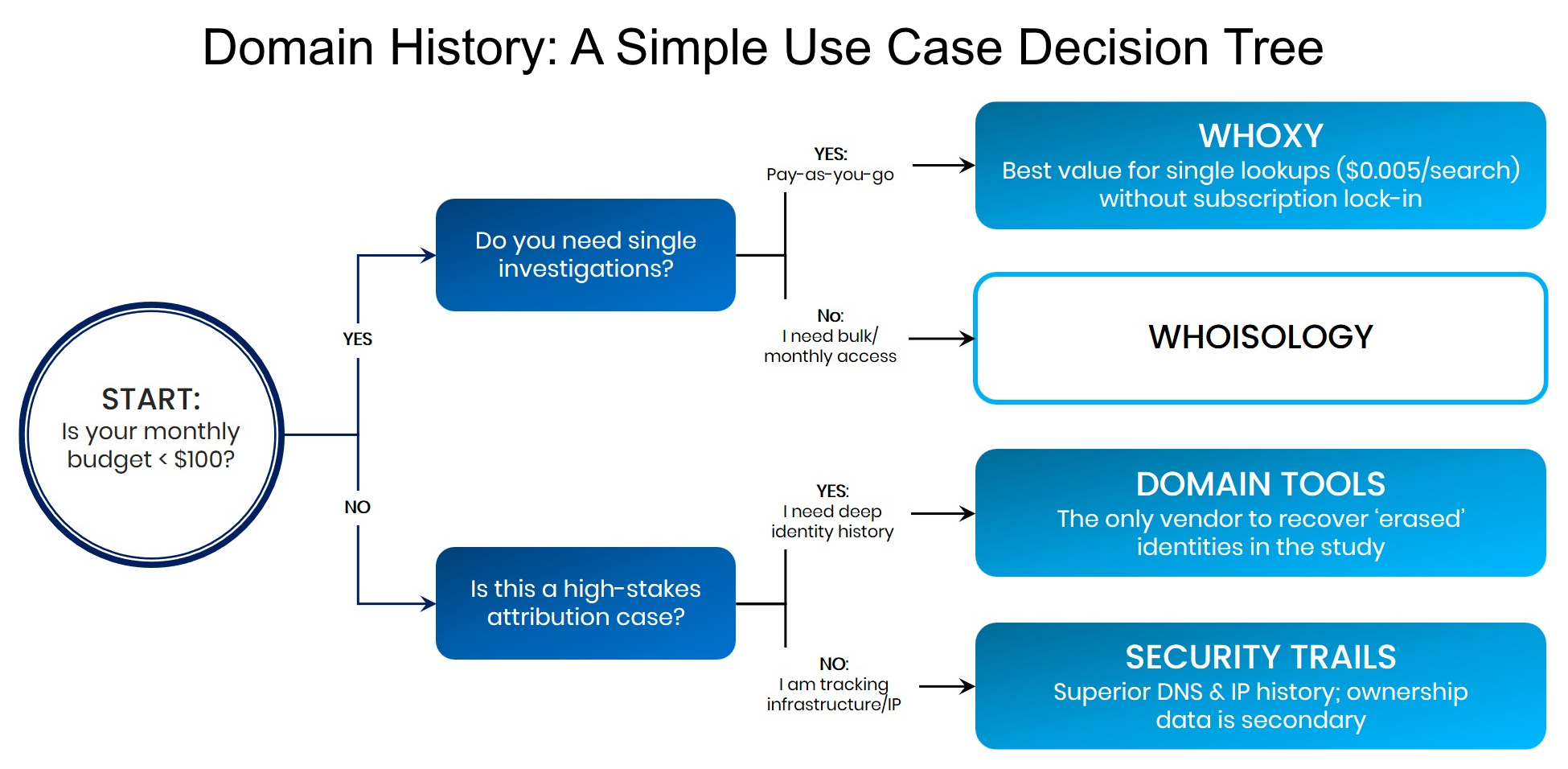
Choosing the Right Tool by Scale
| Search Volume | Economy | Medium | Premium | Ultra-Premium |
|---|---|---|---|---|
| Under 4,000/month | Whoxy | Whoisology | WhoisXML API or DomainTools | - |
| 4,000 to 1 Million | Whoxy | WhoisFreaks | SecurityTrails or WhoisXML custom | DomainTools |
| Over 1 Million | WhoisFreaks | Whoxy or BigDomainData | DomainTools |
A Note on Methodology and Transparency
ObscureIQ obtained legitimate trials for all platforms evaluated and engaged with vendors when possible.
We welcome corrections, challenges, and methodological discussion.
This space benefits from scrutiny.
What Comes Next
The appendix to this report goes deeper rather than wider.
It contains individual, vendor-specific evaluations for each platform included in the study.
Each report examines how the platform actually behaves in practice, not just what it claims to offer.
Appendix reports cover:
- Depth and age of historical records
- Data consistency, gaps, and failure modes
- Strengths and limitations by use case
- Pricing and cost per usable historical event
- Situations where the platform performs best
These evaluations are intentionally detailed.
They are meant to support tool selection, investigative planning, and budget decisions.
Readers looking for a market overview can stop here.
Readers who need to work cases, justify spend, or understand where each tool breaks down should continue into the appendix.
Continue to Vendor Deep Dives
Detailed evaluations for each domain history vendor, including pricing, limitations, and real-world performance.

ObscureIQ Insight
Domain history is not about the past.
It is about what refuses to disappear once recorded.
If your risk model assumes erasure is possible, you are already operating on bad data.
Second-Order Implications
The Bifurcation of Domain Intelligence
The domain intelligence market is splitting into two distinct disciplines.
Identity and registration data
One branch remains focused on identity and registration data.
This includes historical WHOIS records, contact information, and declared ownership.
These datasets remain valuable largely because of their depth.
Their future usefulness, however, is constrained by privacy regulation and ongoing redaction.
Infrastructure behavior
The second branch is increasingly focused on infrastructure behavior.
DNS history, hosting transitions, certificate reuse, and service fingerprints offer continuity even when registrant data disappears.
These signals are harder to redact and often persist longer than ownership records.
Neither discipline is sufficient on its own.
Each answers a different question.
From Lookup to Synthesis
As domain history fragments, investigative certainty shifts.
Ownership can no longer be stated as a single fact.
Instead, it is reconstructed across timelines and signals.
One platform may show historical registrant data.
Another may show infrastructure movement.
A third may reveal certificate reuse or service continuity.
The result is not a clean answer, but a composite view.
This requires a methodological shift.
Domain research is no longer a lookup exercise.
It is a synthesis problem.
Automated systems increasingly attempt to fuse these signals, but human judgment remains essential when timelines conflict or data gaps appear.
The Limits of Erasure
Privacy regulation has reduced the visibility of declared ownership.
It has not eliminated historical persistence.
As redaction expands, historical records are more likely to be obscured than deleted.
Identifiers may disappear while timestamps, technical relationships, or infrastructure artifacts remain.
This creates uneven timelines rather than clean erasure.
In this environment, non-PII signals become more important, not less.
Infrastructure history increasingly functions as the connective tissue when identity data fades.
The future of domain attribution belongs to those who can synthesize fragments, not those who expect clean answers.