Threat Surface Index

How ObscureIQ Calculates Your Risk Score

Your Threat Surface Index (TSI)

Threat Surface Index

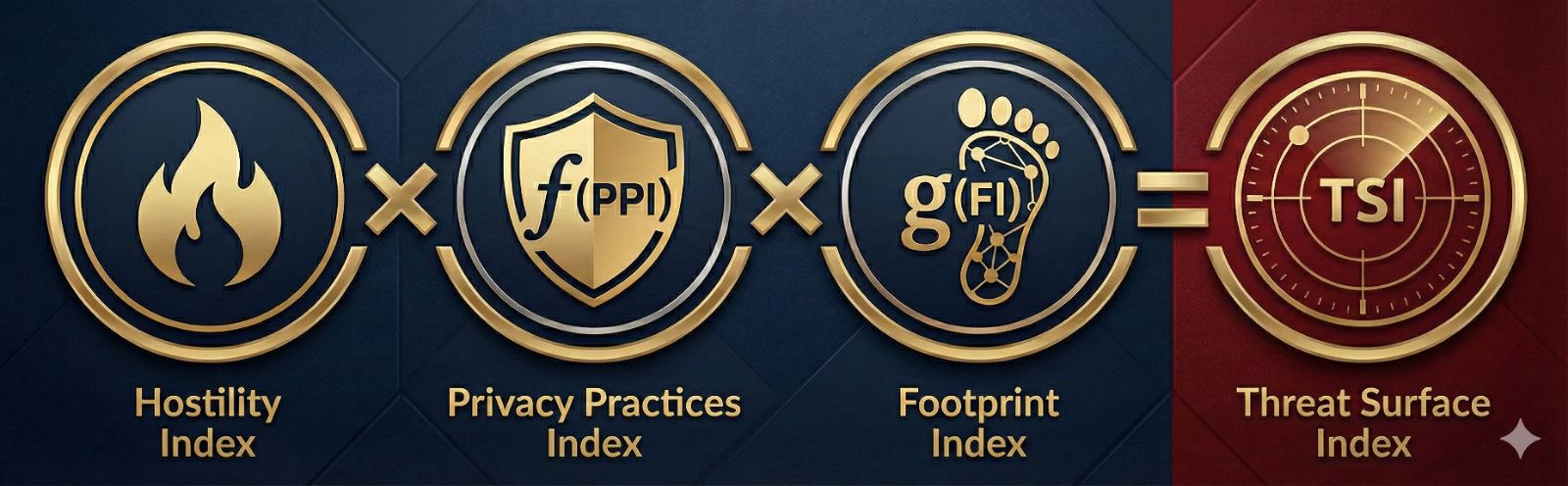
Your Threat Surface Index (TSI) is a single number that captures how likely you are to attract trouble and how much damage it can do.

It blends three factors:

Hostility Index (HI)
Privacy Practices Index (PPI)
Footprint Index (FI)

These combine into one score:

TSI = (HI ÷ 10) × f(PPI) × g(FI)

You do not need to love math. The key idea is simple:

  • Hostility sets your baseline risk.
  • Good privacy practices pull the score down.
  • A large exposed footprint pushes the score up.

Quick Overview for Clients

1

Hostility Index

“The risk of being who you are.”

Measures how much adversarial pressure you face.

Factors we look at:

  • Public notoriety and controversy
  • Sensitivity of your role
  • Recent media spikes
  • Active litigation
  • Extremist or fringe chatter about you
  • Known or credible threats
  • Election or event cycles that raise your profile

Input source: A structured Hostility survey and threat research.

👉 [Take the Hostility Index survey]

2

Privacy Practices Index (PPI)

“The risk of how you live and work online.”

Measures behavioral exposure.

What we look at:

  • Device hygiene and patching
  • Password and MFA habits
  • Messaging and email choices
  • Data minimization habits
  • Travel and venue security routines
  • Household and staff practices
  • Vendor and app choices

Input source: A detailed Privacy Practices survey.

Where to start:

👉 [Start a Privacy Practices assessment]

PPI is treated as a brake in the math:

We normalize your PPI score, then apply
f(PPI) = 1 / (1 + PPI_norm)

Better practices lower PPI_norm, so f(PPI) gets closer to 1.

Risky behavior pushes PPI_norm up and drags f(PPI) down, which lowers your TSI.

In plain terms: good habits are rewarded. Bad habits stop you from ever being “low risk,” even if no one hates you.

3

Footprint Index (FI)

“The risk of what leaks and what can be used against you.”

Measures your public digital footprint.

What we look at:

  • People search and data broker listings
  • Breached credentials and dark web hits
  • Public OSINT surface
  • Property, DMV, voter and corporate linkages
  • Image, license plate and facial exposure
  • Prior doxxing or leak events

Input source: ObscureIQ Footprint Audit.

Where to start:

👉 [Schedule a Footprint Audit]

FI is treated as an amplifier:

We normalize FI and apply
g(FI) = 1 + FI_norm

Cleaner footprint keeps g(FI) close to 1.

Large exposed footprint pushes g(FI) above 1 and multiplies your risk upward.

4

Threat Surface Index (TSI)

Your final TSI score blends all three:

TSI = (HI ÷ 10) × f(PPI) × g(FI)

Typical ranges:

  • 2 – 6: Low risk
  • 7 – 15: Moderate risk
  • 16 – 20: High risk
  • 25+: Extreme risk

Often celebrities in controversy, executives in hot litigation, or principals with recent threats.

You receive:

  • A single TSI number.
  • A risk band (Low / Moderate / High / Extreme).
  • A breakdown that shows how HI, PPI and FI are pushing the score up or down.
  • A prioritized set of remediation steps.

How the math actually works

Hostility Index (HI)

Scale: 0 to 159 points.

We divide HI by 10 to set your baseline risk factor.

Example: HI 92 → 9.2 baseline.

Privacy Practices function f(PPI)

We collect your raw PPI survey score.

Normalize it relative to our client population.

Compute f(PPI) = 1 / (1 + PPI_norm).

If you are disciplined with privacy, f(PPI) stays closer to 1.

Sloppy practices pull f(PPI) down and stop your TSI from ever being low.

Footprint function g(FI)

We compute your raw FI from the audit.

Normalize it across our client base.

Compute g(FI) = 1 + FI_norm.

A smaller footprint keeps g(FI) near 1.

Large exposed footprint pushes g(FI) above 1 and magnifies your TSI.

Final TSI

Multiply the three factors:

Example:

HI = 96 → 9.6

f(PPI) = 0.8

g(FI) = 1.4

TSI = 9.6 × 0.8 × 1.4 ≈ 10.7 (Moderate–High)

Why we use this structure

Hostility captures who you are and why anyone would target you.

PPI rewards habits you can control.

FI captures what is already out there and weaponizable.

The final TSI balances intrinsic risk, lifestyle choices and data exposure into one index that can move over time as we improve your posture.

Sample Hostility Index Output

Hostility Index Report

Client: Sample Executive

Date: [Month] [Day], [Year]

Hostility Index Score

HI Score: 104 / 159
Risk Tier High
Percentile 84th percentile among ObscureIQ executive clients

Drivers of Hostility

Role sensitivity

Public-facing CEO of a controversial company.

Regular media exposure.

Recent media spikes

Two negative news cycles in the last 90 days.

Active social media campaigns criticizing company decisions.

Litigation and regulatory activity

Named party in an ongoing civil lawsuit.

Under current regulatory scrutiny.

Extremist or fringe chatter

Low but nonzero mentions on fringe forums.

One historical threat report from three years ago.

Category Breakdown

(0 = none, 5 = extreme)

Public notoriety 4 / 5
Current controversy 4 / 5
Role sensitivity 5 / 5
Recent negative media 4 / 5
Credible threats 2 / 5
Extremist/fringe chatter 2 / 5
Litigation / regulatory heat 3 / 5
Upcoming catalysts (earnings, elections, deals) 3 / 5

Interpretation

This client sits in a sustained high-hostility band.

Risk is driven more by public role and controversy than by direct threats.

Short term volatility is expected around key events and news cycles.

Prescribed Actions to Lower HI

  • Narrative and media management plan for the next 6–12 months.
  • Tight coordination between legal, PR and security around litigation milestones.
  • Continuous threat monitoring across mainstream, fringe and dark web channels.
  • Clear policies on social media engagement to avoid escalating hostile narratives.

Together those three steps generate your Threat Surface Index and the remediation roadmap that follows.