JFK's Arithmetic
A novella in development. What happens when a man from 1963 meets the information environment of 2026 — and coins a better word for the thing that runs it.
The fiction track of the Narrative Warfare Series. The other documents map the machinery. This one places a man inside it.
"The country remembered him. He had not been there."
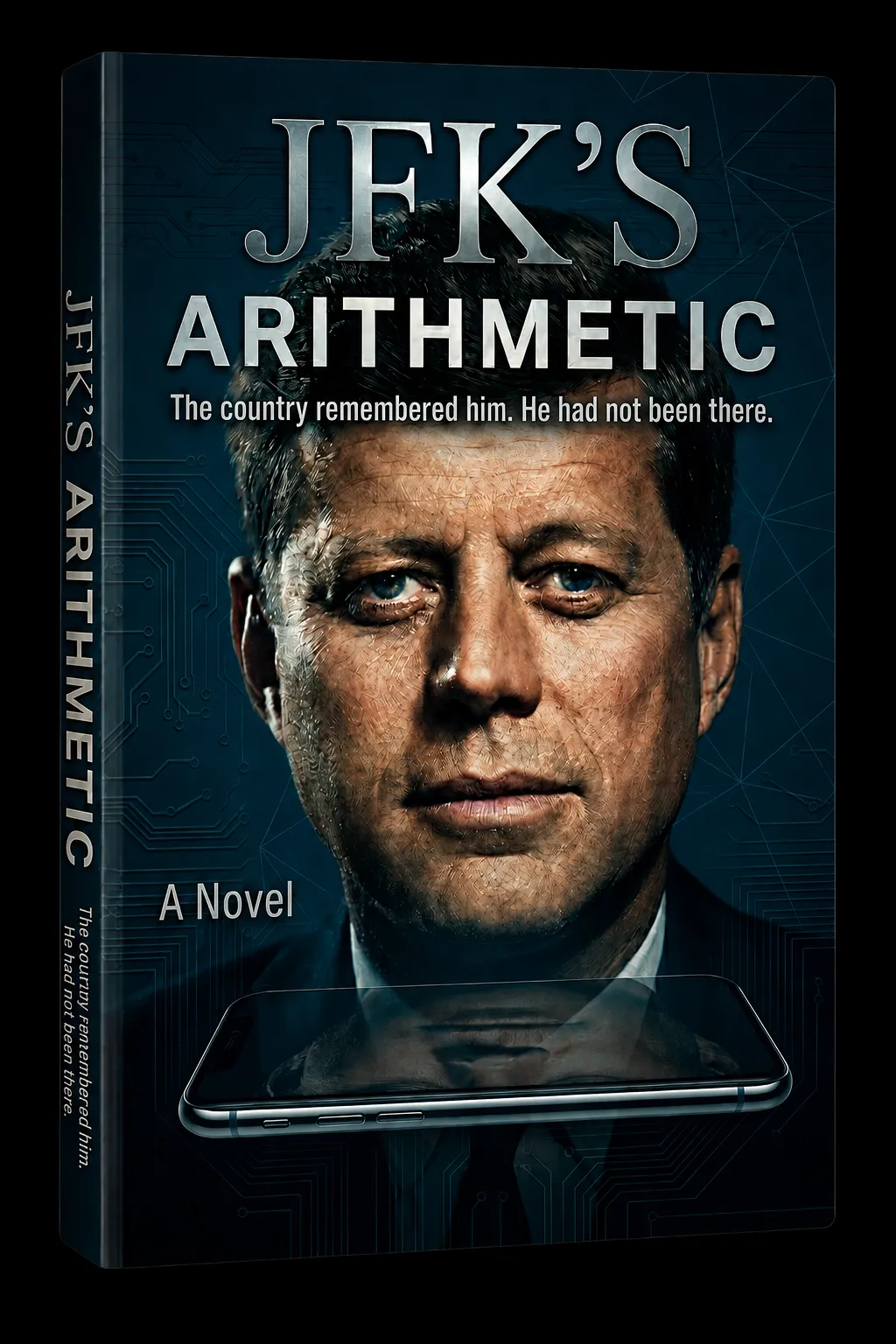
In 2026, a man wakes in a Washington hospital.
His face is John F. Kennedy's. Not a likeness. The face. Without the years that should have been in it. Without the wound.
He is told he is the President. He is told he won the election. He does not remember any of it.
The other tracks in this series map the machinery. How belief forms in the first seventeen minutes. How coordinated narrative environments operate. How modern information systems shape perception at scale.
Those tracks are written for operators and analysts.
JFK's Arithmetic is written for everyone else.
It does what doctrine cannot. It places a man who has never lived inside the modern information environment at the center of it, and lets the reader watch him try to make sense of what he sees.
"And it chooses whatever makes that happen?"
"Yes."
"Whether true or false?"
"It does not know true or false. It knows what keeps people watching."
He thought of newspapers. He thought of Hearst. He thought of Luce. He thought of the wire reports from Saigon and Berlin and Havana. He thought of the men who had lied to him in rooms with maps. None of this was new. All of it was new.
Propaganda had always had an author. Even when the author was hidden, the author existed. A state. A party. A campaign. A priest. A publisher. A man with a checkbook and a theory of the world. There was comfort in an author, even a hostile one, because an author had intention and intention could be read.
This thing had no intention in the old sense.
It had appetite.
He set the phone down.
"The word most people use is algorithm," Rourke said.
He looked at the phone. The word was ugly in his mind. Too clean. Too Greek. Too satisfied with itself. It sounded like something a mathematician would say while leaving the room before the consequences arrived.
"Algorithm," he said.
"Yes."
He said it again, silently, and found no purchase in it.
The screen was still awake. His invented self stood before the invented memory of a crowd that had actually been there. Below him, the comments continued to move. The people were still speaking to one another beneath the frozen record of a thing that had happened and had not happened.
"No," he said.
Rourke waited.
"Arithmetic is better."
"Sir?"
He touched the phone once, lightly, with his index finger.
"This is not thought," he said. "It is arithmetic wearing the clothes of thought."
Rourke did not write it down.

December and the opening of January. Approximately fourteen pages. They contain the full awakening and first encounter with the device, the coining of arithmetic, and the initial exchanges between Kennedy and Helen Rourke.
Download the Sample PDFThe complete novella is in development. Interested readers can ping Jeff Jockisch on LinkedIn for access to the full manuscript.
JFK's Arithmetic is not decoration. It is parallel terrain.
Some readers absorb doctrine. Others absorb story. Both paths lead to the same recognition. The information environment we live inside is not neutral, and most of us stopped noticing it years ago.