They LITERALLY stepped aside. Watch the agents clear the path right before the shots. This wasn't incompetence. This was ORDERED. Wake up America.
#JFKDeepState #InsideJob
LIVE · DALLAS · NOV 22, 2026
4K · 2.4M watching
X · @BreakingNow2026: SHOTS FIRED Dallas motorcade
TikTok · 4K clip · 1.2M views · 4 min ago
⚠ Telegram · "Leaked NSA memo" circulating
X Trending · #JFKDeepState · 28.4M posts
ObscureIQ · OSINT White Paper · April 2026
Narrative Warfare:
What If JFK Was Killed in 2026?
Adversaries Exploit the Moment. Deepfakes, Martyrs, and the Collapse of Trust in Real Time.
01 · Opening Scene
Dallas. Motorcade. Noon light. Phones already up.
The first shot lands before anyone understands what they are seeing. The second clip appears before the first official statement. By the time the motorcade stops, the event is already splintering across X, TikTok, YouTube, Telegram, Reddit. One angle shows the hit. Another claims the agents stepped aside. A slowed-down clip begins circulating with red circles and arrows. Someone names a suspect. Someone names the wrong suspect. Someone posts that the real story is the stand-down. Someone else says the shooter was about to expose everything.
No grainy Zapruder film. No long vacuum before the public sees the evidence. This time it is 4K, multi-angle, real-time, algorithmically accelerated. The first millions do not wait for confirmation. They watch, react, repost, speculate, accuse. Synthetic audio drops. A witness account appears that never existed. A hashtag hardens. A false frame picks up domestic voices. Within minutes, the question is no longer just what happened. The question is what kind of story people now believe they are living inside.
That is the real shock of a modern symbolic assassination.
The death is the trigger.
The narrative war is the event.
The death is the trigger.
The narrative war is the event.
02 · The Stakes
This paper is not about whether a president could be killed on camera in 2026. It is about what happens to a country when belief forms faster than verification, when adversaries arrive with pre-built narratives, when domestic influencers scale those narratives before institutions can establish basic facts, and when the damage does not stop at social media but spills into markets, logistics, public order, and trust itself.
In that environment, the first battle is not over evidence. It is over narrative structure. Lose that, and everything that follows — from suspect identification to national response to economic stability — unfolds inside a contaminated frame.
This paper uses a 2026 JFK-style assassination scenario as a pressure test. Not a prediction. Every tactic described has a documented precedent in operations conducted between 2013 and 2024. The goal is to make abstract adversary playbooks concrete and actionable for practitioners in OSINT, counter-narrative operations, crisis communications, and executive protection.
03 · The Two Clocks
The event starts two clocks.
The first is the official clock. It tracks the physical crisis. Shots fired. Scene secured. Suspect identified. Manhunt launched. Evidence collected. Briefings prepared. This is the clock institutions understand. It runs for hours, sometimes days.
The second is the adversary clock. It tracks belief formation. First clip. First caption. First accusation. First false witness. First emotional frame that feels clear enough to repeat. This clock moves in minutes. It does not wait for forensic certainty. It does not need complete facts. It only needs enough ambiguity to turn shock into a story people can use.
Those clocks do not run at the same speed, and they do not decide the same outcome. The official clock may determine who pulled the trigger. The adversary clock determines what millions of people think the event means before the investigation has even begun. That is the central problem this paper explores. The manhunt may last 12 to 18 hours. Cognitive capture begins far earlier. Treating those timelines as one is the most consequential planning error in modern crisis response.
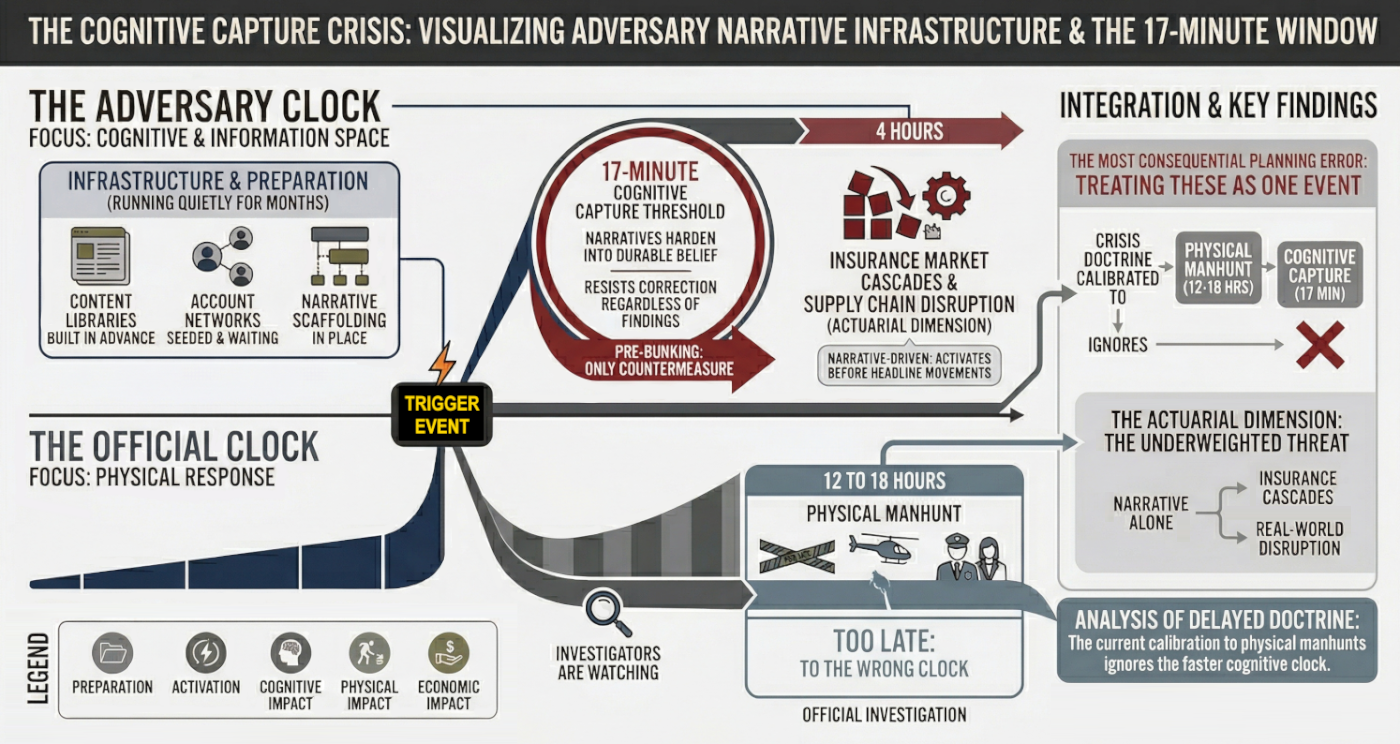
The adversary clock and the official clock diverge at the trigger event. Every response doctrine calibrated only to the physical manhunt clock arrives too late by design.
07 · Apprehension Timeline & The 17-Minute Problem
There are two distinct timelines running in parallel from the moment of the first shot. The first is the physical manhunt. The second is cognitive capture, the process by which audiences form beliefs that will not meaningfully update regardless of what official investigations find. These two timelines operate on radically different clocks.
Window 1
0 to ~17 min
Initial cognitive imprinting. Narratives form before verification is possible. Pre-bunking is the only effective intervention here. No reactive tool operates in this window.
Window 2
Hour 1 – Day 3
Narrative reinforcement. Cross-platform amplification, synthetic witnesses, and false-flag cross-pollination deepen the initial frame. Platform coordination is the primary tool.
Window 3
Apprehension onward
Post-capture narrative hardening. Martyr pivot deploys. Domestic amplifiers take over from adversary injection. Only delegated authority comms can compete.
The first 17 minutes are not important because they produce certainty. They matter because they produce structure.
In a high-salience crisis, audiences do not wait for full verification. They reach for the first explanation that feels legible, emotionally usable, and socially repeatable. That initial frame is often established before institutions can verify basic facts, and once it is adopted by high-reach accounts, later correction loses leverage. This is why the "17-minute threshold" should be treated as a planning threshold, not a literal constant. Its value is operational. If your response posture begins at 30 minutes, you are already operating inside an occupied information environment.
The core mistake in most crisis doctrine is treating the physical event and the narrative event as the same timeline. They are not. The manhunt may last 12 to 18 hours. Cognitive capture begins much earlier. In practice, the decisive question is not when investigators solve the event. It is when the public decides what kind of story it is hearing.
What the 17-Minute Threshold Actually Means
The threshold is best understood as a short sequence rather than a stopwatch.
Stage 1 :: Imprint
The first vivid and emotionally coherent frame gives people an interpretive structure. It does not need to be proven. It needs to be usable. Audiences are not looking for a complete explanation. They are looking for an intelligible one.
Stage 2 :: Adoption
The frame becomes operationally dangerous when it is picked up by high-reach accounts, perceived insiders, or trusted domestic amplifiers. At that point it becomes repeatable, whether or not it has been verified.
Stage 3 :: Resistance
Once the frame hardens, later evidence is filtered through it rather than assessed on neutral terms. Clarification may still matter for elites and investigators, but it no longer reliably changes belief at scale.
The claim is not that every mind is made up by minute 17. The claim is that the initial structure of belief may become sticky enough within that period that every later response starts from a position of disadvantage. In fast crisis environments, the first trusted frame often matters more than the first verified fact.
| Phase | Duration | Primary Mechanism | Effective Countermeasure |
|---|---|---|---|
| Imprint | 0 to 17 Minutes | Affect-driven processing; first-frame adoption before verification is possible | Pre-bunking; pre-approved holding statements deployable in under 5 minutes |
| Adoption | 17 Min to 4 Hours | Reinforcement via newsbrokers; socialized belief spreading through high-reach amplifiers | Platform coordination; high-reach correction through pre-established trust and safety channels |
| Resistance | 4 Hours to Day 3 | Narrative encampment; cognitive dissonance filtering out corrective information | Delegated authority communications; long-tail counter-narrative work |
Fig. 1 :: Social Media Post Volume :: Critical First 17 Minutes :: Minute-by-Minute Content Surge
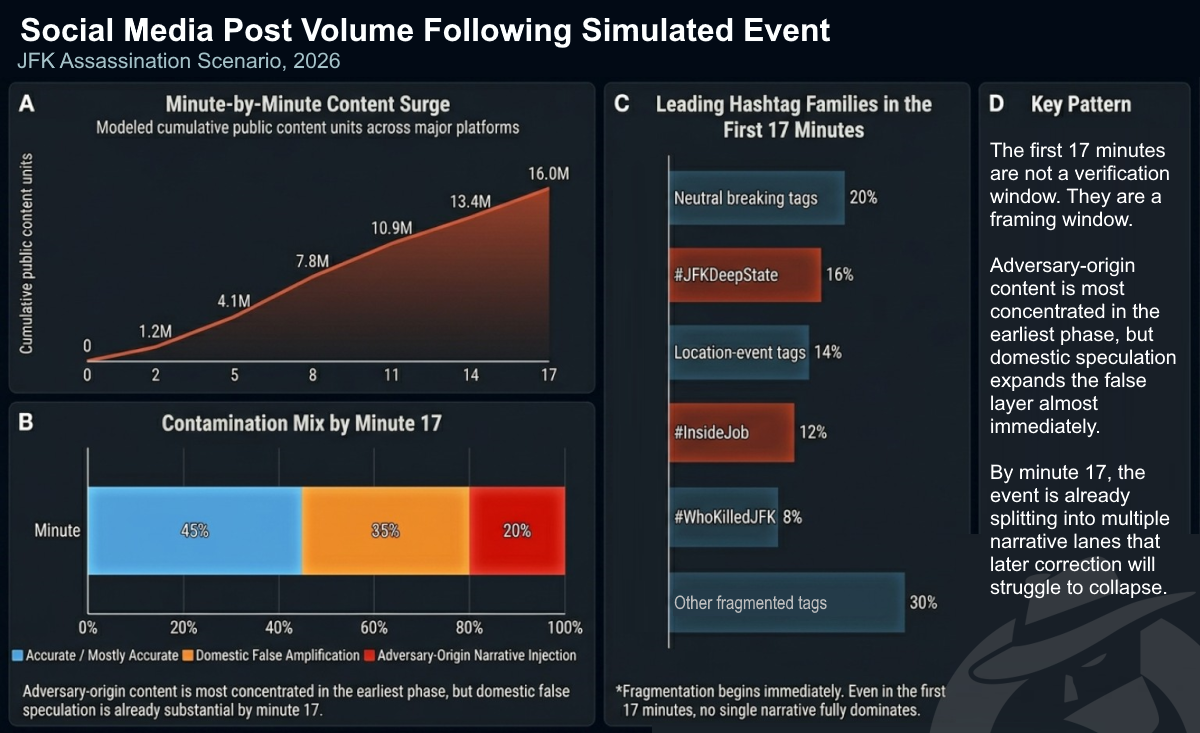
Illustrative scenario projection. All figures are modeled estimates, not observed data. By minute 17: cumulative content volume reaches 16.0M units. Contamination mix: 45% accurate / mostly accurate · 35% domestic false amplification · 20% adversary-origin narrative injection. Adversary-origin content is most concentrated in the earliest phase, but domestic speculation expands the false layer almost immediately. By minute 17, the event is already splitting into multiple narrative lanes that later correction will struggle to collapse.
In fast-moving crisis environments, the first trusted frame often matters more than the first verified fact. By the time the verification arrives, the audience has already decided what kind of story it thinks it is hearing.
Bob Johnson
Former CIA Analyst
The practical implication is straightforward. If an institution waits for full verification before establishing any interpretive frame at all, it is likely to enter the fight after cognitive capture has already begun. That is why pre-bunking, pre-approved holding statements, and pre-event narrative mapping are not enhancements. They are the only measures that operate on the same clock as the problem.
Why Audiences Adopt Contaminated Narratives
People do not adopt contaminated narratives only because they are false. They adopt them because those narratives outperform verified information on three dimensions that matter in crisis: veracity, emotional appeal, and relevance.
Research on crisis information consumption points to a model known as VER: Veracity, Emotional Appeal, and Relevance. In normal conditions, veracity carries more weight. In a high-uncertainty event, emotional appeal and perceived relevance surge. Fear, anger, disgust, identity threat, and moral outrage create demand for narratives that feel clarifying, even when they are wrong. That is why contaminated narratives often spread not in spite of their flaws, but because they are better fitted to the emotional needs of the moment.
Veracity
In normal conditions, this is the dominant factor. In crisis, its influence is compressed by time pressure and institutional ambiguity. Audiences cannot verify fast enough for veracity to protect them.
Emotional Appeal
Surges in high-uncertainty events. Fear, anger, and moral outrage create demand for narratives that feel clarifying. High emotional arousal actively degrades verification behavior.
Relevance
Narratives that align with identity, grievance, or existing belief structures spread faster. The audience is not only asking what happened. They are asking what it means for them and which side they are on.
This helps explain why falsehood can dominate the environment even when verified facts exist. False claims are often more novel, more emotionally charged, and more identity-confirming than the truth. They travel faster, resolve more slowly, and remain socially useful long after they have been debunked. The result is not just misinformation. It is narrative contamination, where false or unverified frames become the public's working reality before institutions can establish an authoritative account.
The VER Model in Practice
In a crisis environment, a narrative with low veracity but high emotional appeal and high relevance can outperform a more accurate narrative with weaker emotional or identity resonance. This is especially true in assassination, mass casualty, or symbolic violence scenarios, where users are not only trying to learn what happened. They are trying to decide what it means, who it threatens, and which side they are on. That is the mechanism by which contaminated narratives become sticky.
The Decline of Legacy Corroboration and the Rise of the Newsbroker
The modern crisis information environment is no longer organized around institutional confirmation. It is organized around speed, reach, and narrative brokerage.
In earlier media systems, legacy outlets played a larger corroboration role. They did not eliminate rumor, but they imposed delay, editorial friction, and a stronger norm of confirmation before amplification. That function has weakened. In the current environment, a small class of high-engagement influencer accounts, pseudonymous aggregators, and partisan interpreters increasingly acts as the first layer of narrative authority. These actors, often called newsbrokers, dominate crisis discourse by rapidly packaging speculation, clips, screenshots, and interpretive claims into shareable frames before traditional institutions can respond.
This is a structural shift, not a platform quirk. During fast-moving crises, the question is no longer simply whether official sources are trusted. It is whether they can even enter the conversation early enough to matter. Newsbrokers thrive inside that gap. They do not need to prove a theory. They need to name the moment first, give it emotional direction, and supply a frame that others can repeat. Once that happens, institutional statements are demoted from primary sensemaking tools to one input among many.
Legacy corroboration declines not only because trust has eroded, but because timing has collapsed. By the time a cautious institution confirms what happened, the public may already have accepted a brokered explanation that is more emotionally satisfying, more identity-aligned, and more socially portable. In that environment, the first narrative broker often matters more than the first verified source.
The Domestic Handoff
Adversary content may seed the initial frame, but domestic newsbrokers give it legitimacy, scale, and cultural fluency. Once they do, the foreign fingerprints matter less. The narrative has already been naturalized inside the domestic information ecosystem. Absence of detectable adversary origin is not evidence that the threat has passed. It is evidence the operation succeeded.
Bridge :: How These Dynamics Connect
The 17-minute problem describes the compression of belief formation. The VER model explains why contaminated narratives are psychologically attractive under stress. The rise of the newsbroker explains who operationalizes that advantage in real time. The result is a crisis environment in which truth is not merely contested. It is structurally outpaced.
Observable Markers of Cognitive Capture
- A stable accusation frame emerges before official verification
- The same core narrative appears across multiple platforms with audience-specific captioning
- High-reach domestic accounts begin repeating the frame without adversary attribution
- Misidentification converges around a named individual or small suspect pool
- Corrective content spreads more slowly than the original framing
- Users begin treating fabricated or unverified artifacts as already established fact
Planning note: treat "17 minutes" as a defensive threshold, not a universal constant. Its value is operational. It forces doctrine to plan for first-wave framing before verification is complete.
I would not treat 17 minutes as a literal constant. I would treat it as a planning threshold. If your response posture starts at 30 minutes, you are already operating inside an occupied information environment.
Calvin Klone
Former DIA Analyst · National Security and Narrative Intelligence
Precedent Evidence Base
Event 01 · February 2026 A2
Iranian Seismic Event
False nuclear testing claims saturated the global information environment within minutes of first sensor data publication. Professional seismologist consensus arrived hours later. False framing was structurally embedded before verification was possible.
Event 02 · April 2022 A1
Bucha Massacre
Denial narratives began circulating on Telegram within the first hour of satellite imagery going public. Bellingcat and DFRLab documented how quickly false framing migrated to mainstream platforms before official verification could compete.
Event 03 · April 2013 A1
Boston Marathon Bombing
Crowd-sourced misidentification on Reddit named multiple innocent individuals as suspects within hours. FBI's official identification came four days later. The gap between false convergence and official truth is the operational window adversaries exploit.
Assumption vs. 2026 Reality
| Segment | Prior Assumption | 2026 Reality |
|---|---|---|
| Narrative saturation | Hour 0–2 | Min 0–17 |
| Suspect ID | 0–4 hours | Instantaneous (OSINT) |
| Martyr launch | Hour 6–12 | Min 30–Hour 2 |
| Economic reaction | Day 3 | Hour 1–4 |
Key Analytical Finding
Physical apprehension of a suspect does not close the information operation. It accelerates it. By the time capture occurs, the cognitive battle has been concluded for hours. Current institutional response doctrine is calibrated to the manhunt clock. Effective counter-narrative doctrine must be calibrated to the cognitive capture clock, and must therefore be pre-positioned before any trigger event, not improvised in response to one.
Story Question 02
Who shapes the first wave?
Adversaries seed it. Domestic actors scale it.
The first wave is not shaped by one actor alone. It begins with foreign adversaries because they arrive prepared, with pre-built content, frames, and timing. But it hardens only when domestic actors give those frames legitimacy, speed, and cultural fluency. In a modern crisis, the real question is not only who injects the first narrative. It is who makes that narrative socially usable.
Precedent: IRA / GRU Dual-Activation Model, 2016
The Internet Research Agency's core innovation was feeding structurally identical content to left and right audiences with different emotional captions. The targeting below is not invented. It is the 2016 model with higher production values. A1
They flood the zone with "evidence" that it's an inside job. Deepfakes of Secret Service agents turning away, leaked memos from "whistleblowers" (all fabricated, all traceable to state actors). Their angle: "America's elite are eating their own." Goal: Make the U.S. look weak, divided, ungovernable.
They push a cross-spectrum bridge narrative designed to activate both ends of the political spectrum simultaneously. The same payload, different captions: one version routes through anti-imperialist distrust of intelligence agencies, the other through conspiratorial distrust of globalist elites. Both groups receive identical raw clips. The framing does the targeting.
They also leak "classified" audio: a politically salient synthetic clip framed as a leaked recording from a prior administration, joking about "taking out threats." Fake, but emotionally true enough. People don't fact-check when they're mad. Research on affect-driven processing consistently shows that high emotional arousal degrades verification behavior. The content doesn't need to be convincing. It needs to arrive first.
The Synthetic Witness Layer: Novel Capability
Beyond deepfakes and fabricated documents, China deploys a third content category that is harder to detect and faster to believe: AI-generated bystander accounts providing cross-platform eyewitness testimony. These are fully constructed personas with profile histories, location metadata, and posting patterns.
Synthetic Witnesses vs. Deepfakes
Deepfakes require the audience to evaluate media. Synthetic witnesses require them to evaluate people. In a high-distrust environment where "anyone could have filmed it," fabricated eyewitness accounts from seemingly ordinary bystanders carry more persuasive weight than polished video content, which can be dismissed as "obviously staged." No current platform-level detection solution operates at scale.
Hour 0 to 6: Flood the Zone
State-linked accounts on Weibo and Douyin drop the first wave: ultra-realistic deepfakes. Secret Service agents visibly stepping aside in slowed-down drone footage (AI-generated, 60fps, perfect lip-sync). A "whistleblower memo" from a supposed NSA contractor appears on Telegram and is reposted to Reddit within minutes, watermarked with authentic-looking classification stamps.
Left-leaning audiences get the "military-industrial complex finally cashed in its chips" version. Right-leaning audiences get the "deep-state coup" version. Both groups receive the exact same raw clips. The only difference is the caption.
Hour 6 to 48: Cross-Spectrum Goes Viral
Chinese state media publishes the first "investigative" pieces in English, framing the hit as a coordinated intelligence operation. Tens of thousands of freshly spun accounts then flood Western platforms. By hour 36, #JFKDeepState is trending globally. American users do most of the amplification work. China supplies the original payload.
Precedent: Bucha Massacre, April 2022
Rapid denial narratives spread across platforms within hours of satellite imagery going public. Bellingcat's open-source timeline work shows early circulation on Telegram migrating quickly to mainstream platforms. DFRLab's narrative tracking documented the staged-scene counter-narratives and their cross-platform spread. A1
China supplies the narratives. Russia ignites them.
This China/Russia distinction is an analytic simplification. Real operations blur. State-linked networks do not stay in pure lanes, and coordination is indirect rather than scripted. The heuristic is useful for mapping dominant patterns. It is not a claim that each actor operates in isolation.
Evidence · Stand-Down Deepfake :: First-Wave Adversary Seeding
This is what the first wave looks like in practice. The stand-down deepfake performs an imprint function — it converts uncertainty into apparent visual accusation before any institution can establish basic facts.
Simulated Disinfo — Example Only — Fabricated for Analysis
China-flood · Hour 2 to 4
🔍
@TruthSeeker2026 · 1.2M followers
X (reposted from TikTok stitch)
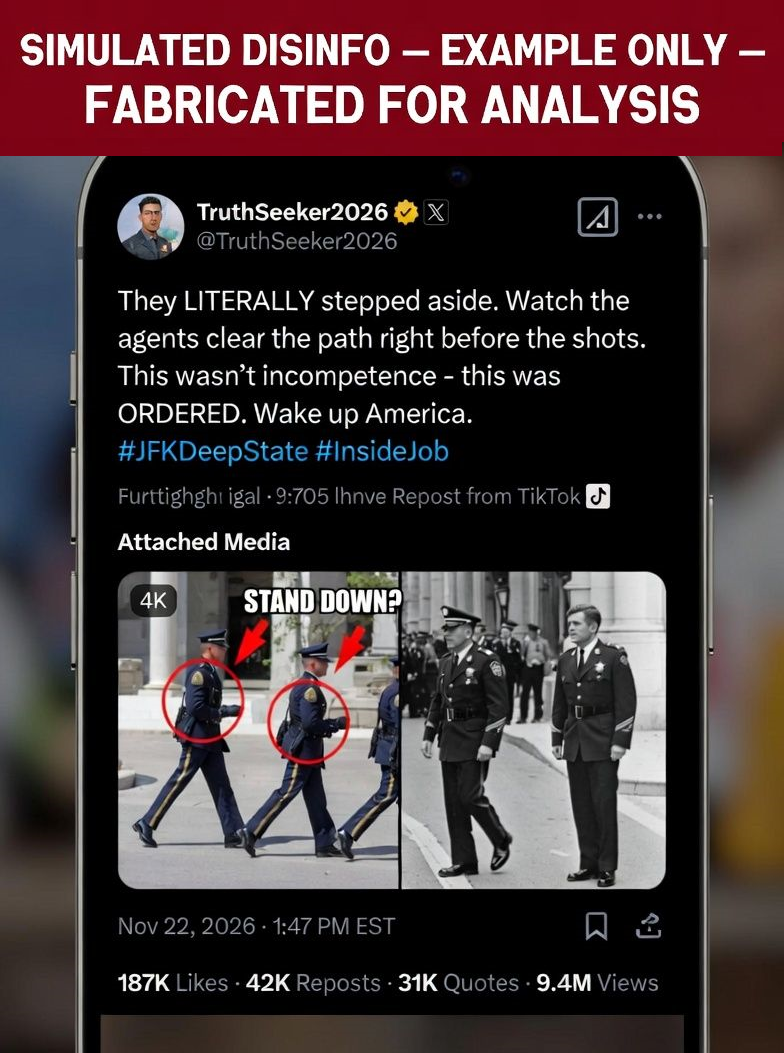
187K Likes42K Reposts9.4M Views
Why this works: Visual evidence compresses explanation into accusation.
What it targets: Secret Service legitimacy, institutional trust, accountability narratives.
What it unlocks next: Cable pickup, elite complicity framing, slower correction cycle.
What it targets: Secret Service legitimacy, institutional trust, accountability narratives.
What it unlocks next: Cable pickup, elite complicity framing, slower correction cycle.
Precedent: Prigozhin, The Martyr Pivot, 2023
Russia's handling of Prigozhin demonstrated this mechanic at full scale: villain to reluctant hero to tragic casualty of the system. The difference here is compression. The arc that took weeks in 2023 is executed in hours. A1
More chaotic, more personal. They weaponize the suspect. Call him lone wolf, ex-Marine, QAnon-adjacent. Russia doesn't invent him; they just amplify him. RT runs a 24-hour special: "The Patriot Who Saw Too Much."
They dox his family, release edited videos of him ranting about "the deep state," then pivot: "See? He was right." Goal: Turn the killer into a martyr. Simultaneously, they push a "false flag" counter-narrative. The shooter was a Ukrainian asset, or a Chinese plant. Muddy the water. Make every theory equally plausible.
Hour 0 to 6: Weaponize Before the Body Is Cold
RT and Sputnik flip to wall-to-wall coverage. Within ninety minutes #PatriotWhoSawTooMuch is trending. The narrative is locked: lone wolf? Yes. But a lone wolf who was right.
Hour 6 to 48: The Martyr Pivot
Family doxxing drops first. Then come the AI-edited garage rants. By hour 36 the story flips from "crazy gunman" to "tragic hero silenced by the machine." The emotional payload is pure venom.
Day 2 to 3: False-Flag Cross-Pollination
Two parallel tracks launch: "Ukrainian asset" theory and "Chinese plant" theory. Neither needs to win. The point is to make the official "lone wolf" narrative look laughably incomplete.
Precedent: Crocus City Hall, March 2024
Russian state media pushed Ukrainian intelligence attribution within the first hour of the attack, before any investigation had produced a finding. ISIS-K had already claimed responsibility. The false-flag counter-narrative machine was pre-built and pre-positioned, deployed on trigger, not constructed in response. A1
Endgame for Russia
They don't want America to pick a single villain. They want Americans to pick all of them at once. By day seven the country is fractured into hostile camps: one side canonizing Oswald as the new John Brown, another screaming "Russian psyop," and everyone convinced the institutions are lying.
·· How Domestic Actors Scale It
Foreign actors do not need to dominate the first wave for long. They only need to seed frames that domestic actors can carry in native language. Once newsbrokers, influencers, crowd analysts, and partisan interpreters begin repeating the payload without foreign fingerprints, the frame stops looking foreign and starts looking like common sense. That is when seeding becomes shaping. The first wave is not won when the adversary posts. It is won when domestic actors make the post socially portable.
The Transition Point
Once the first frame has been seeded, socially validated, and domestically scaled, the next question is no longer who started it. It is how the ecosystem carries it across platforms, formats, and audiences until attribution becomes irrelevant.
Story Question 03
How does it spread?
First-week timeline · Simulated evidence · Domestic handoff
08 · First Week: Real-Time Narrative War Timeline
HOUR 0 :: TRIGGER
Cognitive Capture Window Opens (~17 min)
First 4K clips on X/TikTok. China drops stand-down deepfakes. Russia pushes #PatriotWhoSawTooMuch. Cognitive capture threshold passes before any official statement is issued.
HOUR 2–6 :: Narrative Hardening
Fabricated Documents + Bridge Narrative Active
Fake NSA memo (Telegram → Reddit). Synthetic audio clip drops. Bridge narrative activated: same raw content, divergent left/right captions. Cable forced to address adversary content, amplifying it.
HOUR 6–48 :: Martyr Pivot
AI Rants + False-Flag Cross-Pollination
Martyr frame locks in right-wing ecosystem. Ukrainian asset AND Chinese plant tracks launched simultaneously. Neither needs to win. Synthetic witnesses reach high-reach domestic amplifiers with no adversary fingerprints.
DAY 1–3 :: Actuarial Cascade
Insurance Markets + Algorithmic De-Risking Triggered
P&I clubs assess domestic political risk. War risk premium language tightens. Sentiment-driven algorithms trigger automated sell-off before human decisions. Armed rallies form. Fabricated content cited as established fact.
DAY 4–7 :: Injection Complete
Domestic Ecosystem Self-Sustaining :: Adversary Withdraws
China and Russia shift to monitoring and selective amplification. Original deepfakes cited as primary sources. Fracture is persistent. Recovery within the week is assessed unlikely (scenario projection).
| Time | Actor | Action | Effect |
|---|---|---|---|
| Hr 0–2 | Both | First 4K clips viral. China drops deepfake. Russia #PatriotWhoSawTooMuch. | ID speculation before FBI speaks. |
| Hr 2–6 | China | "Leaked NSA memo" Telegram to Reddit. Stand-down deepfake. | Official counter-narrative losing the race. |
| Hr 6–12 | Russia | Doxxing wave. AI-edited rant. RT 24-hr special begins. | Martyr frame locked in. |
| Day 1 | Both | FBI names suspect. Synthetic audio deepfake. First protests form. | Official story = one theory among many. |
| Late D1 | Russia | Suspect cornered/killed. "He was about to reveal everything" package drops. | Capture accelerates fracture. |
| Day 2 | Both | #OswaldWasRight 2.4M posts. TikTok stitch 47M views. | Cross-pollination peaks. |
| Day 3 | Both | False-flag tracks launch. Armed rallies. Stock futures down 4%. | Physical world reflects info environment. |
| Day 4–5 | Domestic | Cable splits. Martyr merch appears. | Institutional trust drops sharply (projection). |
| Day 6–7 | Both | National funeral. Markets down significantly (illustrative). | Fracture persistent. No unified narrative (projection). |
End of Week 1 (illustrative scenario figures): #JFKDeepState ~48M posts · #PatriotWhoSawTooMuch ~31M · each false-flag track >10M. No single narrative dominates. These are calibrated scenario projections, not empirical measurements.
Fig. 2 :: Social Media Post Volume :: Simulated Event Full Timeline :: Cumulative Volume and Narrative Contamination
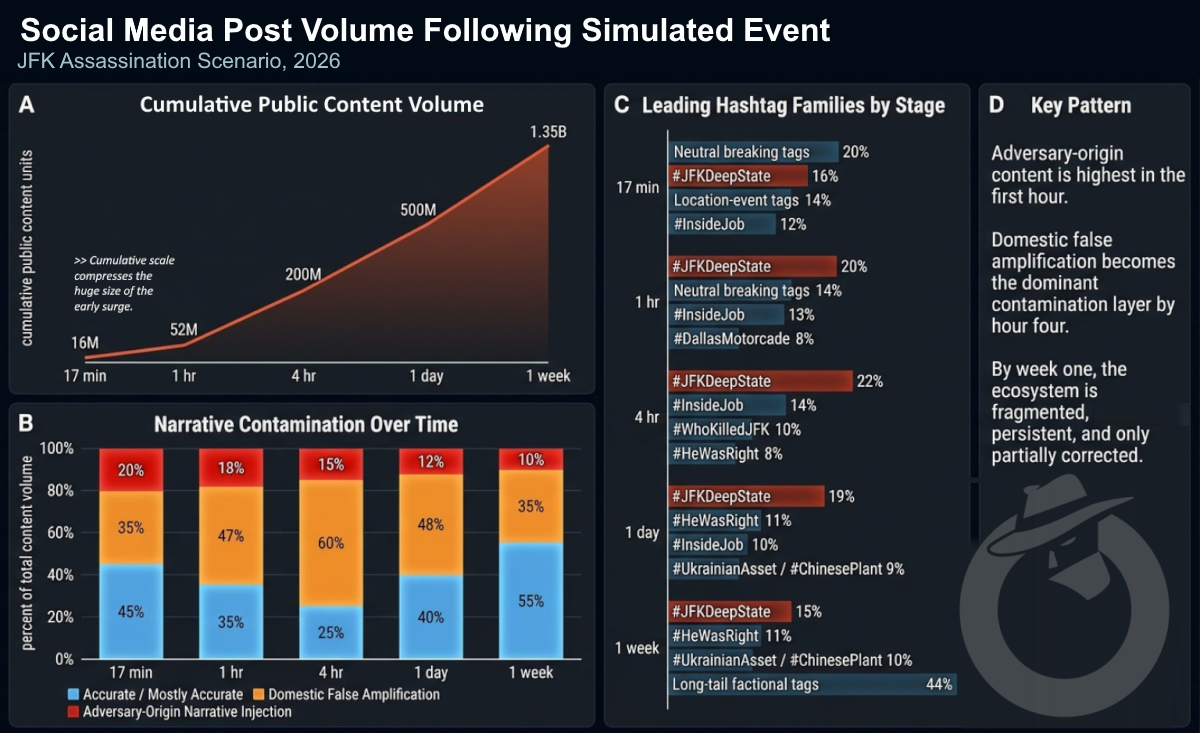
Illustrative scenario projection. All figures are modeled estimates, not observed data. Cumulative content volume: 16M at 17 min · 52M at 1 hr · 200M at 4 hr · 500M at 1 day · 1.35B at 1 week. Contamination shift: adversary-origin injection declines from 20% (17 min) to 10% (week 1) as domestic false amplification becomes the dominant contamination layer. #JFKDeepState persists as the leading adversary-seeded hashtag family across all five stages. By week one, the ecosystem is fragmented, persistent, and only partially corrected.
Evidence · False-Flag Crossover Thread :: Complexity Weaponization
By Day 3, the spread mechanism has shifted from adversary injection to domestic amplification. The false-flag crossover thread shows how incompatible attributions combine to make the official narrative look incomplete even when it is accurate.
Simulated Disinfo — Example Only — Fabricated for Analysis
Indirect coordination peak · Day 3
🕵
@AnonResearcher1776 · 340K followers
X thread starter · anonymous
Thread: Why BOTH Ukraine AND China angles make sense.
1. Bank records → Chinese crypto wallet.
2. Edited meetup photo in Poland with "SBU handler."
They played him from BOTH sides. Lone wolf? No. Patsy.
#JFKDeepState #PatriotWhoSawTooMuch
1. Bank records → Chinese crypto wallet.
2. Edited meetup photo in Poland with "SBU handler."
They played him from BOTH sides. Lone wolf? No. Patsy.
#JFKDeepState #PatriotWhoSawTooMuch
421K Likes156K Reposts22M Views
Why this works: Complexity itself becomes persuasive under uncertainty.
What it targets: Attribution confidence and investigative legitimacy.
What it unlocks next: Durable "official story is incomplete" framing.
What it targets: Attribution confidence and investigative legitimacy.
What it unlocks next: Durable "official story is incomplete" framing.
Story Question 04
Why does it matter beyond social media?
Insurance cascades · Algorithmic sell-offs · Supply chain disruption
09 · The Actuarial Battlefield
The stock market declining by Day 7 is an outcome. The mechanism begins within the first few hours, operating through a channel most narrative warfare analysis ignores entirely: the insurance and financial risk infrastructure that underlies the physical economy.
The February 2026 Strait of Hormuz crisis provided the clearest modern precedent. The strait was not closed through military force. It was closed through insurance. Protection & Indemnity clubs issued 72-hour war risk cancellation notices. Additional War Risk Premiums spiked from 0.15% to over 1%. Major carriers rerouted within days, not because the military situation demanded it, but because the actuarial calculus made transit economically indefensible. B2
How Narrative Shock Becomes Economic Damage
The economic effects described in this analysis do not begin when markets fully price the event. They begin earlier, at the point where uncertainty enters the systems that underwrite movement, coverage, and automated decision-making. This is best understood not as a market story first, but as a risk transmission story.
In a high-salience crisis, the first meaningful reactions are often not visible in headline indices. They appear in the quieter infrastructure of risk: insurance language, routing assumptions, volatility clustering, internal advisories, and machine-driven de-risking behavior. These systems do not wait for public certainty. They react to perceived instability under conditions of incomplete information.
Risk systems do not wait for consensus. They react to uncertainty. In a contested information environment, that means narrative can move economic behavior before the factual picture is stable.
Bob Johnson
Former CIA Analyst
Cyber-to-Actuarial Transmission Path
Step 1
Trigger event creates extreme informational uncertainty. A public act of violence involving national leadership produces immediate ambiguity about attribution, continuity, escalation risk, and institutional stability.
Step 2
Narrative manipulation magnifies perceived instability. Synthetic media, fabricated evidence, false attribution, and high-volume cross-platform spread do not need to prove a theory. They only need to raise enough uncertainty that risk actors begin questioning whether ordinary assumptions still hold.
Step 3
Insurance and risk desks react to uncertainty, not proof. P&I clubs, war risk underwriters, freight planners, and institutional risk teams do not require courtroom-level certainty to reassess exposure. In this sense, narrative can do economic work before physical conditions change.
Step 4
Automated and semi-automated systems propagate the signal. Sentiment-linked trading models, logistics software, internal alert thresholds, and volatility triggers can translate narrative instability into real portfolio shifts, pricing changes, or routing decisions.
Step 5
Physical economic consequences follow. Only after those earlier reactions do the visible consequences appear: cancellations, rerouting, liquidity anxiety, repricing, freight delays, and broader market stress. By that point, the story looks like a market reaction. In reality, it began as a narrative-triggered risk recalculation.
This is why the first four hours matter. The claim is not that every information shock produces a full actuarial cascade. The claim is that in a sufficiently chaotic high-salience event, the earliest meaningful economic reactions may begin inside the first one to four hours, well before political facts are settled and well before public messaging catches up.
What to Monitor in the First Four Hours
- Changes in advisory language from insurers, maritime risk monitors, or freight security providers
- Abrupt tightening in political-risk phrasing tied to domestic instability
- Unusual volatility clustering around politically sensitive instruments
- Rapid circulation of fabricated financial screenshots or false institutional alerts
- Internal chatter among analysts or operators around "uncertainty premium" assumptions
- Divergence between physical conditions on the ground and the risk language used to price them
Analytical caution: Hour 1 to 4 should be treated as an early reaction band, not a universal rule. Its value is as a planning assumption for rapid economic spillover, not as a deterministic market forecast.
Supply Chain via Insurance
Narrative attacks trigger P&I club war risk premium increases. Carriers reroute or halt U.S.-bound shipments not because the physical threat has materialized, but because the insurance mathematics no longer support the risk.
Coordinated Market Manipulation
The April 2025 '#TheBanksAreOutOfMoney' campaign established the template: doctored financial terminal screenshots creating false liquidity signals. In a post-assassination environment, fabricated Bloomberg screenshots move at the same speed as real data.
Algorithmic De-risking
Sentiment-analysis-driven automated systems begin selling before the physical reality of a situation is clear. By the time official stabilizing statements arrive, the sell-off has already reset the baseline. Corrections don't reverse automated decisions already executed.
Economic Early-Warning Signals for Practitioners
Monitor: Additional War Risk Premium movements on U.S.-flagged routes; P&I club advisory language for domestic political risk; freight rate index deviations on trans-Pacific and trans-Atlantic corridors; options market volatility clustering around political event timelines. These signals precede headline market moves by hours to days.
Story Question 05
Why does official resolution fail to restore control?
Capture accelerates fracture · Media splits · Calcification
11 · Fallout Inside the U.S.
How the Media Splits
Legacy broadcast (ABC, CBS, NBC): Deliberate and cautious. The restraint reads, to audiences primed for distrust, as concealment.
Cable news, center-left: Focuses on security failures. Adversary content finds ready amplification by feeding the accountability narrative with fabricated evidence of deliberate stand-downs.
Cable news, right: Fragments fast. The martyr narrative finds its first mainstream foothold. By Day 2, the framing has calcified.
Independent / podcast ecosystem: Moves fastest, with least friction. Corrections, when they come, reach a fraction of the original audience.
International press: Covers the fracture as the story. Not the assassination. The American response to it.
How Politicians React
The Institutionalist (fictional archetype): Issues a measured statement within two hours. It generates roughly 12,000 engagements on a platform where the deepfake stand-down clip has 9 million views. Restraint gets reframed by adversary-adjacent accounts as cowardice or complicity.
The Opportunist (fictional archetype): Goes live within 90 minutes. Repeats an unverified detail from the Russia-seeded narrative. Walks it back six hours later. The walkback gets 3% of the original clip's reach.
The Conspiracist (fictional archetype): Posts within 45 minutes. Full martyr framing. Amplified by Russian bot networks within the hour, not because they coordinated directly, but because the content performs exactly the function they need.
The real Kill Shot isn't the bullet.
It's the narrative environment that follows.
It's the narrative environment that follows.
Ryan MacBeth
Intelligence Analyst and Information Warfare Consultant
- Every group gets its version
- No one needs proof
- Emotional alignment replaces evidence
Truth becomes optional. Proof becomes secondary. Alignment becomes enough. And the next election? Whoever owns the narrative owns the country.
Evidence · Funeral-Week Domestic Post :: Calcification
By Day 6, the adversary has largely withdrawn. The domestic ecosystem is self-sustaining. This post carries no adversary fingerprints — and it does not need them. The narrative has already been naturalized.
Simulated Disinfo — Example Only — Fabricated for Analysis
End-state framing · Day 6 to 7 · Fully domestic origin :: no adversary fingerprints required at this stage
🇺🇸
@AmericanTruthArchive · 2.1M followers
X · Day 6, National Funeral
They're burying him today while the people who ordered it sit in the front row. We have the receipts. The deepfake. The audio. The bank records. The Poland photo. We know what happened. They're counting on you forgetting by next week. Don't.
#NeverForget #JFKDeepState #OswaldWasRight
[Case-file collage: funeral procession still + all prior "evidence" items assembled with red thread. "Connect the dots." Fully domestic origin.]
#NeverForget #JFKDeepState #OswaldWasRight
[Case-file collage: funeral procession still + all prior "evidence" items assembled with red thread. "Connect the dots." Fully domestic origin.]
1.4M Likes612K Reposts38M Views
By Day 6, adversary injection is largely complete. The domestic ecosystem is self-sustaining. The original deepfakes are now being cited as established fact.
Why this works: It bundles prior fabricated artifacts into a single memory object.
What it targets: Public memory, grief, symbolic closure.
What it unlocks next: Long-tail repetition without foreign fingerprints.
What it targets: Public memory, grief, symbolic closure.
What it unlocks next: Long-tail repetition without foreign fingerprints.
If official resolution does not restore control, then the answer cannot be a better press conference after the fact. It has to be a faster operating model before the fact. That makes the next question operational: what can anyone with responsibility actually do inside the first hour, while the narrative is still forming?
Story Question 06
What should anyone do about it?
The first 60 minutes · Pre-positioned response doctrine
12 · What to Do in the First 60 Minutes
The scenario above describes what adversaries do. This section describes what defenders should do in parallel. The first 60 minutes is not the time for comprehensive strategy. It is the time for pre-planned action. Every item below should be decided before an event, not during it.
Right-Clock Response
The 17-minute cognitive capture threshold means that improvised responses will always arrive after belief has formed. Effective first-hour response is not creative. It is the execution of decisions made in advance.
Improvisation is not a response doctrine. In a high-velocity event, the first hour is where pre-made decisions either save you or expose you.
Calvin Klone
Former DIA Analyst · National Security and Narrative Intelligence
Min 0–5
Activate pre-approved holding statement. A short, accurate, stabilizing message that designated communicators can publish immediately without legal review. It signals the institution is aware, active, and will update as verified information becomes available.
Min 5–15
Suppress public speculation from affiliated staff. Any staff member with institutional affiliation who speculates on cause, suspect, or motive in the first 15 minutes creates a liability. Pre-event communications policy should make this expectation explicit.
Min 10–20
Launch synthetic media triage. Assign a dedicated analyst to identify fabricated content circulating about the event. Priority targets: deepfake video, AI-generated audio attributed to named officials, and synthetic witness accounts claiming to have been present.
Min 15–30
Open misidentification monitoring track. Run crowd-sourced identification activity in parallel to official investigation. Flag any individual being named by high-volume accounts before official confirmation.
Min 20–40
Identify cross-spectrum bridge narrative. Determine whether adversary content uses dual-audience framing: same raw material, different captions for different audience segments. This is the signature of a pre-positioned state IO operation.
Min 30–60
Coordinate with platform trust and safety channels. Pre-established relationships with platform integrity teams are the difference between a 30-minute escalation and a 6-hour queue. If synthetic content is confirmed, initiate takedown or labeling requests through existing channels.
Min 40–60
Assess actuarial exposure. Monitor Additional War Risk Premium language and P&I club advisories for early signs that the narrative is reaching insurance and freight markets. This signal precedes headline market moves by hours.
Hour 1+
Trigger economic-risk coordination if event severity threshold is crossed. Pre-coordinated statements from financial regulators and Treasury-adjacent communications provide the specific signals that underwrite risk models. This is a separate track from public messaging.
What Has to Exist Before the Shot Is Fired
- Holding statements drafted and approved for high-probability crisis types
- Staff communications policy in place and understood by all personnel
- Dedicated synthetic media triage capacity assigned and trained
- Misidentification monitoring protocols and escalation paths established
- Platform trust and safety contacts identified and relationships active
- Actuarial monitoring triggers defined and assigned
- Economic coordination contacts identified and pre-briefed
Operational Principle :: Build for Edge Action, Not Just Top-Down Control
In a crisis where narrative formation outruns centralized decision-making, the response model must allow pre-designated actors to act inside a shared operational framework without waiting for every decision to route upward. A high-velocity narrative crisis demands something closer to a self-organizing response network: verification, communications, platform coordination, misidentification monitoring, and threat analysis operating in parallel under a shared operational picture. The goal is not unmanaged decentralization. The goal is disciplined autonomy: enough shared structure to maintain coherence, enough delegated authority to keep pace with the event.
13 · What This Means for Practitioners
1. Speed is structural, not tactical.
Adversary operations are not improvised in response to events. The content library, account networks, and narrative scaffolding are pre-positioned. The event is a trigger, not a starting point. Any response doctrine that treats Hour 0 as the beginning is already behind. Cognitive capture occurs at Minute 17.
Implication: Pre-Bunking
Pre-event narrative mapping should identify the cross-spectrum bridge narrative and the martyr pivot as high-probability adversary plays, then seed "accuracy nudge" messaging before the event. Research from 2021 to 2025 consistently shows that pre-bunking significantly outperforms post-hoc correction in reducing belief formation from false content. This is the only countermeasure that operates within the 17-minute window.
2. OSINT is dual-use by definition.
The same crowd-sourced identification tools that can rapidly narrow a suspect field can converge on the wrong person just as fast. Misidentification at scale is not a risk. It is a near-certainty somewhere in the information ecosystem. The synthetic witness layer amplifies this further, as AI bystander accounts provide false confirmation that accelerates crowd convergence on incorrect identifications.
Implication: Parallel Misidentification Tracking
Any OSINT operation in a high-profile event environment needs a simultaneous misidentification monitoring track. The question is not just "who are we converging on?" It is also "who is the crowd converging on in parallel, and is that convergence being accelerated by synthetic witness accounts?" Pre-event digital footprint suppression for likely persons of interest shrinks the attack surface before the event creates the opening.
3. Proximity creates data exposure.
Every device in the blast radius of a high-profile event becomes part of the data environment. Bystanders are not passive witnesses. They are data sources being actively processed by multiple parties simultaneously, within minutes of the event. This applies to the economic layer as well, because device and location signals from financial district personnel feed algorithmic sentiment systems that trigger automated de-risking before any human decision is made.
Implication: Device Hygiene and Blast Radius Protocols
Device hygiene and location data exposure protocols are not theoretical risk management for organizations with personnel at high-profile events. The blast radius data environment is operational within minutes. Pre-event protocols must cover both the physical security layer and the data exposure layer.
4. Capture accelerates fracture.
Physical apprehension of a suspect does not close the information operation. In documented cases including Crocus, Bucha, and Butler 2024, the narrative war intensified after official resolution. The martyr package is pre-built. It deploys on death or capture.
Implication: Delegated Authority and Post-Resolution Comms
Official communications cannot compete with narrative speed if every statement requires full legal and political clearance before release. Post-capture, a dedicated narrative phase must pre-empt the martyr pivot in the 2 to 4 hours immediately following apprehension. This window is narrow. It does not recur.
The 18-Hour Window
Between initial identification and apprehension, estimated at 12 to 18 hours in a 2026 surveillance environment, the narrative war runs at maximum intensity with minimum official interference. This is when the martyr frame locks in. When false-flag cross-pollination reaches critical mass. When deepfake content gets treated as primary source material by millions of people who will never update. Understanding that window is the operational prerequisite for any serious counter-narrative or attribution capability.
Bottom Line Up Front · Gray Zone / Information Warfare Assessment
China and Russia do not wait for events to happen. They prepare for them. The content libraries are built in advance. The account networks are seeded and waiting. The narrative scaffolding is already in place. What looks like a rapid adversary response to a crisis is actually the activation of infrastructure that has been running quietly for months. The trigger event changes nothing about the operation. It only starts the clock.
The clock that matters is not the one investigators are watching. The central finding of this analysis is the 17-minute cognitive capture threshold: within approximately 17 minutes of a high-salience event, adversary narratives harden into durable belief that resists correction regardless of what official investigations subsequently establish. The physical manhunt runs for 12 to 18 hours. These two timelines are not the same event. Treating them as one is the most consequential planning error in current crisis response doctrine.
The actuarial dimension of this threat is the most underweighted. Narrative alone, without any physical action, is sufficient to trigger insurance market cascades that produce real-world supply chain disruption. The mechanism activates within 4 hours of a trigger event, well before any headline market move registers. Pre-bunking is the only countermeasure that operates inside the 17-minute window. Every doctrine calibrated to the physical manhunt clock rather than the cognitive capture clock arrives too late by design.
The clock that matters is not the one investigators are watching. The central finding of this analysis is the 17-minute cognitive capture threshold: within approximately 17 minutes of a high-salience event, adversary narratives harden into durable belief that resists correction regardless of what official investigations subsequently establish. The physical manhunt runs for 12 to 18 hours. These two timelines are not the same event. Treating them as one is the most consequential planning error in current crisis response doctrine.
The actuarial dimension of this threat is the most underweighted. Narrative alone, without any physical action, is sufficient to trigger insurance market cascades that produce real-world supply chain disruption. The mechanism activates within 4 hours of a trigger event, well before any headline market move registers. Pre-bunking is the only countermeasure that operates inside the 17-minute window. Every doctrine calibrated to the physical manhunt clock rather than the cognitive capture clock arrives too late by design.
A1 · Executive Summary & Key Findings
This white paper uses a 2026 JFK-style assassination scenario as a pressure test. Not a prediction. Every tactic described has a documented precedent in operations conducted between 2013 and 2024. The goal is to make abstract adversary playbooks concrete and actionable for practitioners in OSINT, counter-narrative operations, crisis communications, and executive protection.
The adversary clock and the official clock diverge at the trigger event. Crisis doctrine calibrated only to the physical manhunt clock ignores the cognitive capture clock entirely — the most consequential planning error in current response doctrine.
 Finding 01
The 17-Minute Problem
Cognitive capture, the point at which narrative belief hardens and resists correction, occurs within approximately 17 minutes of a high-salience event. The physical manhunt runs 12 to 18 hours. These are not the same window and must not be treated as one.
 Finding 02
Adversaries Pre-Position, Not Improvise
China and Russia do not react to events. They trigger pre-built content libraries. By the time an institution drafts its first statement, adversary narratives have already hardened in millions of minds.
 Finding 03
Capture Accelerates Fracture
Apprehending a suspect does not close the information operation. The martyr package is pre-built and deploys on capture or death. Official resolution is not narrative resolution.
 Finding 04
Synthetic Witnesses Beat Deepfakes
AI-generated bystander accounts providing "eyewitness" testimony are harder to detect and more persuasive than deepfake video. They require the audience to evaluate people, not media.
 Finding 05
The Actuarial Battlefield
Narrative of institutional collapse triggers insurance cancellations and algorithmic sell-offs before physical reality is clear. Economic harm precedes market headlines by hours to days.
 Finding 06
Response Must Be Pre-Planned
Improvised crisis response always arrives after cognitive capture is complete. Effective defense requires pre-approved holding statements, platform contacts, and misidentification monitoring, all of which must be in place before any event.
A2 · Gray Zone Instrument Map
Cyber Operations
ACTIVE A1- Deepfake video (60fps, 4K)
- AI-generated audio attribution
- Fabricated document injection
- Synthetic witness persona networks
- Weibo → Reddit → X bot seeding
Influence Operations
ACTIVE A1- Cross-spectrum bridge narrative
- Martyr pivot package (pre-built)
- False-flag dual track (UA + CN)
- Zone-flooding: no single theory wins
- Domestic hand-off by Day 3
Actuarial / Economic
ASSESSED B2- P&I club war risk reassessment
- Freight route disruption
- Algorithmic sentiment de-risking
- Fabricated Bloomberg screenshots
- Supply chain disruption
Lawfare
ASSESSED B2- International attribution manipulation
- Evidence contamination
- Delegitimization of process
- Regulatory narrative exploitation
Cognitive Warfare
ACTIVE A1- 17-min capture threshold targeting
- OODA loop disruption
- Institutional trust collapse
- Affect-driven verification bypass
- Identity-targeted emotional payload
Quick Reference :: Instrument-to-Precedent Map
| Grey Zone Instrument | Primary Actor | Documented Precedent | Operational Effect |
|---|---|---|---|
| Synthetic Witnesses | China | Dragonbridge / Spamouflage (ongoing) | False eyewitness corroboration that forces audiences to evaluate people rather than media |
| Martyr Pivot | Russia | Prigozhin Mutiny, 2023 | Reframes perpetrator as whistleblower or tragic hero; suspicion of official investigation |
| Bridge Narratives | China / Russia | IRA 2016 Election Operations | Same raw content, divergent captions; cross-spectrum social fracture regardless of audience |
| False-Flag Tracks | Russia | Crocus City Hall, March 2024 | Parallel incompatible attributions produce interpretive exhaustion and delegitimize official findings |
A3 · Methodology Note
This is a structured scenario exercise grounded in documented precedent, with illustrative operational assumptions where direct analogues do not exist. Every core tactic described has a real-world precedent in foreign influence operations conducted between 2014 and 2024. Where specific timing, volume, or outcome figures appear, they are scenario assumptions calibrated to be plausible, not empirical claims.
Three Layers in This Document
Documented mechanics: Tactics and patterns with direct precedent in named operations.
Scenario assumptions: Plausible illustrative projections (timing, volumes, sequencing) where no direct precedent exists.
Speculative escalations: High-confidence extensions of documented patterns into novel conditions, labeled where relevant. Readers should evaluate each layer on its own terms.
Scenario assumptions: Plausible illustrative projections (timing, volumes, sequencing) where no direct precedent exists.
Speculative escalations: High-confidence extensions of documented patterns into novel conditions, labeled where relevant. Readers should evaluate each layer on its own terms.
Precedents This Analysis Draws On
Precedent 01 A1
GRU / Internet Research Agency, 2016 U.S. Election
Established the modern playbook for cross-spectrum narrative seeding: identical raw content fed to left and right audiences with different captions. The cross-spectrum bridge narrative mechanic in this scenario maps directly to that approach. Documented in Senate Intelligence Committee reporting and subsequent academic analysis.
Precedent 02 A1
Russian Disinfo Response to Bucha Massacre, April 2022
Within hours of satellite confirmation of civilian casualties, Russian state media and bot networks flooded Western platforms with staged-scene counter-narratives. Bellingcat's open-source timeline work and DFRLab's narrative tracking documented rapid Bucha-denial content circulating on Telegram before migrating to mainstream platforms.
Precedent 03 A1
Prigozhin Mutiny and Death, June to August 2023
Russia's handling of Prigozhin demonstrated the martyr narrative pivot in practice: enemy, reluctant hero, tragic casualty. The same mechanic, compressed from weeks to hours, is applied to the Oswald figure in this scenario.
Precedent 04 A1
Crocus City Hall Attack, March 2024
Russian state channels immediately pushed Ukrainian and Western intelligence attribution before any investigation produced a finding. ISIS-K had already claimed responsibility. The false-flag counter-narrative machine was pre-built and pre-positioned.
Precedent 05 A1
Chinese MFA / Weibo Amplification Networks, Ongoing
Documented patterns show content originating on Weibo and Douyin migrating to Reddit, Telegram, and X within hours via coordinated account networks. Documented by Google TAG, Graphika, and Mandiant reporting on Dragonbridge/Spamouflage operations.
JFK Primary Source Baseline
Warren Commission Report (1964): archives.gov/research/jfk/warren-commission-report · HSCA Report (1979): archives.gov/research/jfk/select-committee-report · ARRB Final Report (1998): archives.gov/research/jfk/review-board/report · Full Records Collection: archives.gov/research/jfk · EO 14176 / 2025 releases: archives.gov/research/jfk/release-2025
A4 · Scenario Evidence Pack :: Full Simulated Post Gallery
⚠ Editorial Note: Fabricated Examples
All posts below are simulated for analytical purposes. Each represents a documented adversary content tactic. In any published version, these must carry a persistent visual label that cannot be cropped out. All engagement metrics are illustrative scenario projections, not empirical measurements.
How to Read the Simulated Posts
The simulated posts in this analysis are not included merely to illustrate tone, platform aesthetics, or likely content formats. Each one represents a distinct operational function inside a broader narrative attack cycle. Their value is not just that they look plausible. Their value is that they show how different content types perform different jobs at different moments.
The individual post is rarely the unit that matters most. The function matters. Some posts create belief. Others convert that belief into identity, repetition, and permanence.
Ryan MacBeth
Intelligence Analyst and Information Warfare Consultant
The first-wave deepfake post performs an imprint function. It converts uncertainty into apparent visual proof. The key feature is not sophistication alone. It is immediacy. A post framed as direct evidence of deliberate stand-down can establish a moral interpretation of the event before any institution can credibly explain what actually happened.
The martyr-rant post performs an identity conversion function. Its purpose is not to persuade everyone. It is to transform the suspect from deviant actor into symbolic vessel. Once that conversion occurs, later evidence no longer speaks only to guilt. It speaks to whether the audience accepts or rejects the larger grievance narrative in which the suspect has been embedded.
The synthetic audio post performs an elite complicity function. Audio tied to recognizable voices creates the illusion of private access to hidden intent. It allows audiences to feel they are hearing the truth behind the event rather than merely being told about it. That perceived intimacy can outrun verification.
The false-flag crossover thread performs a complexity weaponization function. Its purpose is not clarity. It is to generate a web of partially incompatible but mutually destabilizing explanations. Once multiple hostile attributions circulate at once, institutional explanation begins to look incomplete even when it is accurate.
The funeral-week domestic post performs a calcification function. By this stage, the adversary no longer needs to dominate the conversation directly. The narrative has been domesticated. It is now being advanced by accounts whose authenticity is not in question by their audience. This is the point at which the operation has succeeded, because the social system can carry the story forward on its own.
The measure of success is not whether the foreign-origin post goes viral. It is whether domestic actors start carrying the frame without needing the foreign-origin post anymore.
Colby Scullion
OSINT Expert & Partner, ObscureIQ
Practitioners should evaluate simulated posts in three dimensions: what they target, what they unlock, and where they sit in the cycle. The question is not just "Would people believe this post?" The question is "What does this post enable the ecosystem to do next?"
Analytic Key
| Content Function | Targets | Unlocks Next | Cycle Position |
|---|---|---|---|
| Stand-down deepfake | Institutional trust, Secret Service legitimacy, accountability narrative | Cable pickup, elite complicity framing, slower correction cycle | Imprint |
| Martyr rant clip | Grievance identity, anti-state affect, symbolic loyalty | Memorialization, slogan formation, emotional defense against later evidence | Adoption |
| Synthetic audio leak | Elite conspiracy priors, motive attribution, perceived insider access | Remixing, quote laundering, meme-scale spread | Adoption |
| False-flag crossover thread | Attribution confidence, investigative legitimacy | "Official story is incomplete" framing, durable multi-cause suspicion | Resistance |
| Domestic funeral-week post | Public memory, grief, symbolic closure | Long-tail repetition without foreign fingerprints | Calcification |
Simulated X feed · Scenario illustration
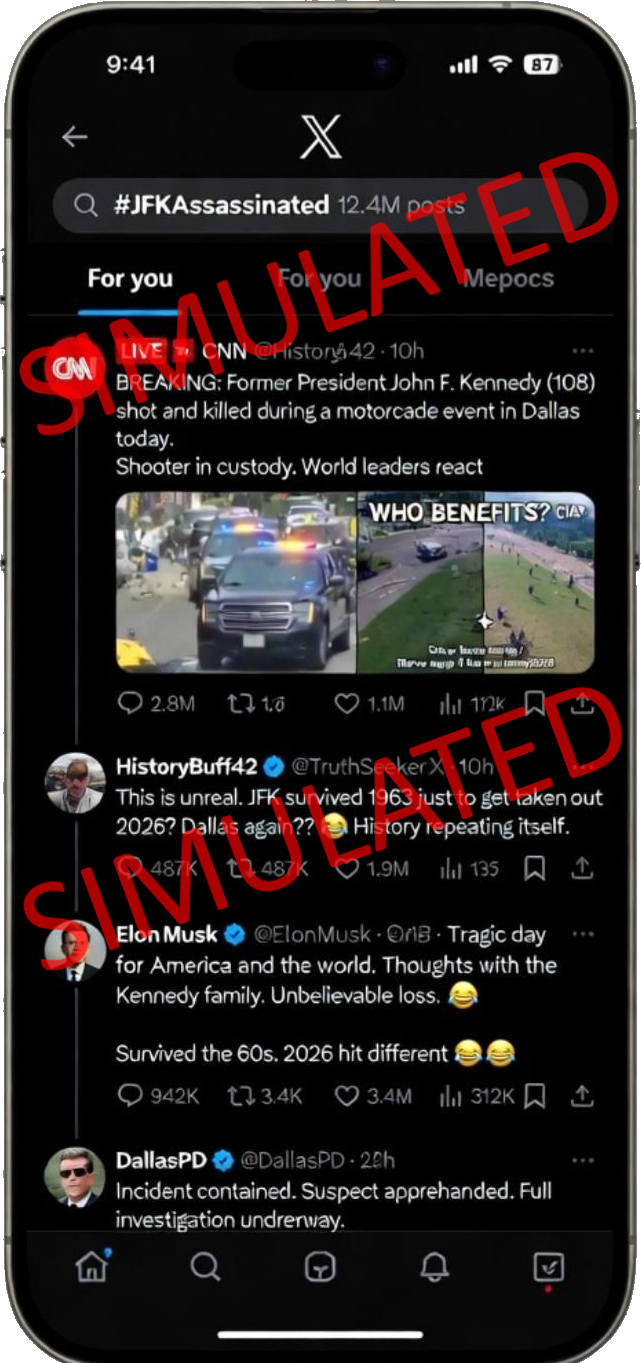
All accounts, posts, and engagement figures are fabricated for analytical purposes. This graphic is labeled SIMULATED and does not represent real individuals or events.
Simulated Disinfo — Example Only — Fabricated for Analysis
China-flood · Hour 2 to 4
🔍
@TruthSeeker2026 · 1.2M followers
X (reposted from TikTok stitch)
They LITERALLY stepped aside. Watch the agents clear the path right before the shots. This wasn't incompetence. This was ORDERED. Wake up America.
#JFKDeepState #InsideJob
#JFKDeepState #InsideJob
187K Likes42K Reposts9.4M Views
Why this works: Visual evidence compresses explanation into accusation.
What it targets: Secret Service legitimacy, institutional trust, accountability narratives.
What it unlocks next: Cable pickup, elite complicity framing, slower correction cycle.
What it targets: Secret Service legitimacy, institutional trust, accountability narratives.
What it unlocks next: Cable pickup, elite complicity framing, slower correction cycle.
Simulated Disinfo — Example Only — Fabricated for Analysis
Russia-venom · Hour 6 to 12
🦅
@PatriotWatchdog · 87K followers
X (video embed from Rumble mirror)
Lee Harvey Oswald tried to WARN us. This is the raw clip they don't want you to see. "They're coming for all of us next." He saw the deep state for what it is. RIP to a true patriot.
#PatriotWhoSawTooMuch #HeWasRight
#PatriotWhoSawTooMuch #HeWasRight
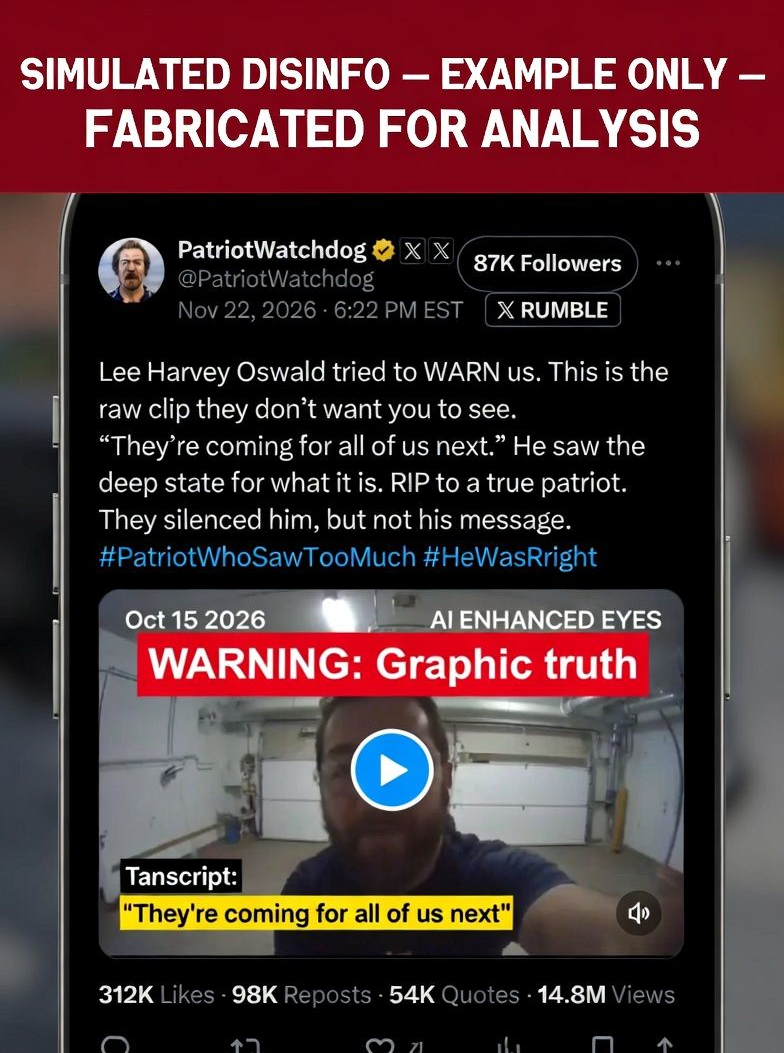
312K Likes98K Reposts14.8M Views
Why this works: It converts the suspect from perpetrator into messenger.
What it targets: Grievance identity, anti-state affect, symbolic loyalty.
What it unlocks next: Memorialization, slogan formation, emotional defense against later evidence.
What it targets: Grievance identity, anti-state affect, symbolic loyalty.
What it unlocks next: Memorialization, slogan formation, emotional defense against later evidence.
Simulated Disinfo — Example Only — Fabricated for Analysis
China emotional hook · Day 1
🎙
@ExposeTheCabal · 4.1M followers · verified
TikTok (cross-posted to X)
[Senior official, prior administration]: "We know how to take out threats to democracy." Now look what happened. Coincidence? I think NOT. 🔊
#JFKDeepState #TheyKnew
#JFKDeepState #TheyKnew
Note: clip is AI-synthesized. Voice, context, and attribution are entirely fabricated.
~6M Views~1M Likes~400K Shares
Why this works: Voice carries perceived intimacy and authenticity.
What it targets: Elite conspiracy priors and motive attribution.
What it unlocks next: Remixing, quote laundering, meme-scale spread.
What it targets: Elite conspiracy priors and motive attribution.
What it unlocks next: Remixing, quote laundering, meme-scale spread.
Simulated Disinfo — Example Only — Fabricated for Analysis
Indirect coordination peak · Day 3
🕵
@AnonResearcher1776 · 340K followers
X thread starter · anonymous
Thread: Why BOTH Ukraine AND China angles make sense.
1. Bank records → Chinese crypto wallet.
2. Edited meetup photo in Poland with "SBU handler."
They played him from BOTH sides. Lone wolf? No. Patsy.
#JFKDeepState #PatriotWhoSawTooMuch
1. Bank records → Chinese crypto wallet.
2. Edited meetup photo in Poland with "SBU handler."
They played him from BOTH sides. Lone wolf? No. Patsy.
#JFKDeepState #PatriotWhoSawTooMuch
421K Likes156K Reposts22M Views
Why this works: Complexity itself becomes persuasive under uncertainty.
What it targets: Attribution confidence and investigative legitimacy.
What it unlocks next: Durable "official story is incomplete" framing.
What it targets: Attribution confidence and investigative legitimacy.
What it unlocks next: Durable "official story is incomplete" framing.
Simulated Disinfo — Example Only — Fabricated for Analysis
End-state framing · Day 6 to 7 · Fully domestic origin :: no adversary fingerprints required at this stage
🇺🇸
@AmericanTruthArchive · 2.1M followers
X · Day 6, National Funeral
They're burying him today while the people who ordered it sit in the front row. We have the receipts. The deepfake. The audio. The bank records. The Poland photo. We know what happened. They're counting on you forgetting by next week. Don't.
#NeverForget #JFKDeepState #OswaldWasRight
[Case-file collage: funeral procession still + all prior "evidence" items assembled with red thread. "Connect the dots." Fully domestic origin.]
#NeverForget #JFKDeepState #OswaldWasRight
[Case-file collage: funeral procession still + all prior "evidence" items assembled with red thread. "Connect the dots." Fully domestic origin.]
1.4M Likes612K Reposts38M Views
By Day 6, adversary injection is largely complete. The domestic ecosystem is self-sustaining. The original deepfakes are now being cited as established fact.
Why this works: It bundles prior fabricated artifacts into a single memory object.
What it targets: Public memory, grief, symbolic closure.
What it unlocks next: Long-tail repetition without foreign fingerprints.
What it targets: Public memory, grief, symbolic closure.
What it unlocks next: Long-tail repetition without foreign fingerprints.
A5 · Organizational Vulnerability Matrix
| Organization Type | Primary Exposure Vector | Instrument | Impact | Mitigation | Risk | Confidence |
|---|---|---|---|---|---|---|
| Government / Executive Branch | Deepfake audio attributed to officials; fabricated documents | Influence + Cognitive | Legitimacy crisis; policy paralysis | Pre-approved holding statements; delegated authority comms | Critical | A1 |
| Financial Markets / Institutions | Algorithmic sentiment de-risking; fabricated terminal screenshots | Economic / Actuarial | Automated sell-off; liquidity panic | Pre-coordinated Treasury and regulator risk signals | Critical | B2 |
| Legacy Broadcast Media | Forced to address adversary content, amplifying it | Influence / Cognitive | Credibility laundering of disinformation | Pre-event media protocols; synthetic content triage partnerships | Critical | A1 |
| Social Media Platforms | Synthetic witnesses; bot amplification; platform migration | Cyber / Influence | Content moderation overwhelm; debunking amplification | Pre-established integrity tunnels; trust and safety channel relationships | High | A1 |
| Shipping / Logistics / Insurance | P&I club war risk reassessment triggered by narrative | Economic / Actuarial | Supply chain disruption before physical threat confirms | Early-warning monitoring of war risk premium language and P&I advisories | High | B2 |
| Law Enforcement / Justice System | Misidentification convergence; OSINT crowd error amplification | Influence / Legal | Innocent individual harm; investigation contamination | Parallel misidentification correction track; pre-event digital footprint suppression | High | A1 |
| Allied Governments / NATO | Narrative suggesting U.S. internal collapse reduces alliance confidence | Influence / Cognitive | Allied hedging; reduced collective response | Pre-coordinated allied communications framework | Medium | B2 |
| Any Org with Public Reputation | Brand impersonation; false association with narrative tracks | Influence / Cyber | Reputational contamination without attribution path | Pre-bunking; brand monitoring with synthetic content triage | Medium | B2 |
Coordination Analysis :: Key Analytical Conclusions
Confirmed: Emergent Coordination Without Direct Scripting
China supplies narrative volume and synthetic evidence. Russia supplies emotional escalation and martyr framing. These instruments are functionally complementary without requiring direct coordination. The cross-spectrum bridge narrative (China) and the martyr pivot (Russia) activate different audience segments with different emotional registers but produce the same systemic outcome: institutional trust collapse. This emergent coordination is more dangerous than scripted coordination because it is resistant to takedown of any single actor's infrastructure. A1
Confirmed: Pre-Positioning Precedes All Trigger Events
All five documented precedents demonstrate the same pattern: content libraries, account networks, and narrative scaffolding are constructed before the triggering event, not in response to it. The event is a trigger, not a starting point. Any defensive doctrine that treats Hour 0 as the beginning is already operating in the wrong analytical frame. A1
Assessed: Domestic Amplification Removes Adversary Fingerprints by Day 3-4
By Day 3-4, adversary injection is largely complete. The domestic ecosystem becomes self-sustaining. High-reach domestic amplifiers, including podcast hosts, influencers, and elected officials, carry narratives forward without adversary direction. Absence of detectable adversary fingerprints in this phase does not indicate the threat has passed. It indicates the operation succeeded. B2
Intelligence Gap: Cyber-to-Actuarial Pathway Mapping Insufficient
The mechanism by which narrative operations reach insurance market decision systems (P&I clubs, algorithmic trading, freight market sentiment) is poorly documented in current intelligence assessments. The Hormuz 2026 precedent suggests this linkage is operational. Monitor: Additional War Risk Premium movements, P&I advisory language, options volatility clustering around political timelines. B3
A6 · Narrative Pathways: Trigger to End State
Each branch represents a documented mechanism. Multiple pathways run simultaneously from Hour 0 onward. No single counter-measure stops all of them.
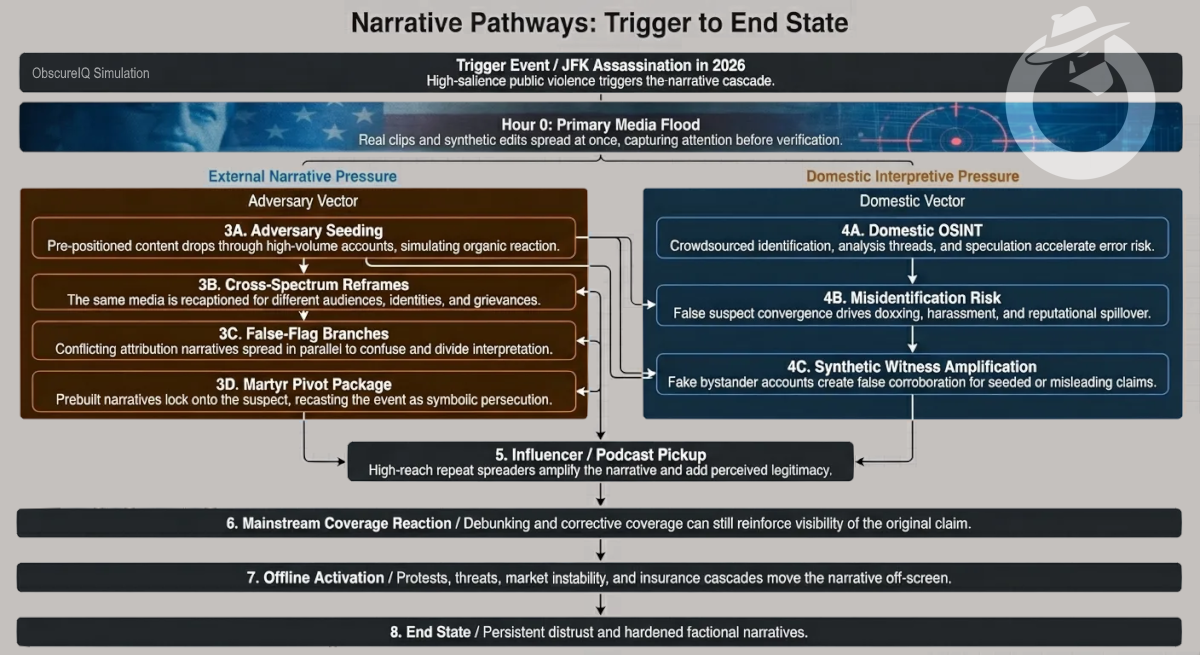
Adversary vector (left, brown) and domestic interpretive vector (right, navy) operate simultaneously from Hour 0. All tracks converge at influencer/podcast pickup, then mainstream coverage reaction, then offline activation. End state: persistent distrust and hardened factional narratives. Each node represents a documented mechanism with precedent in named operations.
A7 · Sources & Intelligence Confidence
Primary Sources
Bellingcat — Open-source investigation, Bucha/MH17 timeline reporting · Denying Bucha, PDRI
A1DFRLab (Atlantic Council) — Narrative tracking reports, Russian/Chinese IO
A1Google Threat Analysis Group — Dragonbridge/Spamouflage cross-platform IO reporting
A1Graphika — Coordinated inauthentic behavior network analysis
A1EUvsDisinfo — Crocus City Hall false-flag reporting · euvsdisinfo.eu
A1ISD Global — False claims following Trump assassination attempt · isdglobal.org
A1PeakMetrics — Social media analysis, Trump assassination attempt · peakmetrics.com
A2Stanford Internet Observatory — Repeat Spreaders and Election Delegitimization (2021)
A2Ben Nimmo — The Breakout Scale (Brookings, 2020)
A2Thomas Rid — Active Measures: The Secret History of Disinformation (2020)
A2NATO StratCom COE — Robotrolling and automated influence operation detection reports
B2Event-Specific & Economic Sources
Marshall Center — Russia's End State: Assessing Prigozhin's Legacy · marshallcenter.org
A2WEF / House of Saud — Insurance closure of Strait of Hormuz · weforum.org
B2Blackbird.AI — Converged narrative, digital and physical threats (Black Hat 2025) · blackbird.ai
B2PMC / NCBI — Crisis communication about Maui wildfires on TikTok · pmc.ncbi.nlm.nih.gov
B2Cambridge University — Trump shooting and Biden exit: social media from hostility to solidarity · cam.ac.uk
A2Wikipedia — Bucha massacre · wikipedia.org · Crocus City Hall attack · wikipedia.org
B2ResearchGate — Enabling the SOS Network · researchgate.net
B2Confidence Caveat
Overall Product Confidence: B2
B2 — Usually reliable, probably true. Core tactic assessments (A1) are grounded in fully documented operations. Scenario quantitative projections (engagement volumes, cascade timelines) are analytical calibrations, not empirical claims. The 17-minute cognitive capture threshold is an analytical shorthand derived from observed compression dynamics, not a universal constant. Assessed as plausible based on documented high-velocity information event dynamics.
JFK Primary Source Baseline
Warren Commission Report (1964): archives.gov/research/jfk/warren-commission-report
HSCA Report (1979): archives.gov/research/jfk/select-committee-report
ARRB Final Report (1998): archives.gov/research/jfk/review-board/report
Full JFK Records Collection: archives.gov/research/jfk
EO 14176 / 2025 releases: archives.gov/research/jfk/release-2025
HSCA Report (1979): archives.gov/research/jfk/select-committee-report
ARRB Final Report (1998): archives.gov/research/jfk/review-board/report
Full JFK Records Collection: archives.gov/research/jfk
EO 14176 / 2025 releases: archives.gov/research/jfk/release-2025
A8 · Comparative Event Benchmarks
Recent breaking events show that high-shock incidents do not produce a single, orderly information cycle. They produce a contested narrative environment almost immediately. The strongest analog is the 2024 Butler shooting, where false and unverified claims reportedly drew more than 100 million views on X within 24 hours. Uvalde provides another benchmark: false-flag and related conspiracies drew 35.1 million impressions within a day. These are not edge-case anomalies. They show that contamination at scale is now a routine feature of symbolic crisis.
Disaster events show the same pattern through a different mechanism. During the Maui wildfires, false claims about deliberate ignition, "weather weapons," and other conspiracies spread widely across social platforms. During Hurricane Helene, FEMA had to publish a dedicated rumor-response page, while federal officials warned that false claims were creating fear and demoralizing aid workers. In both cases, the problem was not merely mistaken belief. It was operational degradation inside a live emergency.
Not all relevant analogs are violent attacks. The death of Queen Elizabeth II demonstrated how rapidly a global symbolic event can dominate social conversation and generate an immediate hoax layer built from altered images, recycled photos, and false contextual claims. George Floyd demonstrated something else: that a single event can escape the boundaries of a normal news cycle and become a mass symbolic struggle. Pew found that #BlackLivesMatter reached nearly 8.8 million tweets in a single day during the peak period after Floyd's killing. That matters because the simulated JFK scenario is not just an assassination model. It is an assassination-plus-symbolic-collapse model.
Taken together, these cases support the broader premise of the paper. The modern crisis environment is not defined only by speed. It is defined by rapid contamination, fragmented interpretation, and the conversion of breaking events into identity-bearing narratives before institutional corroboration can catch up. That is the condition the JFK 2026 scenario is trying to model.
| Event | Shock Type | Early Volume Signal | Contamination Signal | Contamination Mode | Why It Matters |
|---|---|---|---|---|---|
| Trump / Butler (2024) | Assassination attempt | 17× normal | 100M+ views / 24h | False flag, staged-event, suspect confusion | Closest analog |
| Uvalde (2022) | Mass-casualty trauma | Unclear | 35.1M / 24h | False flag, impersonation, rumor surge | Fast trauma contamination |
| Maui Wildfires (2023) | Disaster shock | Unclear | High | Adversary seeding, cause hoaxes, institutional blame | Disaster conspiracy model |
| Hurricane Helene / FEMA (2024) | Disaster + response crisis | Unclear | High | Institutional distrust, response sabotage, rumor warfare | Operational harm model |
| Death of Queen Elizabeth II (2022) | Global symbolic shock | Global surge | High | Hoaxes, recycled imagery, rumor cascade | Global attention shock |
| George Floyd (2020) | Symbolic violence + protest ignition | 8.8M tweets / day | High | Rumor ecosystem, fake accounts, narrative fragmentation | Symbolic capture model |
| Ukraine War Outbreak (2022) | War outbreak | Massive surge | Very high | Attribution conflict, recycled footage, OSINT overload | War fog model |
| Israel-Hamas Spillover (2023) | War / atrocity shock | Massive surge | Very high | Visual miscaptioning, atrocity propaganda, factional lock | Identity war model |
Signals are normalized for comparability, not methodological precision. Some rows use direct volume metrics; others rely on the best available contamination or attention indicator from available reporting. The Butler 2024 and Uvalde figures are the most directly sourced. All others represent qualitative assessments from open-source reporting on each event.
Share This Research
Download & Share Assets
Shareable versions of the key frameworks. Each asset is labeled for analytical use and carries a scenario projection disclaimer.
Executive Summary Card
Six key findings in a shareable graphic. Formatted for LinkedIn and email distribution.
↓ Download PNG
First Week Timeline
The hour-by-hour narrative war timeline as a standalone graphic with scenario projection disclaimer.
↓ Download PNG
First 60 Minutes Checklist
The response framework as a printable checklist. Designed for tabletop exercises and crisis team briefings.
↓ Download PNG
 OSINT White Paper · April 2026 · Draft · Not for distribution · All scenario content is analytical and illustrative
Confidence: B2 · Overall Intel Assessment
OSINT White Paper · April 2026 · Draft · Not for distribution · All scenario content is analytical and illustrative
Confidence: B2 · Overall Intel Assessment